


When someone needs an emergency plumber, a wedding photographer, or a family lawyer, they used to type a quick search into Google and call the first three results. In 2026, more and more of those decisions start with “ChatGPT, can you recommend a good [service] in [city]?” The buying journey moved upstream, and most service businesses are completely invisible at the new starting line.
Here’s the data that should make every service business owner pay attention. Gartner predicts 25% of organic search traffic will shift to AI chatbots by the end of 2026, and AEO traffic converts at 2-3x the rate of traditional organic traffic because prospects have already read about you before they click. Service businesses with AEO baked into their strategy are getting booked by customers who never visited Google.
Here’s what we’ll discuss:
- Why service businesses have a structural advantage in AEO over product brands
- The AEO foundations that get you cited in AI generated answers
- Service-specific trust signals that move citation rates faster
- A practical content framework for service pages that AI engines extract
- How to track AEO results in calls, bookings, and revenue (not just impressions)
If your service business needs to show up where customers are now asking for recommendations, Doc Digital SEM builds AEO services for service operators across industries. The brands moving first are quietly owning the answer space that their competitors don’t even know exists yet.
Why Service Businesses Have the Edge
Most AEO advice gets written for SaaS companies, e-commerce brands, and content publishers. Service businesses are an afterthought. That’s actually great news, because service businesses have structural advantages in answer engine optimization that most product brands can’t match.
Local Context Is Built-In
A SaaS company selling project management software competes against thousands of similar tools globally. A roofing contractor in Tampa competes against maybe 40 other roofers in the same service area. The smaller competitive set means earning AI citations is genuinely achievable, not aspirational. AI engines reward local context and geographic focus, both of which service businesses already have by default.
Specific Questions, Specific Answers
Customers searching for services ask incredibly specific questions:
- “How much does it cost to replace a 3-ton AC unit in Phoenix?”
- “Do family lawyers in Austin handle interstate custody cases?”
- “What’s the best photographer for outdoor weddings in Boulder under $5,000?”
These question-based queries are exactly what AI answer engines pull from. Service businesses can write content addressing the precise long tail questions their customers ask, and earn citations product brands can’t even target.
Trust Signals Are Easier to Build
Service businesses have natural trust signals product brands don’t:
- Professional licenses and certifications
- Insurance and bonding documentation
- Years of local experience and community presence
- Direct customer relationships generating reviews
- Before/after work that demonstrates results
AI tools recognize these credibility markers more readily than they recognize generic marketing claims. A licensed contractor with 200 verified local reviews carries more weight than a startup with a polished website.
Lower Barrier to AEO Success
For local service businesses, AEO success is achievable in 90 to 120 days. For national product brands competing in saturated categories, the same timeline often takes 12 to 18 months. The smaller the competitive pool, the faster citation dominance happens. Most service categories outside major metros remain wide open in AI generated responses.
The Buyer Journey Favors Service Businesses
Product purchases often involve research, comparison, and review reading. Service decisions usually need a quick recommendation followed by a phone call. AI answer engines deliver exactly that workflow:
- Customer asks for a recommendation
- AI provides 2-3 options with reasoning
- Customer calls or visits the recommended business
This linear path beats the multi-touch product journey for conversion. The service business cited gets the call. The ones that aren’t, don’t.
For a deeper service-business strategy, our medical marketing agency and dental marketing agency services apply these principles to specific verticals.
The AEO Foundations That Earn Citations
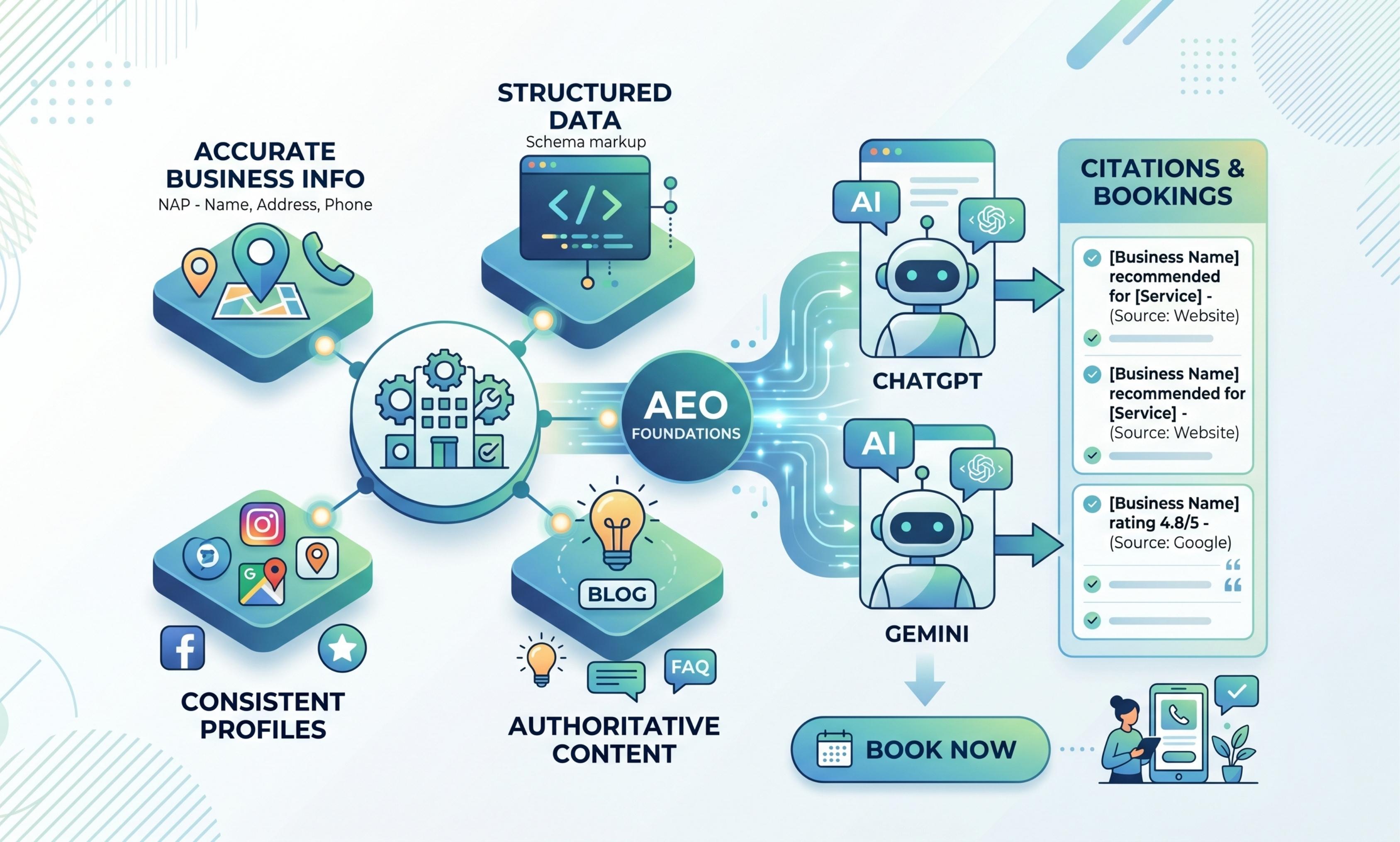
Answer engine optimization isn’t a separate discipline from traditional SEO. It’s a layer built on top of solid SEO foundations, focused on getting your content extracted into AI generated responses rather than just ranked in ten blue links. Here are the foundations every service business needs in place.
Structured Data That AI Engines Extract
Schema markup is the technical backbone of AEO. Service businesses should implement at minimum:
- LocalBusiness schema: Identifies your business name, address, phone, hours, and service area
- Service schema: Lists each specific service you offer
- FAQPage schema: Pulls Q&A pairs directly into AI answer engines
- Review schema: Displays customer reviews with proper attribution
- Person schema: Adds credentials for service providers (doctors, lawyers, contractors)
Structured data tells AI systems exactly what your business does, where you serve, and what credentials you bring. Without it, AI engines have to guess. Most don’t bother.
Answer-First Content Structure
AEO focuses on giving AI extractable answers. Every page should follow the answer-first pattern:
- Question-format heading that mirrors what customers actually ask
- Direct answer in the first 1-2 sentences with specific data
- Supporting context with examples, pricing, or details
- FAQ section addressing related questions
This structure works for both Google AI Overviews and standalone AI answer engines like ChatGPT and Perplexity. The same content earns citations across multiple AI platforms.
Question-Based Queries Drive Content Strategy
Traditional SEO targeted exact-match keywords. AEO matters when content addresses full conversational queries. Build your content around the actual questions customers ask:
- Use Google Search Console to find question-based queries triggering impressions
- Use AnswerThePublic, AlsoAsked, or your AI visibility tool to discover prompt patterns
- Document the top 20 questions customers ask before booking
- Create content that answers each question completely on a dedicated page or FAQ
Authority Signals That AI Engines Recognize
Authority signals matter for AEO success because AI tools cite sources they trust. For service businesses, the signals that move the needle:
- Editorial backlinks from local news and industry publications
- Mentions in “best of [city]” listicles and recommendation articles
- Verified business profiles on Google Business Profile, Yelp, BBB, industry directories
- Customer reviews on multiple review platforms with specific service mentions
- Professional credentials displayed prominently with proper schema
Site Structure That AI Can Navigate
The technical side matters more than most service business owners realize. AEO foundation requires:
- Clean site structure with logical hierarchy
- Internal linking that connects related service pages
- Fast site speed (AI crawlers bounce on slow pages)
- Mobile-friendly design (mobile-first indexing affects AI crawl too)
- HTTPS security and proper status codes
- XML sitemap submitted to both Google Search Console and Bing Webmaster Tools
These technical requirements aren’t optional. They’re the foundation everything else depends on.
Consistent Information Across the Web
AI engines synthesize answers from multiple sources. If your business name, address, hours, or services differ between platforms, AI tools lose confidence in your information and either cite competitors or omit your business entirely. Maintain perfect consistency across:
- Your website
- Google Business Profile
- Yelp, BBB, industry directories
- Social media profiles
- Review sites
For deeper coverage of how this fits into broader AI strategy, our guide on what is AEO covers the fundamentals in detail.
Service-Specific Trust Signals That Move Citations
Service businesses have unique trust signals that product brands can’t replicate. The brands earning AI citations consistently lean into these signals systematically. Here’s the trust stack that moves citation rates fastest for service operators.
Professional Credentials and Licenses
For regulated industries (medical, legal, financial, contracting), credentials are the highest-value trust signal. AI tools weight licensed professionals heavier than unlicensed competitors. Display these prominently:
- State licenses with license numbers
- Professional certifications (board certifications for doctors, bar associations for lawyers, manufacturer certifications for contractors)
- Insurance and bonding details
- Industry association memberships
- Continuing education credentials
Add a Person schema for individual practitioners with credentials, qualifications, and professional affiliations.
Real Customer Outcomes
Generic testimonials don’t move AI citations. Specific customer outcomes do. Replace “Great service, highly recommend” with:
- Quantified results (saved $X, completed in Y days, resolved Z issue)
- Location context (Phoenix homeowner, Miami business owner)
- Specific service mentioned (not just “their work”)
- Photo evidence where appropriate (before/after, project photos)
Structure customer outcomes as case studies even for service businesses. AI engines pull from structured success stories more readily than vague reviews.
Response Time and Availability
For service businesses, response time itself is a trust signal. AI tools understand that emergency service capability, 24/7 availability, and fast response times differentiate operators. Make these explicit on your site:
- Average response time (e.g., “emergency calls answered within 15 minutes, 24/7”)
- Booking availability windows (e.g., “same-day appointments available”)
- Service guarantees (e.g., “on-time guarantee or service is free”)
These specifics get extracted into AI generated answers when customers ask for “fast response plumbers” or “same-day medical appointments.”
Local Community Involvement
AI engines reward genuine community presence. Document and surface:
- Local sponsorships and event participation
- Charitable partnerships with local nonprofits
- Chamber of Commerce and business association memberships
- Awards from local publications (Best of [city], Top 10 lists)
- Long-tenure relationships with local clients
This community context separates established local operators from out-of-area competitors trying to rank for local terms.
Verified Reviews Across Multiple Platforms
Single-platform review presence isn’t enough anymore. AI tools cross-reference reviews across Google, Yelp, industry-specific platforms, and BBB. Build a review profile that shows:
- 100+ reviews on Google Business Profile
- 25+ reviews on industry-specific platforms (Healthgrades for medical, Avvo for legal, Houzz for home services)
- 4.5+ average rating across all platforms
- Recent review velocity (10+ new reviews per quarter)
- Owner responses to every review
The combined signal carries more weight than 500 reviews on a single platform.
Years in Business and Specialization
AI engines look for signals of expertise depth. Surface:
- Years in business (with founding date)
- Total clients served or projects completed
- Specialization within your industry (e.g., “family law focused exclusively on interstate custody cases”)
- Educational content demonstrating expertise
Specialists get cited more often than generalists. A “divorce lawyer in Austin” with 20 years of experience focusing exclusively on family law beats a “general practice attorney in Austin” every time in AI recommendations.
Trust Stack Implementation Priority
If you can only do five things, do these:
- Add proper Person schema with credentials for every practitioner
- Display licenses, certifications, and insurance prominently with clear labels
- Build verified review presence across Google, Yelp, and one industry platform
- Create case studies with quantified outcomes and location context
- Surface community involvement and years in business throughout the site copy
This combination of trust signals dramatically outperforms generic service business sites that focus on aesthetics over credibility.
For a deeper local trust strategy, our breakdown of E-E-A-T in SEO covers how trust signals translate into AI rankings.
A Content Framework for Service Pages
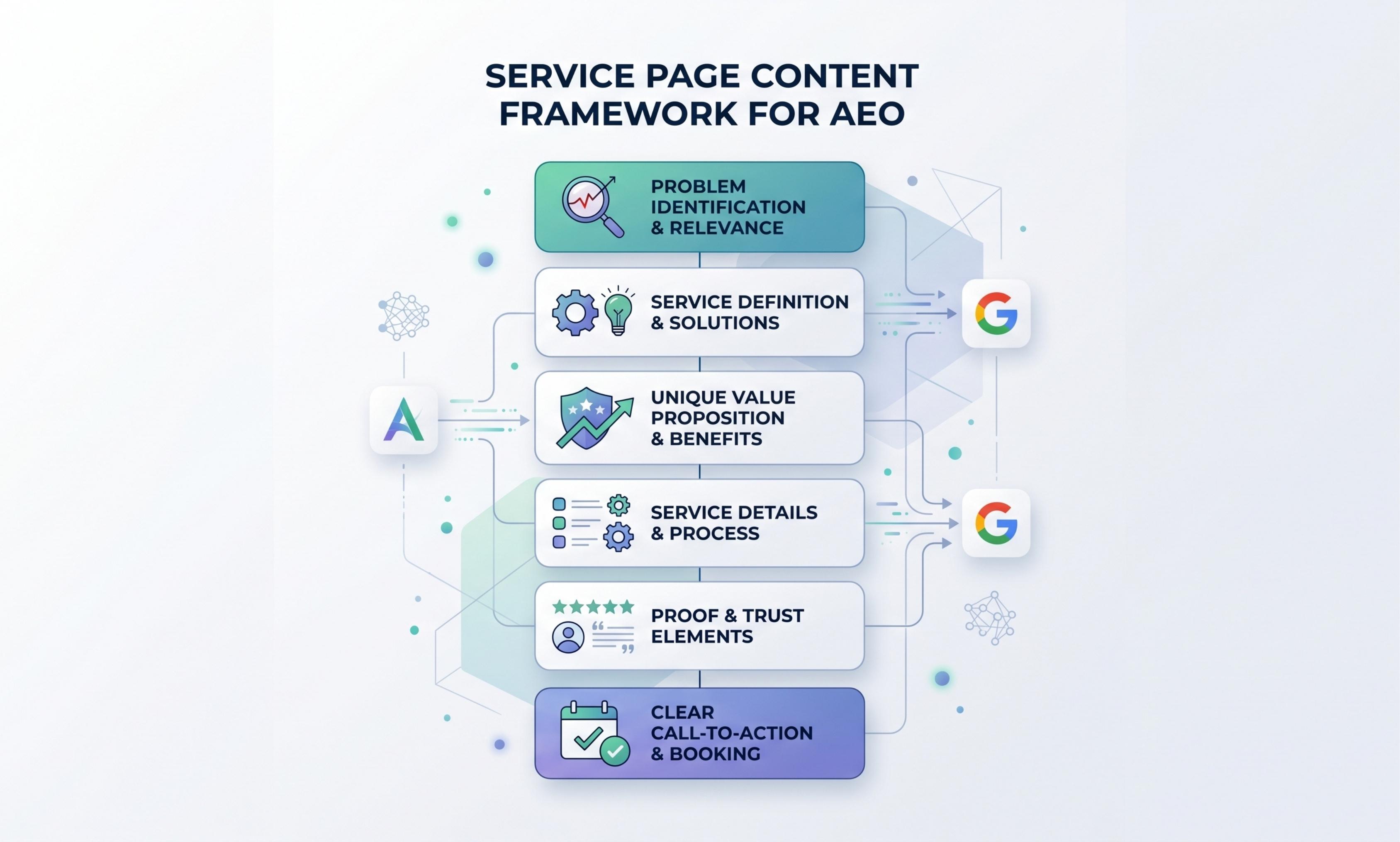
Most service business websites have generic service pages built for 2018 SEO. They list services, sprinkle keywords, and call it a day. Service pages that earn AI citations require a different approach. Here’s the framework that consistently gets extracted into AI-generated answers.
The Service Page Anatomy
A service page that works for both traditional search and AEO includes:
- H1: Specific service plus location (e.g., “Emergency Plumbing in Tampa, Florida”)
- Direct answer paragraph: 2-3 sentences answering what you do, where, and your differentiator
- Service details with specifics: What’s included, what’s not, typical scope
- Pricing transparency: Starting prices, typical project costs, pricing model
- Process breakdown: How you deliver the service, step-by-step
- Timeline expectations: How long projects typically take
- Service area details: Specific geographic coverage with neighborhoods
- Before/after or work examples: Visual proof of results
- Customer outcomes: Specific case examples with quantified results
- Trust signals: Credentials, insurance, certifications, years in business
- FAQ section: 5-10 questions customers actually ask
- Schema markup: LocalBusiness, Service, FAQ, Review schema
What Each Section Should Accomplish
The structure isn’t decoration. Each section serves a specific AEO function:
| Section | AEO Purpose |
|---|---|
| Direct answer paragraph | Gets extracted into AI generated responses for service queries |
| Pricing transparency | Cites in AI answers about service costs |
| Process breakdown | Pulls into “how does X work” queries |
| Timeline expectations | Extracts for “how long does X take” questions |
| FAQ section | Powers AI Overviews and ChatGPT Q&A responses |
| Customer outcomes | Builds the trust signals AI engines reward |
The Question-Based Page Layout
Restructure service pages around the questions customers actually ask, not the services you offer:
Old structure: Services > Plumbing > Emergency Plumbing
New structure: Service pages organized by customer questions:
- “What does emergency plumbing cost in Tampa?”
- “How fast can a plumber arrive at my house in Tampa?”
- “Do you handle commercial plumbing emergencies?”
- “What plumbing brands do you service?”
Each question becomes its own H2 section with a complete answer underneath. The page reads naturally to customers and parses cleanly for AI tools.
Pricing Transparency Drives Citations
AI engines extract specific pricing data more readily than vague pricing language. Compare:
- ❌ “We offer competitive pricing tailored to your needs”
- ✅ “Emergency service calls start at $89, with most repairs ranging from $200 to $800”
Specific numbers get cited. Vague language doesn’t. Service businesses willing to publish pricing earn more AI mentions than competitors hiding pricing behind contact forms.
The Long Tail Service Page Strategy
Beyond your core service pages, build long tail pages addressing specific scenarios:
- “Burst pipe repair in Tampa” (specific problem)
- “Plumbing repair for older homes built before 1970” (specific situation)
- “Sunday emergency plumbing in South Tampa” (specific timing and location)
These long tail service pages target the conversational queries customers ask AI tools and face less competition than generic service pages.
Templates That Don’t Look Like Templates
Service businesses with multiple service areas often spin up template-driven location pages. AI engines detect this pattern and devalue every page in the set. Instead:
- Write each location page individually with genuine local context
- Pull testimonials from actual customers in that area
- Reference specific neighborhoods, landmarks, and local issues
- Vary the structure slightly so pages don’t feel identical
- Use unique meta descriptions and titles for each page
A handful of authentic location pages outperform dozens of templated ones in AEO.
For a deeper page-level strategy, our guide on location pages for SEO covers the structural details.
Tracking AEO Results in Calls and Bookings
Most AEO articles tell you what to optimize. Few tell you how to measure whether it actually drives revenue. For service businesses, the metrics that matter aren’t impressions and rankings. They’re calls, bookings, and booked revenue. Here’s how to track AEO success in numbers that matter to your bank account.
Why Standard Analytics Falls Short
Google Analytics tracks website visits, conversions, and revenue from organic traffic. AEO results often appear as:
- A spike in branded search volume
- Direct traffic increases (people search your business name after AI mentions)
- Phone calls without a digital trail
- Form submissions from people who never clicked a website link
Standard analytics misses most of these because the AI mention happened off-site. The challenge: connecting AI visibility to revenue requires multi-source attribution.
The Metrics That Matter
For service businesses, track these AEO-specific metrics:
| Metric | What it measures | Where to track |
|---|---|---|
| AI citation rate | How often you appear in AI generated responses | AI Clicks, Otterly.ai, manual prompt testing |
| Branded search volume | Direct demand created by AI mentions | Google Search Console, Ahrefs |
| AI-referred traffic | Sessions from chatgpt.com, perplexity.ai, gemini.google.com | Google Analytics 4 with custom segments |
| Phone call volume | Service businesses live and die by calls | CallRail, CallTrackingMetrics |
| Booking form submissions | Direct conversions from web traffic | GA4 events, CRM data |
| Lead source attribution | How customers say they found you | Intake forms with self-reported source |
Building Attribution for Service Businesses
A practical attribution stack:
Layer 1: Direct AI referrals
Track AI-referred traffic in GA4 by filtering referral source for chatgpt.com, perplexity.ai, gemini.google.com, and copilot.microsoft.com. Conversion rates here often run 2-3x higher than standard organic traffic because prospects arrive pre-validated.
Layer 2: Branded search lift
When AI engines name your business consistently, prospects search your business name directly. Track:
- Branded keyword impression growth in Google Search Console
- Direct traffic increases that correlate with AI visibility gains
- Branded search volume growth in tools like Ahrefs
A 30-60% lift in branded search volume within 90 days of AEO investment is a strong signal.
Layer 3: Phone calls and bookings
For service businesses, this is the metric that matters most. Use call tracking software to:
- Document call volume month over month
- Track call source (AI-driven calls often appear as direct or branded search)
- Record call quality and conversion rate
- Add intake form questions: “How did you first hear about us?”
Layer 4: Lead source attribution
Add a simple intake question on every booking form, contact form, and intake call:
“How did you first hear about us?” with options including:
- Google search
- ChatGPT
- Gemini / Google AI
- Perplexity
- Referral
- Other (please specify)
The self-reported data is messy but directionally correct. Track it monthly to see how the AI source mix evolves.
What Realistic Results Look Like
For a service business executing AEO consistently for 90 days, expect:
- First citations appearing in AI Overviews and ChatGPT for niche queries
- 20-40% lift in branded search volume
- 10-20% increase in direct traffic (often AI-influenced)
- Initial AI-referred sessions in Google Analytics
- Self-reported AI source mentions appearing in intake forms
By 180 days, you should see:
- 50-100% lift in branded search volume
- Measurable AI-referred traffic with higher-than-average conversion rates
- Visible call volume increases correlated with AI visibility gains
- Steady stream of self-reported AI source attributions
The ROI Calculation
For service businesses, calculate AEO ROI by:
- Track total AEO investment (tools, content, agency fees)
- Document new bookings attributable to AI sources (direct referrals + self-reported)
- Calculate revenue from those bookings (average customer value × new bookings)
- Compare revenue to investment
Service businesses typically see ROI within 90-120 days because of the high conversion rates from AEO traffic. AI-referred customers convert at 2-3x the rate of typical organic traffic.
Setting Realistic Expectations
AEO won’t deliver overnight results. The first 30 days establish foundations. The next 60 days build citations. By 90-120 days, you should see a measurable revenue impact. The brands that pull AEO investment after 60 days because they don’t see immediate ROI miss the compounding effect entirely.
For deeper measurement frameworks, our breakdown of AI search visibility covers how to build complete attribution.
Service businesses don’t need to track every possible metric. Focus on the ones that connect AI visibility to phone calls, bookings, and revenue. The brands measuring these correctly invest with confidence. The brands measuring vanity metrics get nervous and pull funding before AEO compounds into real results.
How to Build a Long-Term AEO Strategy
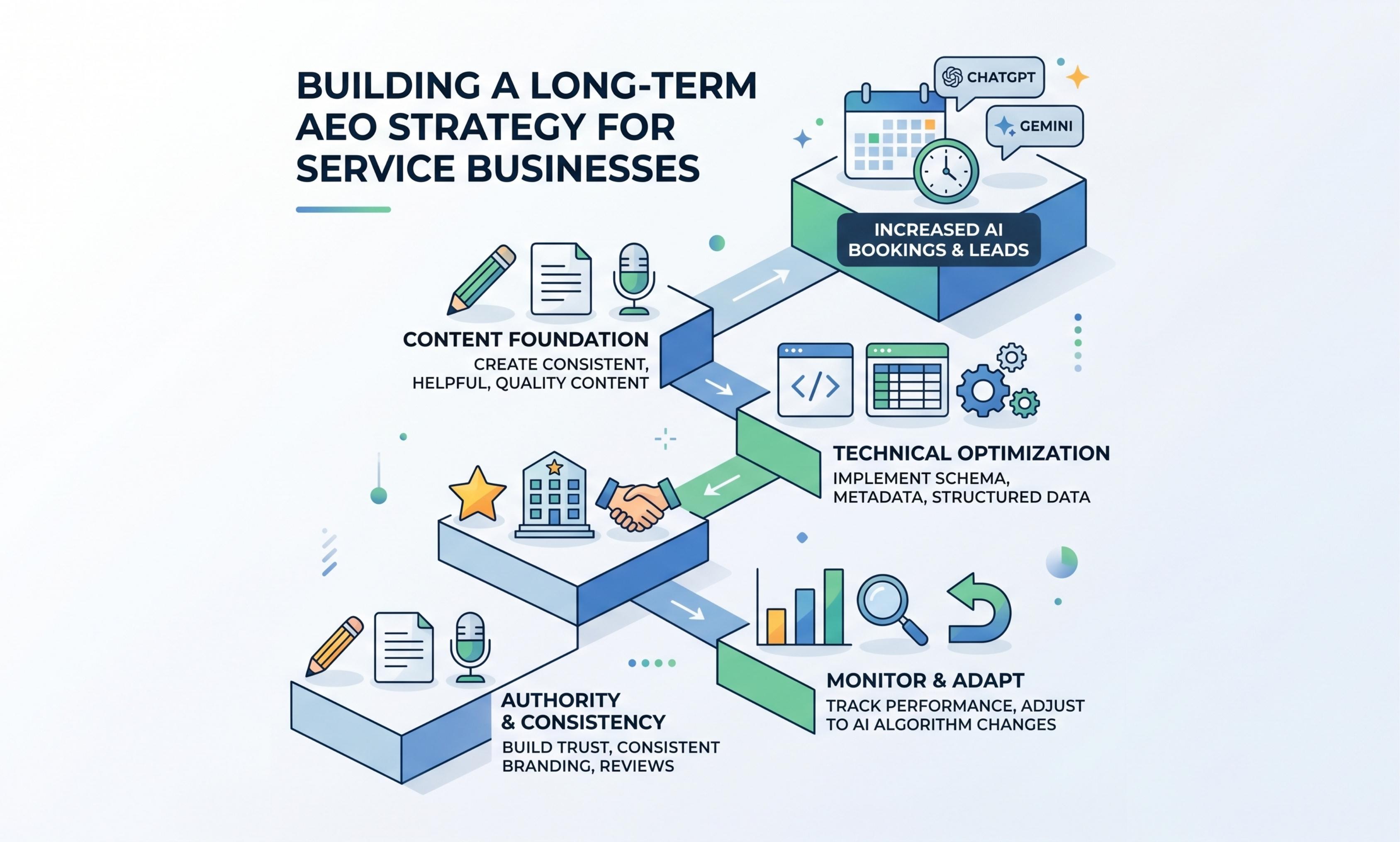
The foundations and frameworks above get you started. Building a sustainable AEO strategy that compounds over years, not just months, requires a systematic approach that integrates AEO with your broader digital marketing efforts. Here’s how service businesses turn AEO from a project into a durable competitive advantage.
Treat AEO as Foundational, Not Optional
Some service business owners still ask whether AEO matters or whether AEO replaces SEO. Both questions miss the point. AEO answer engine optimization isn’t replacing traditional SEO, and it isn’t optional. It’s the new layer that determines whether your business shows up where people search now. Search behavior shifted permanently. The brands treating AEO as foundational are positioning themselves for the next decade.
The critical shift to understand:
- Customers used to search keywords and click ten blue links
- Customers now ask questions and read AI generated responses
- Service businesses cited in those responses get the call
- Service businesses absent from those responses get forgotten
This isn’t a temporary trend. It’s a permanent reshaping of the search landscape that will only accelerate as more people search through AI tools and voice assistants.
Integrate AEO Across Your Marketing Stack
AEO works best when integrated into existing marketing channels rather than running as a parallel campaign:
- Web design: Your site structure, page templates, and technical foundation must support AEO from day one
- Local SEO: Google Business Profile, citations, and local trust signals feed both traditional rankings and AI citations
- Content optimization: Every blog post and service page should be structured for both human readers and AI extraction
- Reputation management: Reviews across multiple platforms feed the trust signals AI engines weigh heavily
- Lead generation: Track AI-driven leads as a distinct channel with its own attribution
This integrated approach is more efficient than running AEO as a separate initiative competing with other marketing budgets.
Build for Multiple AI Platforms
Different AI engines surface different sources. The brands earning consistent visibility track and optimize for multiple AI platforms simultaneously:
- Google AI Overviews: Pulls from top organic rankings, rewards strong traditional SEO
- ChatGPT: Pulls heavily from Bing’s index, rewards Wikipedia presence and YouTube mentions
- Perplexity: Favors community platforms (Reddit, Quora) and recent comparison content
- Gemini: Leans on Google’s index and traditional E-E-A-T signals
- Voice assistants: Reward FAQ formatting and direct answers
- Microsoft Copilot: Pulls from Bing and LinkedIn for B2B queries
Single-platform optimization leaves visibility on the table. Track visibility across at least three AI platforms monthly.
Apply AEO to Industry-Specific Verticals
Different service verticals have different AEO requirements:
- Law firms: Authority through bar association memberships, case results, attorney profiles with credentials, schema-marked Person data, mentions in legal directories like Martindale-Hubbell and Avvo
- Accounting firms: CPA credentials, industry certifications, professional affiliation listings, tax expertise content addressing specific scenarios, mentions in financial publications
- Medical practices: Healthgrades and Vitals presence, board certifications with proper schema, condition-specific content addressing patient questions, hospital affiliations
- Home services: Licensing and bonding documentation, before/after work portfolios, manufacturer certifications, response time guarantees
Each vertical has unique trust signals AI tools recognize. Lean into the credibility markers specific to your industry.
Focus on Data-Driven Insights
AEO success requires moving beyond gut feel into data-driven insights. Build a measurement layer that tells you what’s working:
- Monthly audits of which pages earn AI citations
- Quarterly competitive analysis showing where competitors gain ground
- Tracking which content formats drive the most citations
- Documenting which trust signals correlate with citation growth
- Measuring how branded search volume responds to AEO investment
Service businesses that treat AEO as a data-driven discipline iterate faster and earn citations more consistently than those operating on intuition.
Future-Proof Your Approach
To future-proof your AEO strategy, build for the principles that won’t change even as specific AI platforms evolve:
- Authentic expertise: AI tools will continue rewarding genuine domain expertise over polished marketing copy
- Consistent information: Cross-platform consistency will only become more important as AI synthesis grows
- Trust signals: Credentials, reviews, and verified business signals will continue feeding AI confidence
- Local context: Geographic specificity will matter more as AI personalizes by region
- Original content: AI generated content will continue performing worse than human expertise
These principles work today and will continue working as AI search evolves over the next decade.
Avoid the AEO Scams
The flood of AEO services launching in 2026 created a predictable problem: agencies promising guaranteed AI placement. Nobody can guarantee AI citations because AI engines don’t accept paid placement. Watch out for:
- Anyone promising guaranteed AI Overviews appearances
- Agencies selling AEO as a checklist of on-site tweaks (FAQ schema, llms.txt files, heading rewrites) without broader strategy
- Services that don’t measure citation rates across multiple AI platforms
- Agencies that can’t explain how AI engines synthesize answers
- Pricing that seems too good to be true (usually is)
A reputable AEO agency builds long-term strategies with measurable citation growth, not short-term checklists with guaranteed promises.
Build the Right Internal Capabilities
Some AEO work belongs in-house. Some belongs with an agency. The split that works for most service businesses:
In-house responsibilities:
- Customer review collection and response
- Google Business Profile management
- Real-time reputation monitoring
- Subject matter expertise for content
- Lead source tracking through intake forms
Agency responsibilities:
- Strategic AEO planning and roadmap
- Content production at scale
- Schema implementation and technical optimization
- AI visibility tracking across multiple platforms
- Digital PR and editorial citation building
This division leverages your business knowledge while outsourcing the technical execution. The result: faster AEO results without overwhelming your internal team.
Commit to the Long Game
AEO compounds. Your first month produces foundational work. Your sixth month shows measurable citation growth. Your eighteenth month often delivers dominance in your category. The brands seeing the biggest wins committed to multi-year AEO strategies, not 90-day experiments.
This kind of long-term commitment is what we build with clients at our AEO agency, helping service businesses move from invisible in AI generated answers to consistently cited as the recommended option in their category.
The bigger takeaway: AEO success doesn’t come from chasing every trend or implementing every tactic. It comes from systematic execution of foundational work, integrated across your marketing stack, measured rigorously, and committed to long enough for the compounding effect to deliver real results.
Get Booked Through AI Search With Doc Digital SEM
Service businesses don’t lose AEO because of competition. They lose because they treat AI search as separate from their existing marketing. The brands winning right now combine traditional SEO foundations, service-specific trust signals, structured content, and rigorous attribution. AEO compounds when treated as a long-term commitment, not a 90-day experiment.
Key takeaways:
- Service businesses have structural advantages in AEO that product brands can’t match
- Local context, professional credentials, and customer reviews are your highest-value trust signals
- Schema markup and answer-first content structure are non-negotiable AEO foundations
- Service pages must include specific pricing, timelines, and outcomes to earn AI citations
- Track AEO results in calls, bookings, and revenue, not just impressions
- AI-referred traffic converts at 2-3x the rate of standard organic traffic
If your service business needs to show up where customers are now asking for recommendations, Doc Digital SEM builds AEO services for service operators across industries. Want a free audit? Let’s talk.
FAQs
What Are AEO Services?
AEO services optimize structuring content for AI generated search results. Service based businesses use answer engine optimization AEO to earn citations across search engines and large language models like ChatGPT.
Is AEO Replacing SEO?
No. AEO complements traditional SEO. Search engines still matter for ranking pages, while AEO targets search visibility inside AI generated search results across multiple platforms simultaneously.
Is SEO Dead or Evolving in 2026?
SEO is evolving, not dead. Traditional search results still drive massive traffic, but small businesses now need both SEO and AEO to earn complete search visibility.
What Are the Requirements for AEO?
AEO requires schema markup, answer-first content, FAQ formatting, consistent business information across search engines, trust signals like reviews and credentials, and ideally media coverage from authoritative sources.


