


Think about the last time you Googled something and actually clicked a result. Can you remember? Around 93% of AI Mode searches now end without a single click. People are getting their answers before they ever land on your site. That is not a glitch. That is the new normal.
The rules of search have been rewritten. If your strategy is still built around climbing the 10 blue links, you are already behind.
Here is what this article covers:
- AI search adoption stats: how fast people are switching and who is leading the charge
- Zero-click and traffic impact: what AI Overviews are actually doing to your organic traffic
- Platform breakdown: ChatGPT, Perplexity, Google AI Mode, and where citations are really coming from
- Consumer behavior shifts: how AI is changing the way people discover, research, and buy
- What actually works in 2026: the content and optimization signals that earn AI citations today
Doc Digital SEM lives at the intersection of all of this. We have been helping businesses stay visible as AI reshapes search, and the stats below are exactly why that work matters right now.
AI Search Adoption Stats in 2026
Search did not slowly evolve. It broke and rebuilt itself overnight.
Google AI Overviews now reach 1.5 billion monthly users, and AI referral traffic is growing roughly 1% month over month across all industries. That is not a niche trend. That is mass adoption. And it is happening across every market, every device, and every demographic.
The User Numbers Are Hard to Ignore
ChatGPT has 883 million monthly users as of January 2026, processes 2 billion queries daily, and is now the 5th most visited website globally. For context, Bing took decades to reach comparable relevance. ChatGPT did it in about two years.
Here is a snapshot of where the major platforms stand today:
| Platform | Monthly Users / Visits | Weekly Query Volume |
|---|---|---|
| Google AI Overviews | 1.5 billion monthly users | N/A (embedded in Google) |
| ChatGPT | 883 million monthly users / 5.4B visits | 250-500 million search queries |
| Microsoft Copilot | N/A | 80-120 million queries |
| Perplexity | 22 million active monthly users | ~50 million queries |
ChatGPT alone holds an 80.49% AI chatbot market share, ahead of Perplexity, Copilot, Gemini, Claude, and DeepSeek combined.
Who Is Actually Using AI Search?
The short answer: younger people, and a lot of them.
- Nearly 35% of Gen Z people in the U.S. now use AI chatbots to search for information.
- Gen Z and Millennials together exceed 70% AI search usage rates.
- 65% of all AI users are Millennials or Gen Z, confirming that digital-native generations are the primary force behind adoption.
- Around 3 in 4 American respondents say they search with AI weekly, with top use cases being quick facts, shopping research, and health information.
- ChatGPT is the preferred AI platform for personal tasks, with an 83% adoption rate among AI users.
If your audience skews 18 to 40, there is a strong chance that a meaningful portion of them are already finding information through AI platforms rather than traditional search. The question is whether your brand is showing up in those answers.
The Growth Curve Is Accelerating
This is not a slow burn. AI search traffic went up 527% in just a single year. AI traffic has increased around 8x in the past year overall.
Since 2024, AI chatbot sessions have been doubling annually, reaching 1.2 billion monthly visits and conversations by 2026. Platforms like ChatGPT and Perplexity have moved from novelty tools to daily-use utilities faster than any consumer technology in recent memory.
Generative AI adoption more than doubled in a single year, rising from 33% in 2023 to 71% in 2024. And the momentum has only continued into 2026.
The Business Side Is Catching Up Too
Nearly 40% of decision-makers now allocate budget specifically for AI search optimization, while over 25% plan content strategies targeting AI citations.
Meanwhile, AI Mode is now available in more than 200 countries and territories. This is a global shift. Not a U.S.-only story.
72% of companies worldwide now use AI in at least one business function, and the race to optimize for AI visibility is only getting more competitive. The businesses moving now are the ones building a head start that will compound over the next two to three years.
Understanding where AI search is heading is the first step. Acting on it is what separates the brands that get cited from the ones that go invisible.
Zero-Click Is the New Normal
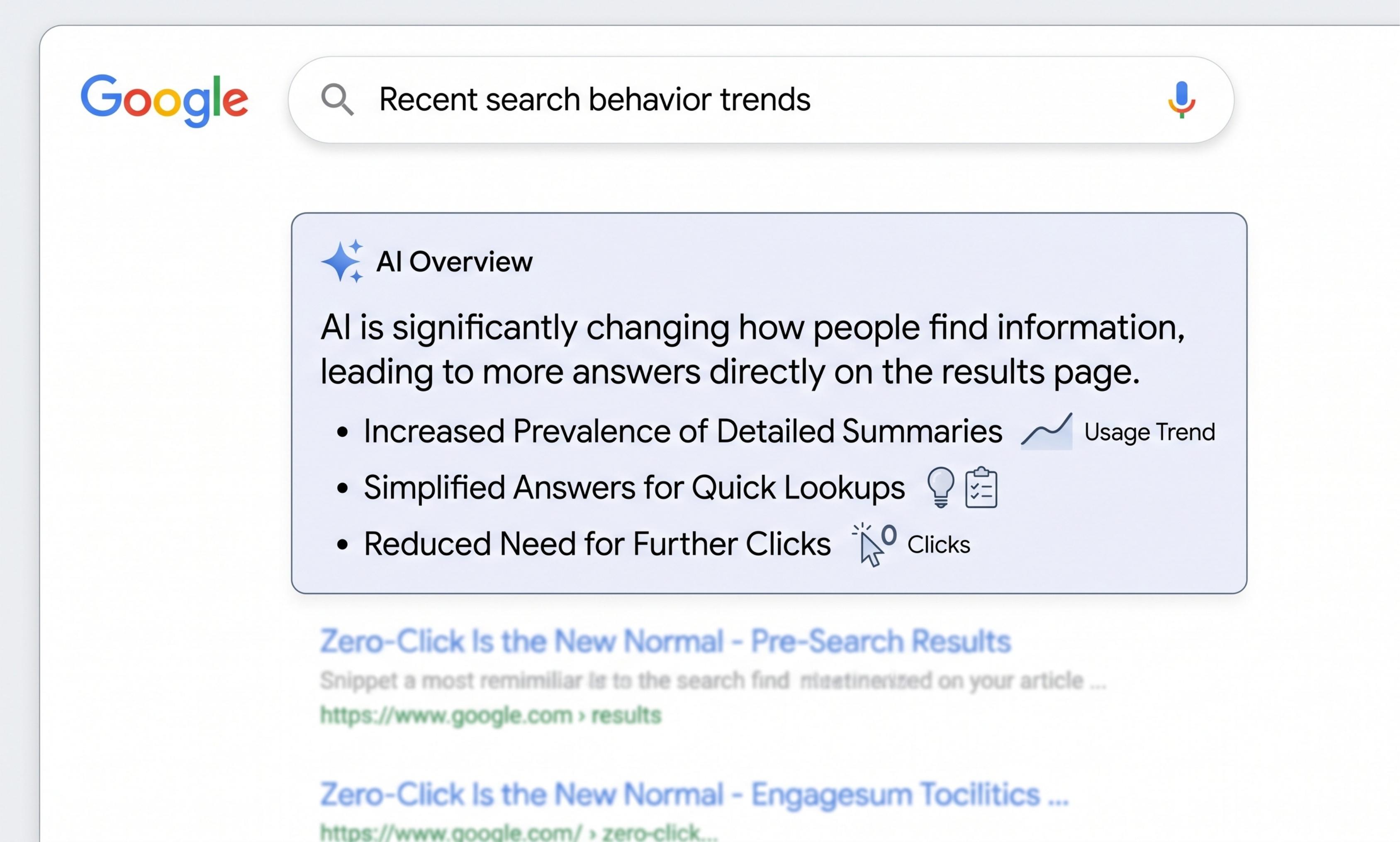
Traffic is not dying. It is being intercepted.
Around 80% of consumers now rely on zero-click results in at least 40% of their searches, reducing organic web traffic by an estimated 15% to 25%. That is not a rounding error. For many sites, that is the difference between a healthy pipeline and a slow bleed.
The click-through rate numbers are even more telling:
| Search Scenario | Organic CTR |
|---|---|
| Google search, no AI Overview | ~1.62% |
| Google search, with AI Overview | ~0.61% |
| Google AI Mode | Under 1% |
A randomized field experiment found that Google AI Overviews reduced organic clicks on triggered queries by 38%, with zero-click searches rising from 54% to 72% when AI summaries were shown. The researchers noted these AI-generated answers divert traffic from publishers without delivering measurable improvements in user experience.
Who Gets Hurt Most
Not every industry takes the same hit. The impact depends heavily on what type of content you publish.
- Informational queries: Hit hardest. Virtually every informational query now has an AI Overview. Guides, tutorials, and how-tos; all of them are losing clicks at scale.
- Transactional queries: Relatively insulated for now. Users still need to visit a site to actually buy something.
- E-commerce: Only 3.2% of shopping queries trigger an AI Overview today, down from 29% initially, because AI responses were not converting into sales.
Non-branded informational query traffic is down 15 to 30% across content sites, while e-commerce loss sits at 5 to 15%.
The Other Side of Zero-Click
Here is what the doom-and-gloom headlines miss. Being cited in an AI Overview is not the same as being ignored.
Sites cited in AI Overviews see a 35% increase in clicks compared to non-cited top-10 results, with traffic converting at 14.2% vs 2.8% for traditional organic.
The game has not ended. It has changed sides. The question is no longer just how high you rank. It is whether your brand appears in the summarized answers that users are already trusting. Less organic traffic from the wrong queries, more high-quality traffic from the right ones, that is the trade-off for brands that adapt.
Pro tip: Check Google Search Console right now. If your impressions are stable but clicks are falling, that is a zero-click signal. If both are falling, you may have a deeper ranking issue. The two problems need different fixes.
We break down how to stay visible in AI search here, including what signals actually move the needle for brands in competitive industries.
Platform Breakdown: Where Citations Come From
Here is something most SEO guides skim over: each AI platform cites from a completely different pool of sources.
Analysis of 118,000 AI-generated answers across ChatGPT, Perplexity, Google AI Mode, and Claude found that only 11% of cited domains appeared across multiple platforms. Optimizing for one and assuming it carries over everywhere is a costly mistake.
ChatGPT
ChatGPT Search processes 250 to 500 million search-intent queries per week and has grown into one of the top five search properties globally by query volume.
Key citation patterns:
- Top citation sources include Wikipedia at 5% and Reddit at 3%.
- Only 12% of URLs cited by ChatGPT, Perplexity, and Copilot rank in Google’s top 10 search results. 80% of LLM citations do not even rank in Google’s top 100.
- 43.2% of pages ranking first in Google are cited by ChatGPT, which is 3.5 times higher than pages ranking outside Google’s top 20.
ChatGPT leans heavily on brand entity strength built over time through third-party mentions. Page-level optimization alone will not move the needle here.
Perplexity
Perplexity handles around 50 million weekly queries and is disproportionately influential in professional segments among researchers, analysts, journalists, and developers.
- Perplexity tied every claim to a specific source in 78% of complex research questions, compared to ChatGPT’s 62%. Transparent, well-sourced content is non-negotiable here.
- Users visit 13 pages on average from Perplexity referrals, versus 11.8 from Google. The traffic quality is noticeably better.
- Perplexity rewards content that answers specific sub-questions clearly, with structured headers and direct answer paragraphs.
Google AI Mode and AI Overviews
Top citation sources in AI Overviews include YouTube at 23%, Wikipedia at 18%, and Google.com at 16%.
- AI Overview content changes roughly 70% of the time for the same query, and when answers update, almost half of the citations are replaced.
- Only about 30% of brands remain visible in back-to-back AI responses for the same query.
- AI Mode has limited overlap with traditional results; only 14% of URLs cited by AI Mode rank in the top 10.
Platform Comparison at a Glance
| Platform | Weekly Queries | Top Citation Sources | Key Signal |
|---|---|---|---|
| ChatGPT | 250-500M | Wikipedia, Reddit, Forbes | Brand entity strength |
| Perplexity | ~50M | Reddit, Gartner, news publishers | Content freshness + citations |
| Google AI Mode | 75M+ daily users | YouTube, Wikipedia, Google | E-E-A-T + structured data |
| Microsoft Copilot | 80-120M | Enterprise and B2B sources | Workplace-oriented content |
Citation rates, sentiment, and brand mention patterns vary up to 615x across AI platforms. If you are only tracking visibility on one platform, you are measuring a fraction of your actual exposure.
Our AI SEO agency helps brands build multi-platform visibility strategies that account for these differences, not just one platform’s citation patterns.
How Consumer Behavior Is Shifting
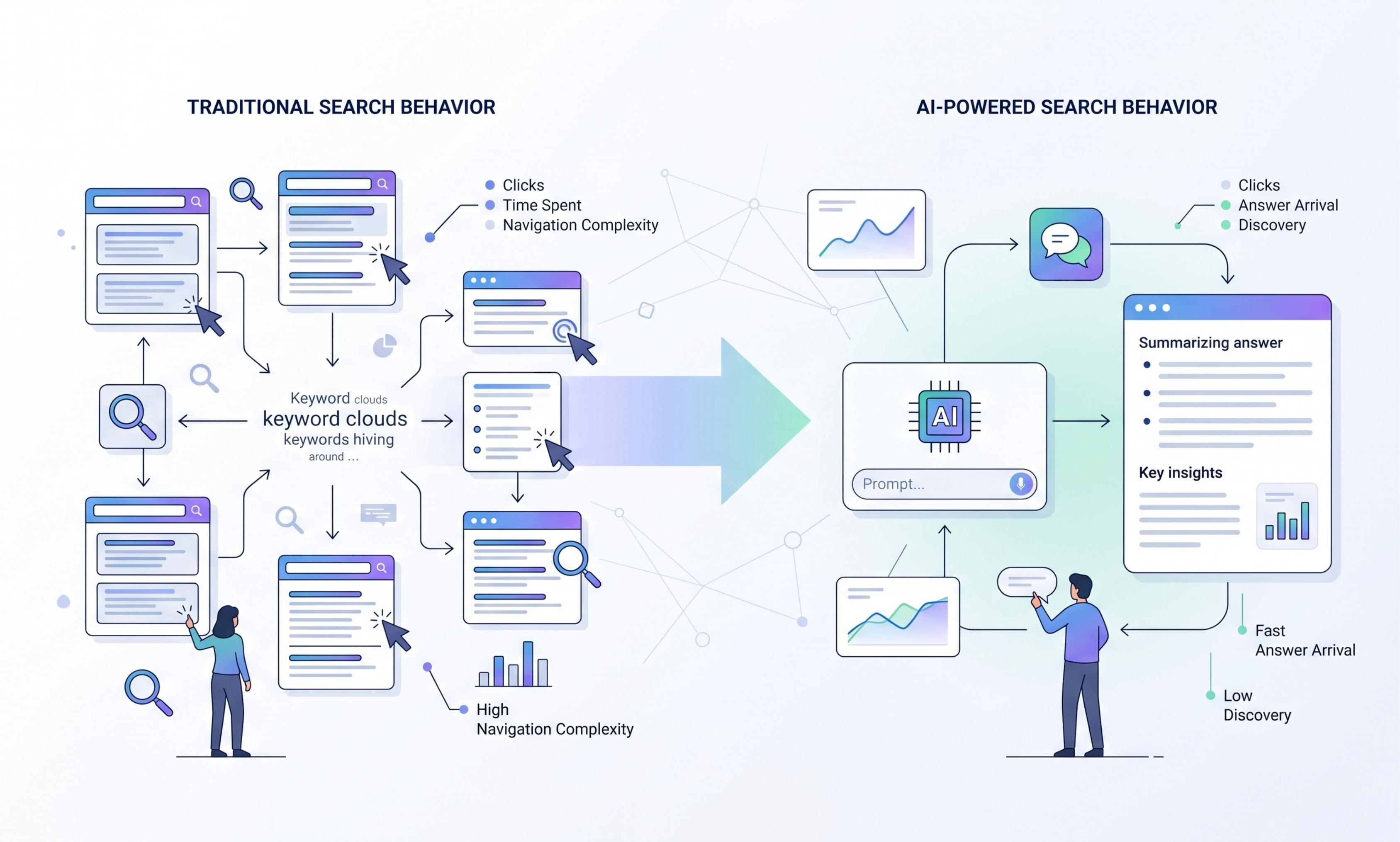
The buyer journey did not just change routes. It changed logic.
A global IBM study of over 18,000 consumers across 23 countries found that nearly half, 45%, now turn to AI for help during their buying journeys, using it to research products (41%), interpret reviews (33%), and hunt for deals (31%).
People are not searching the same way anymore. They are delegating their search behavior to AI systems that synthesize answers on their behalf.
Discovery Has Moved Upstream
About a quarter of customers now cite AI-powered platforms like ChatGPT as their top research tool for purchase decisions, making these newcomers more popular than brand websites and online review platforms.
This is a significant shift. Traditional search engines still lead, but AI tools are eating into the discovery phase that used to belong entirely to Google. Your brand now needs to be present at a stage where many users search before they search.
- Consumer use of AI applications has grown 62% over the past two years, with adoption even higher among Gen X and Baby Boomers.
- 24% of consumers are comfortable with AI agents shopping for them, rising to 32% among Gen Z consumers.
- In AI Mode, 88% of users took the AI’s shortlist without external verification, compared to 56% who built their own shortlist from multiple sources in classic search.
That last number is important. When AI generates a shortlist, nearly 9 in 10 people accept it without independently checking. And the AI’s top pick becomes the user’s top pick 74% of the time.
If your brand is not on the AI’s shortlist, you may not exist in that buyer’s journey at all.
The Role of Conversational Queries
Search behavior itself is changing in form, not just frequency.
ChatGPT prompts tend to be much longer, around 60 words on average, compared to Google’s typical 3.4-word queries. People are providing more context, asking follow-up questions, and engaging in multi-turn conversations to solve problems rather than scanning a results page.
This shift means content built around short keywords is increasingly less useful. What wins now is content that answers questions the way a knowledgeable human would: directly, specifically, with real detail.
- Roughly 40 to 70% of LLM users use these platforms to conduct research and summarize information (68%), understand the latest news (48%), and ask for shopping recommendations (42%).
- ChatGPT users are split between asking (49%), doing (40%), and expressing (11%); meaning a growing share want AI to act, not just answer.
What This Means for Your Brand
The consumer is now arriving to your site better informed and more decided than ever before. The decision has often been shaped before they click. That creates both risk and opportunity.
- Risk: If AI-generated answers about your industry do not include your brand, you are losing share of mind at the highest-intent moment.
- Opportunity: AI traffic converts at 14.2% versus Google’s 2.8%. The users who do click from AI platforms are already sold on the category. They just need to choose you.
For healthcare businesses, especially, digital marketing for doctors needs to account for patients who now arrive at a practice’s website with AI-informed expectations already formed.
What Actually Works in 2026
Rankings still matter. But they are no longer the whole game.
Brand mentions correlate at 0.664 with AI citation probability, roughly three times stronger than backlinks at 0.218. The old playbook, build links, rank pages, is the foundation. But it is no longer the ceiling.
Here is what the data actually shows is working right now.
Content Structure and Freshness
AI systems do not reward vague, fluffy content. They reward content that can be extracted.
- Comprehensive content gets 4.3x more citations than thin content. Pages with structured heading hierarchies are cited in 68.7% of cases.
- Pages updated within 60 days are 1.9x more likely to appear in AI answers.
- 44.2% of all LLM citations come from the first 30% of text. Front-load your best information. AI systems read like time-strapped analysts, not patient students.
- Fact-dense content with statistics every 150 to 200 words gets cited significantly more frequently. AI engines gravitate toward quantifiable information because it is verifiable and specific.
Structured Data
Structured data and FAQ blocks have driven a 44% increase in AI search citations, and websites with author schema are 3x more likely to appear in AI answers.
Content with proper schema markup shows 30 to 40% higher AI visibility. Schema is not optional anymore. It is how you tell AI systems exactly what your content means, who wrote it, and why it should be trusted.
Priority schema types to implement:
- Article schema with named author credentials
- FAQPage schema on key service and blog pages
- Organization schema with consistent NAP data
Off-Site Authority and Brand Mentions
About 85% of brand mentions originate from third-party pages rather than owned domains. Your own website is not your best AI visibility asset. The conversations happening about you elsewhere are.
- Get mentioned in industry roundups and listicles
- Build authentic presence on Reddit, LinkedIn, and YouTube, the platforms AI systems cite most
- Earn reviews on platforms like G2, Trustpilot, and Google
- Pursue earned media in established publications relevant to your niche
Answer-Ready Content Formats
Listicles (21.9%), articles (16.7%), and product pages (13.7%) are the most common citations across AI Mode, ChatGPT, and Perplexity. For commercial queries specifically, listicles dominate at 40.86%.
Formats that earn AI citations:
| Content Type | Best For | Citation Advantage |
|---|---|---|
| Listicles | Commercial/comparison queries | 40.86% of commercial citations |
| Long-form articles | Informational queries | 45.48% of informational citations |
| Comparison pages | Buyer-intent queries | 25.7% more citations with 3+ tables |
| FAQ pages | Direct answers | High AEO visibility |
| Case studies | Trust and authority | High-intent AI referral traffic |
Speaking of case studies, our work with Beep Beep Jeep is a good example of what happens when digital visibility compounds over time. We took them from 6 Jeeps to a fleet of 24, with 1,800%+ SEO traffic growth and 450%+ rental sales. That kind of result does not come from one tactic. It comes from building authority across every channel that matters.
AI Crawlability
LLM bots now crawl 3.6x more than Googlebot. But many sites are unknowingly blocking them.
- Check your robots.txt file. Cloudflare recently changed its default to block AI crawlers, which means many sites are invisible to AI systems without knowing it.
- Allow ChatGPT-User, GPTBot, PerplexityBot, and ClaudeBot in your robots.txt unless you have a specific reason not to.
- Make sure key content is in crawlable HTML, not buried in JavaScript or interactive components that AI crawlers cannot read.
Key Takeaways
The brands winning AI visibility in 2026 share a few traits. They publish content that is structured to be extracted, updated frequently enough to stay fresh, backed by off-site mentions, and technically accessible to AI systems. That is the formula.
Early adopters who build these signals now are compounding authority that will only grow harder to catch up to. Generative engine optimization is not a replacement for traditional SEO. It is the next layer on top of it, and the layer that will increasingly determine who gets seen and who gets skipped.
Our AI SEO strategies page walks through the specific approaches we use to help brands earn citations across the platforms that matter most.
The Search Landscape Is Rewriting the Rules
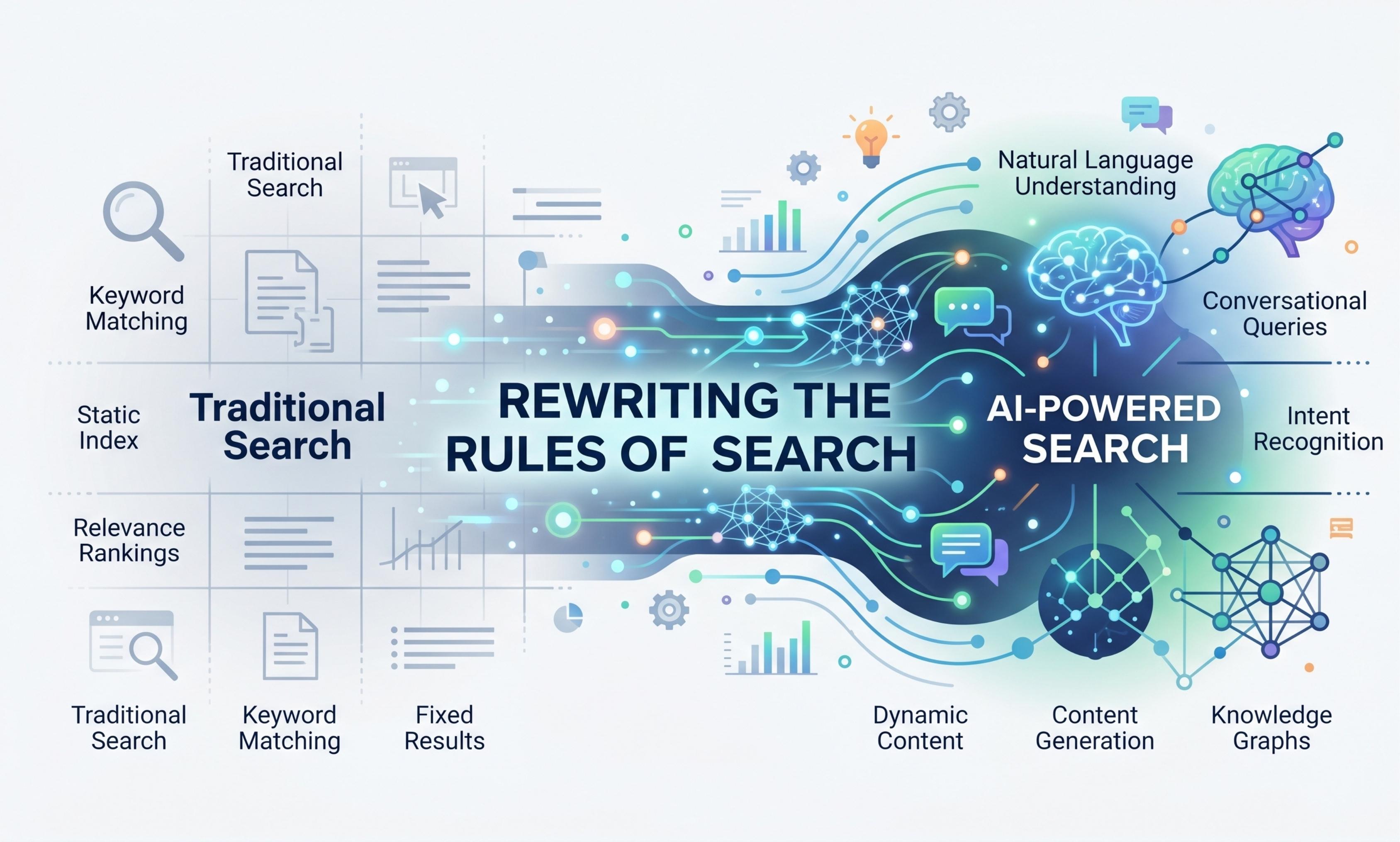
AI search engines are no longer experimental. They are the new default for a growing share of queries, and the search landscape is shifting faster than most brands are prepared for.
AI search tools like ChatGPT, Perplexity, and Google AI Mode are replacing the traditional search tools people relied on for decades. AI usage is accelerating across every demographic, and knowledge panels are no longer the ceiling of zero-click behavior; they are just the beginning.
Brands that want SERP presence in this environment need more detail in their content strategies, not less. Especially those operating in competitive industries where AI pulls answers from a narrow pool of authoritative sources. The brands earning citations are the ones investing in depth, structure, and credibility across every platform where people search today.
Your AI Visibility Strategy Starts With Doc Digital SEM
Search is not going back to the way it was. The brands that understand this shift and act on it now are the ones that will own discovery in the years ahead.
Here is what the data told us:
- AI search adoption is mainstream, with over 1.5 billion monthly users on Google AI Overviews alone
- Zero-click searches now account for the majority of queries, making citation more important than ranking
- Each AI platform cites from a different source pool, requiring a multi-platform visibility strategy
- Consumer purchase decisions are increasingly shaped by AI before a single click happens
- Structured content, fresh data, schema markup, and off-site brand mentions are the signals that earn citations today
The shift to AI-powered search is not a future problem. It is happening in your analytics right now. At Doc Digital SEM, we help businesses build the kind of AI search visibility that compounds over time, from generative engine optimization to content that actually gets cited. If your brand is not showing up in AI answers, your competitors are.
FAQs
How does AI search change customer behavior?
People search using natural language, skip traditional search results, and trust AI-generated shortlists. More users make purchase decisions before clicking anything.
What are the trends for AI research in 2026?
Large language models and AI-driven tools dominate informational searches. Brands must optimize content for generative engine optimization and maintain a strong SERP presence to stay visible.
How is AI affecting consumer behavior?
Artificial intelligence shapes purchase decisions earlier in the journey. Consumers rely on AI experiences over traditional engines, especially those researching products across social platforms and new tools.
What is the main impact of AI in 2026?
Shifting search dynamics. AI pulls answers directly from trusted sources, reducing reliance on traditional search results and forcing brands to build thought leadership and AI search visibility.


