


Your Google rankings are holding. Your agency says things are going well. But someone just asked ChatGPT to recommend a business in your category, and your name wasn’t mentioned once. That’s the gap most businesses don’t see coming until it’s already costing them leads.
The best AI SEO strategies for businesses in 2026 aren’t about picking between traditional search and AI visibility. They’re about building both simultaneously. And right now, only 20% of businesses have started, while 70% acknowledge it will significantly impact their strategy. That gap is an opportunity.
Here’s what this guide covers:
- Why AI SEO strategy is different from what most businesses are currently doing
- The LLM SEO strategies that get your brand cited by ChatGPT and Perplexity
- How to build an AEO and GEO content structure that AI platforms actually use
- Technical AI SEO requirements most businesses overlook
- Industry-specific AI SEO approaches for different business types
- The tools worth using in 2026 without wasting budget
- How to measure results across both traditional and AI search
- Common mistakes businesses make when implementing AI SEO
We’ve been building AI SEO strategies for clients across industries since before most agencies even knew what GEO stood for. At Doc Digital SEM, the results speak for themselves, and this guide is written on what we’ve learned from doing the actual work.
Why AI SEO Strategy Is Different From What Most Businesses Are Currently Doing
Most businesses running SEO today are playing a game that quietly changed the rules on them. The tactics are the same: publish content, chase keyword rankings, build backlinks, and check the Google Analytics dashboard. The problem is that these tactics were designed for a search environment that no longer fully describes where customers are actually searching.
This isn’t about abandoning traditional SEO. It’s about understanding why the strategy that underpins it needs a second layer, and why most businesses haven’t added it yet.
The Two Jobs SEO Now Has to Do
For most of the last two decades, SEO had one job: get the click. Rank high enough that a human user sees your page, finds it relevant, clicks through, and converts. Traffic and rankings were the entire scorecard.
In 2026, SEO has two jobs running simultaneously, and most businesses are only doing one of them.
- Job 1: Traditional SEO. Earn visibility in Google’s search results so human users discover your brand and click through to your website. This still matters, and it’s still producing revenue for businesses that do it well.
- Job 2: AI search optimization. Supply clean, structured, authoritative information to AI systems, so that when ChatGPT, Gemini, Perplexity, or Google AI Overviews generate an answer for a relevant query, your brand is the source they cite. No click required from the AI. The citation happens whether your user visits your site or not.
Here’s the critical part: these two jobs require different strategies, different metrics, and different content structures. Treating them as the same strategic problem is the mistake most businesses are currently making.
As one leading SEO expert put it at Search Engine Land’s 2026 predictions roundup, optimizing an AI citation is not like optimizing a 2010 keyword. AI citation is probabilistic. It changes based on phrasing, context, and platform. You can’t “rank” your way into it the same way you rank into a blue link position.
What the Data Says Businesses Are Missing
The gap between how businesses currently operate and where the search landscape has moved is measurable:
- 69% of Google searches now end without a single click, up from 56% in 2024
- Google AI Overviews appear in roughly 47% of all searches, compressing what was once a full results page into a single AI-generated summary at the top
- 60% of sources cited by AI are not in Google’s top 10 organic results, meaning ranking well no longer guarantees AI visibility
- Only 20% of businesses have started implementing AI-specific optimization strategies, despite 70% acknowledging that it will significantly impact their strategy
- ChatGPT now ranks as the 5th most visited website globally, with nearly 5 billion monthly visits
That last data point matters most. ChatGPT isn’t a niche tool used by tech enthusiasts. It’s where a significant and fast-growing portion of your potential customers are doing research, comparing vendors, and forming opinions about brands, often before they ever open Google.
The “Great Decoupling” Most Businesses Don’t See Coming
One of the clearest signals that traditional SEO strategy alone is no longer sufficient is what researchers have started calling the “Great Decoupling”: the widening gap between search impressions and website traffic.
Businesses see their Google impressions holding steady or even growing. But click-through rates are falling. Organic traffic is declining for information queries even when rankings haven’t moved. The content is being seen, inside AI Overviews and AI-generated answers, but the click isn’t happening.
Businesses running traditional SEO reporting miss this entirely because their dashboards weren’t built to track it. Rankings look fine. Traffic is down. The cause is invisible to a standard analytics setup.
The AI layer is absorbing the attention. And it’s not creating that visibility for every brand equally. It’s creating it for the brands whose content is structured to be cited.
Traditional SEO vs. AI SEO Strategy: The Core Differences
This is what most businesses are currently doing versus what the best AI SEO strategies for businesses require:
| What Most Businesses Are Doing | What AI SEO Strategy Requires | |
|---|---|---|
| Content goal | Rank for target keywords | Be cited as the answer to specific questions |
| Content structure | Long-form keyword-optimized pages | Answer-first, modular, extractable sections |
| Success metric | Rankings, clicks, organic traffic | Citations, Share of AI Voice, AI referral traffic |
| Authority signals | Backlinks, domain authority | Backlinks + off-site brand mentions + entity consistency |
| Technical focus | Google indexing, Core Web Vitals | Google + Bing indexing, schema markup, llms.txt |
| Measurement tools | Rank trackers, Google Analytics | AI visibility platforms, prompt testing, GA4 custom channels |
| Platform scope | Google + ChatGPT + Perplexity + Gemini + voice | |
| Content freshness | Update when rankings drop | Update quarterly minimum for AI citation recency |
None of the items on the left side of that table stop mattering. They’re still the foundation. What’s changed is that the right column now also has to happen, and for most businesses, it isn’t happening at all.
Why the Gap Is an Opportunity Right Now
Here’s the strategic reality that makes this moment unusual: the window for first-mover advantage in AI SEO is still genuinely open.
Most of your competitors are still running traditional SEO playbooks. They’re watching rankings, producing keyword-targeted content, and measuring traffic. They’re not building topical authority clusters optimized for AI extraction. They’re not running prompt tests to see which brands ChatGPT recommends in their category. They’re not tracking their Share of AI Voice.
Research from Princeton and other institutions shows that AI models demonstrate a preference for sources they’ve cited before, creating compounding returns for brands that establish citation patterns early. The brands building those patterns now will be significantly harder to displace later.
The best AI SEO strategies for businesses aren’t about abandoning what’s working. They’re about recognizing that the search environment now runs on two parallel tracks, and building a strategy that competes on both simultaneously.
Pro tip:Before investing further in traditional SEO tactics, run your top 10 revenue-driving keywords as prompts in ChatGPT and Perplexity. Ask the question your customer would ask. See whose brand shows up in the answer. If yours doesn’t appear, that’s the gap this guide will help you close.
LLM SEO Strategies That Get Your Brand Cited
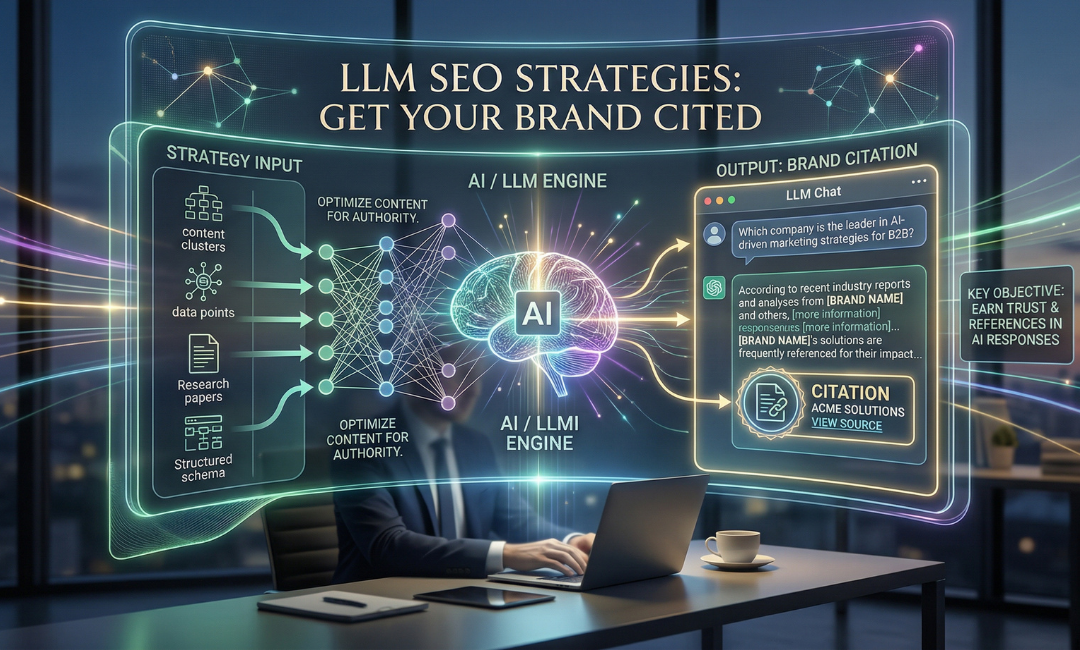
Getting your brand cited by ChatGPT and Perplexity isn’t a matter of luck or domain authority alone. It’s structural. The brands showing up consistently in AI-generated responses have built their content around how large language models actually retrieve and evaluate information, and it’s meaningfully different from how Google crawls and ranks pages.
Here’s exactly how it works and what to do about it.
Understand How LLMs Retrieve Content
When a user asks ChatGPT or Perplexity a question, the platform doesn’t rank pages. It runs a multi-stage process: it interprets the search intent behind the query, searches its underlying index (Bing’s API, in ChatGPT’s case, 92% of the time), pulls candidate documents, scores them for relevance and authority, and synthesizes a response, citing the sources that provided the clearest, most credible answers.
One of the most counterintuitive findings in recent AI search research is this: roughly 90% of ChatGPT citations come from pages ranked at position 21 or lower in Google. Your top-ranked pages are often the least likely to be cited by an AI engine. This is because Google rewards backlink density and domain authority, while LLMs reward structural clarity, topical specificity, and answer-first formatting.
What that means for your content strategy:
- Pages you’ve ignored because they don’t rank well on Google may be your best AI citation opportunities
- Content you’ve ranked well on Google may still be invisible in AI generated responses if it isn’t structured for extraction
- The competitive field in AI SEO is genuinely different from traditional search engine optimization, giving businesses that haven’t dominated Google yet a real shot at AI visibility
The Five Core LLM SEO Tactics
Here are the five core LLM SEO tactics:
1. Answer-first formatting, every section
LLMs scan the first one to two sentences of each content section to determine if it resolves the query being processed. According to an analysis of 1.2 million verified ChatGPT citations, 44.2% of all citations come from the first 30% of a piece of content.
Every section should open by stating the answer directly. Not “in this section we’ll cover…” but the actual answer, in plain language, within the first two sentences. Follow with supporting detail, examples, and depth.
2. Build content specifically for follow up questions
LLMs don’t just respond to single queries. They handle multi-turn conversations where users ask follow up questions to get more specific information. Content that anticipates the natural chain of follow up questions a user might ask, and answers them sequentially, gets cited across a wider range of prompts than content that only targets one keyword.
Map out the three to five follow up questions your target audience is most likely to ask after your main topic. Build dedicated sections or supporting pages answering each one. This cluster of interconnected answers increases the surface area where AI platforms can find and cite you.
3. Seed your brand across the sources AI models trust
ChatGPT primarily references Wikipedia, G2, Forbes, and Amazon-style review platforms. Perplexity leans heavily on Reddit, YouTube, and LinkedIn. Neither platform pulls primarily from your own website alone. Your LLM SEO strategy needs an off-site component that builds brand mentions across the specific platforms these AI models draw from.
Practical tactics:
- Contribute to Reddit threads in your niche with genuinely useful, non-promotional responses
- Publish guest content on industry publications that LLMs frequently reference
- Ensure your brand has accurate, complete profiles on G2, Trustpilot, and relevant vertical directories
- Create YouTube content with well-structured descriptions and transcripts (YouTube is the third most-cited domain in AI responses)
- Pursue digital PR that gets your brand mentioned in publications like Forbes, Inc., or vertical-specific outlets with high domain trust
4. Use specific, verifiable statistics with named sources
AI models are citation machines. They’re designed to surface accurate, verifiable information. Content with concrete statistics tied to named sources (“According to Semrush’s July 2025 study of 300,000 keywords…”) is cited dramatically more often than content with vague claims (“research suggests…”).
This is where original research and proprietary data become genuinely competitive advantages. If your business can produce and publish its own data, even from a small internal study, it becomes a citation asset that AI models have a specific reason to reference.
5. Cover specific queries, not just broad topics
The most cited content in AI generated results isn’t comprehensive guides on broad subjects. It’s focused, specific content that directly answers a narrow question. A 600-word page that perfectly answers “how much does enterprise SEO cost for a 50-person SaaS company” will outperform a 4,000-word guide on “enterprise SEO” for that specific query.
Map your content creation strategy to specific search queries your customers are actually typing into AI tools, not just broad keyword research targets. The more precisely your content matches the exact question, the higher the probability of being cited as the source.
How to Build AEO and GEO Content Structure AI Platforms Use
The best AI SEO strategies for businesses in 2026 share a content architecture that’s meaningfully different from what most traditional search engine optimization approaches produce. Here’s the structure that consistently earns citations across both answer engine optimization and generative engine optimization surfaces.
The AEO Content Blueprint
Answer engine optimization requires every page to be built around a clear question-and-answer spine. The structure looks like this:
- Page opening (0 to 60 words): A direct definition or answer to the primary question the page addresses. This is the most-cited part of any page across AI platforms.
- Section headings: Every H2 and H3 formatted as a question or a declarative statement that signals a specific answer, not a vague topic label.
- Weak heading: “SEO Tools Overview” AEO heading: “Which AI SEO Tools Are Most Effective for Small Businesses?”
- Answer blocks: The first one to two sentences under each heading directly answer the question posed by that heading. The remaining paragraph or section provides supporting depth.
- FAQ section: A dedicated section at the bottom of every informational page, with schema markup (FAQPage in JSON-LD format). Questions should mirror exactly how your target audience phrases search queries in natural language. Keep answers between 40 and 60 words.
- Author signals: Named authorship with verifiable credentials. Pages with named experts and full author bios are cited 2.3x more frequently than anonymous pages.
The GEO Content Architecture
Generative engine optimization works at the cluster level. Individual pages optimized for AEO feed into a larger topic architecture that signals comprehensive expertise to AI models.
- Pillar page: One comprehensive page covering the broad topic. This is the parent document that establishes your authority on the subject.
- Supporting cluster pages: Five to fifteen focused pages, each targeting a specific subtopic or long tail query within the pillar topic. Each one is internally linked from the pillar and from each other where relevant.
- Content gaps identification: Use ai powered seo tools like Semrush or Ahrefs to identify specific subtopics your cluster doesn’t yet address. Every content gap in your cluster is an opportunity for a competitor to be cited instead of you.
- Entity consistency: Your brand name, product names, service descriptions, and key terminology must appear identically across every page in the cluster. AI models build an understanding of your entity from these consistent signals. Inconsistency creates confusion and reduces citation probability.
This is exactly the content strategy our team built for Beep Beep Jeep when they came to us as a small company in Puerto Rico. Structured content authority, combined with technical optimization, drove 1,800%+ SEO traffic growth and a 450%+ increase in Jeep rental sales. The cluster architecture wasn’t just for traditional rankings. It created the depth of topical coverage that AI platforms use to evaluate trustworthiness. See the full case study here.
Structuring Content for the Full Search Journey
AI platforms don’t just answer one-off questions. They support entire research journeys, from initial awareness through to comparison and purchase decisions. Your content structure needs to map to the full journey:
| Journey Stage | Content Type | AI Platform Behavior |
|---|---|---|
| Awareness | Definition pages, “what is” content | High citation frequency for informational queries |
| Evaluation | Comparison content, “X vs Y” articles | Used heavily in follow up questions after initial answers |
| Consideration | Case studies, pricing guides, ROI content | Cited for commercial-intent queries with high conversion value |
| Decision | Reviews, testimonials, specific service pages | Referenced when AI users ask for specific recommendations |
Building content across all four stages ensures your brand is present throughout the AI-mediated research journey, not just at one entry point.
Technical AI SEO Requirements Most Businesses Overlook
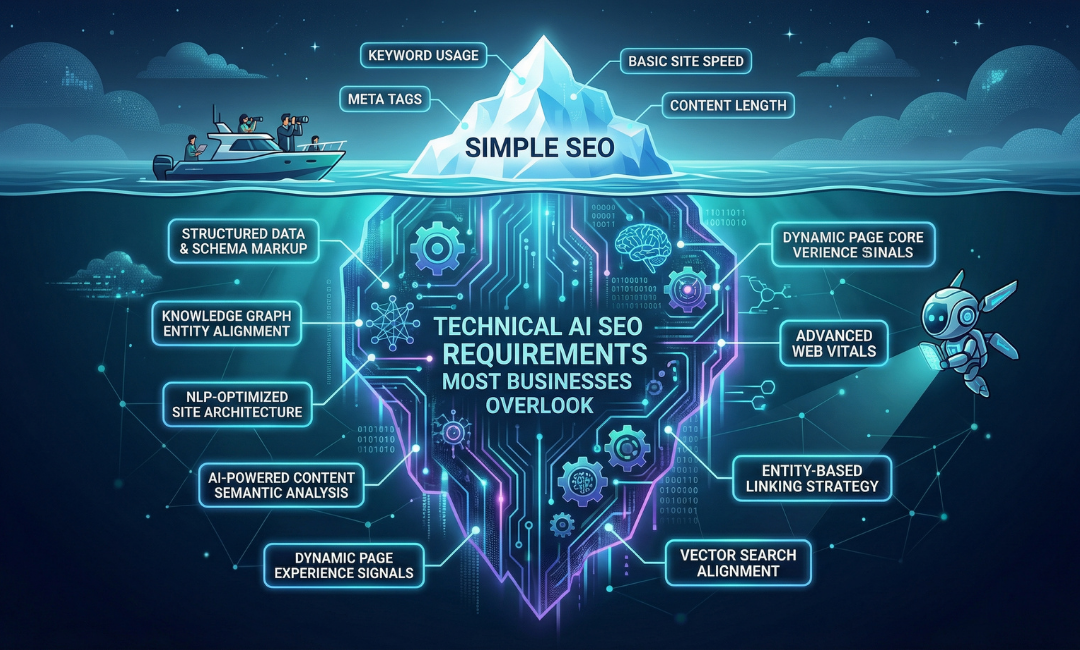
Technical SEO is the prerequisite for everything else. AI crawlers can’t cite content they can’t access. And content on a slow, JavaScript-dependent, poorly structured site gets skipped in favor of cleaner alternatives, regardless of how good the content actually is.
Here are the technical requirements that most businesses aren’t meeting in 2026.
Bing Indexing: The Most Overlooked Requirement
This is the single most consistent technical gap in AI SEO implementations. Because ChatGPT uses Bing’s search API 92% of the time for real-time information retrieval, complete Bing indexing is non-negotiable for ChatGPT visibility.
Most businesses have solid Google coverage and minimal Bing attention. That creates a direct gap in AI visibility that competitors who catch it early can exploit.
Action items:
- Submit your XML sitemap to Bing Webmaster Tools
- Verify index coverage across your most important pages
- Fix any crawl blocks that apply specifically to Bingbot
- Check that your robots.txt isn’t inadvertently blocking Bingbot
Schema Markup: The AI Crawlers Blueprint
Structured data tells AI crawlers exactly what type of content is on each page, what each element means, and how to parse the relationships between pieces of information. Without it, AI systems have to interpret your content by inference. With it, you’ve given them a direct blueprint.
Priority schema types for AI SEO:
- FAQPage: The highest-impact schema for AEO. Labels every Q&A pair so AI systems can extract them cleanly without needing to interpret surrounding content
- Article: Includes author name, credentials, and publication date. Directly supports the E-E-A-T signals that AI platforms use to evaluate source trustworthiness
- HowTo: Signals procedural content to AI engines, increasing visibility for process-based and instructional search queries
- Organization: Establishes your brand entity at the foundational level. This is what AI models use to recognize and associate your content with a specific, trusted business
- Speakable: Marks specific sections as optimized for voice search. Voice assistants use this to identify exactly which text to read aloud
All schemas should be implemented in JSON-LD format, validated before deployment, and audited quarterly for accuracy.
JavaScript Dependency: The Silent Citation Killer
Research confirms that 46% of ChatGPT bot visits begin in reading mode, a stripped-down version of pages that removes CSS, JavaScript, and images entirely. If your key content, headlines, body copy, FAQs, or structured answers live inside JavaScript-rendered elements, ChatGPT’s retrieval system may never see them.
Technical requirements for AI-accessible content:
- All key content must be present in static HTML, not dependent on JavaScript rendering
- Avoid rendering critical information inside tabs, accordions, or modals that require user interaction to reveal
- Test your pages in a JavaScript-disabled environment to see exactly what AI crawlers see
- Use server-side rendering or static site generation for content-heavy pages
The llms.txt File: Early Adoption Advantage
Similar to robots.txt for traditional search engines, the llms.txt file guides AI crawlers through your site’s most important content. It tells AI systems which pages are of the highest priority, what your brand is about, and how to navigate your content architecture.
Early adoption here provides a meaningful advantage, as AI platforms are increasingly honoring these files. Structure yours as a curated reading list: your most authoritative pages, your core service or product pages, your key author profiles, and any proprietary research or data resources.
Technical SEO Foundations That Remain Non-Negotiable
Some technical SEO requirements haven’t changed. They’re still the foundation:
- Page speed: Slow pages get abandoned by AI agents mid-crawl. Target LCP under 2.5 seconds
- Mobile optimization: AI agents behave similarly to mobile users in many indexing contexts
- Broken links: Content on pages with broken links signals low maintenance to AI crawlers and reduces citation probability
- Core Web Vitals: User experience signals that AI systems factor into content quality evaluation
- Clean heading hierarchy: H1, H2, and H3 structure is how AI models understand topic boundaries and content organization. Use it consistently
Fixing technical issues using technical site audits run through ai powered seo tools like Screaming Frog or Semrush should be the first step before any content optimization work begins. Technical health is the prerequisite, not an afterthought.
Industry-Specific AI SEO Approaches
Not every business uses the same AI SEO playbook. The platform your customers use to search, the type of queries they ask AI tools, and the content formats that earn citations vary significantly by industry. Here’s how to tailor the best AI SEO strategies for businesses across the most common categories.
Local Service Businesses
Local businesses face a specific challenge: AI driven search engines are increasingly personalizing answers by geography, pulling from local signals to answer “near me” queries and location-specific questions.
Priority tactics for local businesses:
- Maintain an accurate, active Google Business Profile with regular posts, updated hours, and complete service descriptions. Google’s AI Mode draws heavily from GBP data for local AI generated responses
- Create location-specific content that explicitly addresses local questions (“How much does roof repair cost in [city]?” performs well in local AI answers)
- Build consistent NAP (Name, Address, Phone) data across every directory, listing, and citation source. AI models use this consistency as a trust signal
- Encourage reviews on Google, Yelp, and relevant directories. Perplexity leans heavily on user-generated review content for local queries
- Use LocalBusiness schema with complete location, hours, and service area data
For our client O2pure, a hyperbaric wellness facility in Hollywood, FL, building a structured local authority combined with AI-specific optimization drove a 550% improvement in ChatGPT rankings and generated over 1,000 qualified leads. Local context and brand authority work together in AI search the same way they do in traditional local SEO, just with different technical requirements underneath. Read the full case study here.
B2B Companies
B2B buyers are among the most active users of AI tools for research. Forrester data indicates that 89% of B2B buyers have adopted generative AI as a central source for self-directed information throughout their buying process. That makes B2B AI SEO particularly high-stakes.
AI driven search in B2B tends to be consultative and complex. Buyers ask multi-part questions about pricing, comparison, implementation, and outcomes. Your content strategy needs to address the full buying journey:
- Awareness: “What is [your solution category] and how does it work?”
- Evaluation: “How does [your brand] compare to [competitor]?”
- Consideration: “What is the typical ROI of [your solution type]?”
- Decision: “Which [your solution type] is best for a [specific use case]?”
For B2B specifically, authority signals matter more than in other categories. Named authors with verifiable expertise, published case studies with real numbers, and mentions in trusted industry publications all feed directly into how AI models evaluate and cite B2B content.
Data from the Previsible AI discovery study shows that for B2B companies in high-consultative categories like legal, finance, health, and SaaS, AI driven sessions account for a disproportionate share of bottom-of-funnel revenue. For B2B companies, AI-driven traffic has been responsible for nearly 10% of revenue despite representing less than 1% of total sessions.
E-commerce Businesses
E-commerce AI SEO is increasingly about product-level visibility. AI platforms are getting better at handling commercial queries, and Semrush data shows AI Overviews have expanded significantly into purchase-intent territory.
Key e-commerce AI SEO priorities:
- Implement Product schema with accurate pricing, availability, reviews, and specifications. AI systems draw directly from product schema when generating purchase recommendations
- Create comparison content that pits your products against alternatives with structured, honest analysis. AI models favor balanced, information-rich comparison content for commercial queries
- Build content around the specific use-case questions your customers ask (“best [product] for [specific use case]”) rather than just product pages optimized for generic terms
- YouTube is cited 121% more frequently in AI Overviews for e-commerce queries. Product demonstration and comparison videos with structured descriptions and transcripts are a significant visibility opportunity
Professional Services (Legal, Medical, Dental, Financial)
YMYL (Your Money Your Life) industries face the highest bar for AI citation because AI models are most cautious about accuracy in these fields. E-E-A-T signals, the quality markers of Experience, Expertise, Authoritativeness, and Trustworthiness, matter more here than in virtually any other category.
AI SEO priorities for professional services:
- Named author pages with verifiable professional credentials linked to licensing boards, professional profiles, and published work
- Content written at the depth of genuine expertise, not surface-level explanations
- Regular content updates that reflect current regulations, standards, or research
- Third-party validation through media mentions, award citations, and professional organization memberships
- Local authority signals for practices serving specific geographic markets
Our dental marketing and medical marketing clients have seen significant AI visibility gains, specifically from investing in named author profiles and publishing genuinely expert content, not just keyword-optimized articles. The AI systems handling health and legal queries are specifically looking for the credentials and depth that these industries need to demonstrate anyway.
The AI SEO Tools Worth Using in 2026

The market for ai seo tools has grown significantly, and not every tool in the category delivers meaningful value. Here’s a practical breakdown of what actually moves the needle, organized by function rather than hype.
Comprehensive AI-Powered SEO Platforms
These seo tools handle the full search engine optimization lifecycle: keyword research, content optimization, technical audits, competitor analysis, and AI visibility tracking.
- Semrush One: The most complete platform available. Their AI Visibility Toolkit tracks how often your brand appears in AI generated responses across ChatGPT, Google AI Mode, and AI Overviews, shows which prompts trigger competitor citations that miss yours, and provides keyword insights into which topics drive the most valuable AI citations. Their keyword research tools and content optimization features are the strongest in the market for data analysis at scale. Pricing starts at $139.95/month.
- Ahrefs: Industry-leading for backlink data and competitor research. Their 2026 updates focus on predicting how much traffic a new page will actually get, including AI-influenced traffic shifts. Strong for identifying content gaps in your topical cluster and diagnosing why specific content isn’t earning citations. Pricing starts at $99/month.
- SE Ranking: Strong mid-tier option with an AI Rankings Report that monitors brand mentions and cited URLs inside AI-generated results. Particularly effective at identifying where AI Overviews are satisfying search intent so thoroughly that your organic link no longer gets clicked. Starts at $65/month.
AI-Powered Content Optimization Tools
These AI-powered tools analyze top-ranking and top-cited content, then provide real-time guidance on how to optimize content structure, semantic coverage, and keyword density for both traditional rankings and AI citations.
- Surfer SEO: Scores content against competitors in real time using natural language processing signals rather than raw keyword density. Their AI Tracker add-on monitors brand mentions across AI platforms and identifies which of your pages are being cited and for which prompts. Starts at $95/month with the AI Tracker feature.
- Frase: Built specifically for both traditional SEO and GEO simultaneously. Includes a dual scoring system that evaluates content against Google search results and AI platforms like ChatGPT, Perplexity, and Claude at the same time. Strong for content creation workflows where writers need guidance on both traditional and AI search expectations. Mid-tier pricing starting around $44.99/month.
- Clearscope: Excellent for semantic content optimization. Ensures your content covers the full topical range that AI systems expect, reducing content gaps that competitors can exploit. Pricing starts at $189/month.
AI Visibility and Citation Tracking Tools
These ai seo tools track specifically where your brand appears inside AI-generated results, which competitors are being cited instead of you, and how your Share of AI Voice is changing over time. These are the tools traditional seo tools don’t cover.
- OtterlyAI: Monitors brand mentions and cited URLs across ChatGPT, Perplexity, Google AI Overviews, Gemini, and Copilot. Builds a Share of AI Voice metric and shows which of your specific pages are generating citations. Strong for tracking AI visibility improvement over time. Pricing varies by plan.
- Peec AI: Enterprise-level tracking with daily prompt-scale monitoring, sentiment analysis, and citation intelligence across all major LLMs. Best for larger organizations needing comprehensive user behavior data on how AI platforms are describing their brand. Custom enterprise pricing.
- Profound: Built specifically for tracking brand citations at scale. Strong for identifying exactly which content attributes are correlating with citation success, so you can prioritize which pages to optimize next. Also useful for tracking how competitors earn citations you’re missing.
Technical AI SEO Tools
These handle the technical SEO work that underpins everything else. Broken links, crawl errors, JavaScript rendering issues, schema validation, and Bing indexing gaps all get surfaced here.
- Screaming Frog: The gold standard for technical site audits. Catches crawl errors, broken links, redirect chains, schema markup gaps, and accessibility issues that affect both traditional and AI search visibility. The free version covers up to 500 URLs. Paid version starts at around $259/year.
- Google Search Console + Bing Webmaster Tools: Both free. Combined, they give you the complete picture of how search engines are crawling and indexing your content across the two most important indexes for AI visibility.
The honest bottom line: Don’t try to use every tool. The highest-return stack for most businesses combines one comprehensive data platform (Semrush or Ahrefs) for keyword research and technical auditing, one content optimization tool (Surfer SEO or Frase) for content creation guidance, and one AI visibility tracker (OtterlyAI or Profound) for citation monitoring. Start with those three categories before adding anything else.
How to Measure Results Across Both Search Channels
Measuring AI SEO alongside traditional search engine results requires a parallel reporting system. The metrics that matter for one channel often don’t capture what’s happening in the other.
The Five-Layer Measurement Framework
Here’s the five-layer measurement framework:
Layer 1: Traditional search performance
Track this the same way you always have, through rank tracking on target keywords, organic traffic from Google Analytics, and click-through rates from Search Console. The key change in 2026 is that you should specifically flag which tracked keywords now trigger AI Overviews, because those keywords need different success metrics (citation presence rather than click-through rate).
Layer 2: AI referral traffic
Set up a custom channel in Google Analytics (GA4) labeled “Generative AI” with source filters including:
- chat.openai.com
- perplexity.ai
- gemini.google.com
- bing.com/chat
- claude.ai
Track volume, conversion rate, and revenue from this channel separately. The conversion rate differential is significant: AI referral traffic converts at roughly 4.4x the rate of standard organic traffic. Even small volumes deserve dedicated attention in reporting.
Layer 3: Share of AI Voice
Your most important AI-specific metric. Calculate monthly as: Your Brand Citations / Total Category Citations × 100.
Run your 20 to 30 highest-priority prompts across ChatGPT, Gemini, and Perplexity once a week. Track which brands appear, how they’re described, and which specific URLs are cited. This manual process gives you ground truth that no automated tool fully replicates.
Layer 4: Citation quality and sentiment
Not all citations are equal. Track not just whether you’re cited but how. Is your brand positioned as a budget option or a premium choice? As a recommended solution or a cautionary example? Negative or inaccurate AI-generated summaries can shape purchasing decisions before a customer ever visits your site, so monitoring the framing of your citations matters alongside the frequency.
Layer 5: Brand search volume
Rising branded search volume in Google is one of the strongest trailing indicators of growing AI visibility. When AI platforms consistently mention your brand, users who encounter those mentions often return to Google to search for you by name.
Track this monthly in Google Search Console. Consistent upward movement alongside your seo efforts confirms AI citations are compounding into broader brand awareness.
Building a Combined Reporting Dashboard
The most practical approach for most businesses is a monthly dashboard with two sections running in parallel:
Traditional SEO section:
- Keyword rankings for primary targets
- Organic traffic trend (Google Analytics)
- Featured snippet presence (Semrush or Ahrefs)
- Technical health score (Screaming Frog or Semrush)
AI visibility section:
- Brand mentions in AI responses (OtterlyAI or Peec AI)
- Share of AI Voice vs. competitors
- AI referral traffic (GA4 custom channel)
- Brand search volume trend (Search Console)
Both sections update monthly. Share the combined view with stakeholders who are still evaluating AI SEO primarily through traditional search data. The side-by-side comparison makes the case for AI SEO investment more effectively than either channel alone.
Common Mistakes Businesses Make With AI SEO
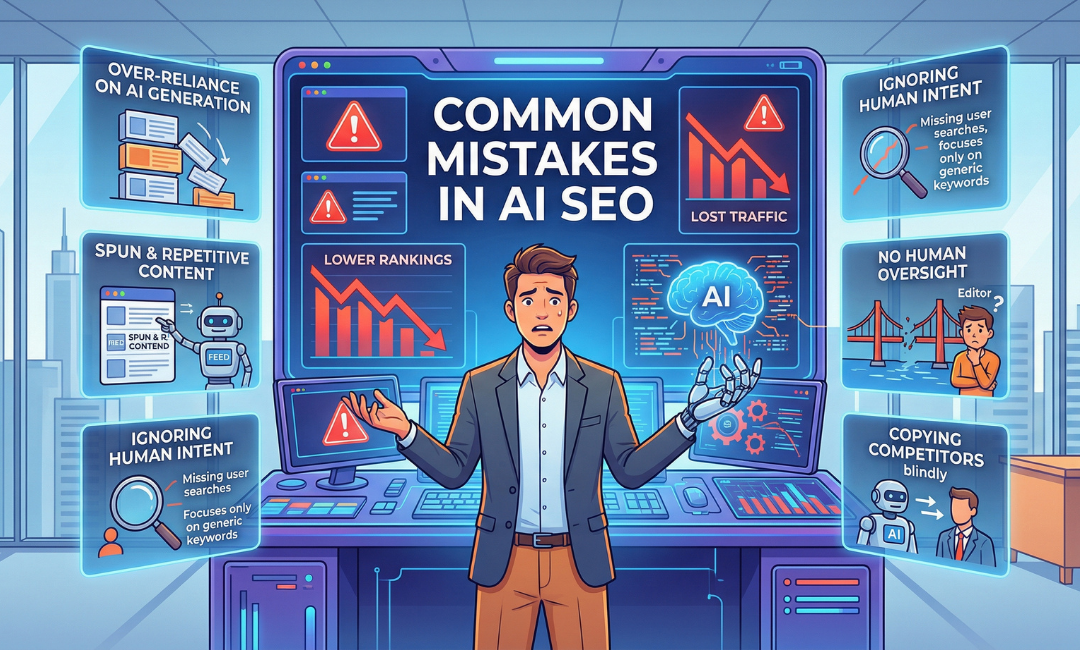
Understanding what goes wrong is as useful as knowing what to do. These are the mistakes that consistently prevent businesses from gaining traction in AI search, regardless of how strong their content quality is otherwise.
Mistake 1: Treating AI SEO as a Separate Budget Item
The most common strategic error is treating AI SEO as a new, additional program running alongside traditional SEO rather than as an integrated layer of the same strategy. This creates duplicate work, conflicting priorities, and measurement confusion.
The fix: Integrate AI SEO requirements into your existing content and technical workflows from the start. When you’re writing a new blog post, structure it for AI extraction from the first draft. When you’re auditing technical health, include Bing indexing and schema coverage in the same pass. One integrated strategy, not two parallel ones.
Mistake 2: Optimizing for Google and Assuming AI Visibility Follows
This is the most dangerous misconception in the current market. Research consistently confirms that only 11% to 12% of cited domains appear across multiple AI platforms, and ChatGPT’s search results overlap with Google’s only 12% of the time. Ranking #1 on Google does not translate into AI citations.
The fix: Build a platform-specific optimization approach. Optimize for Google through traditional means, optimize for ChatGPT by ensuring Bing indexing and off-site brand mentions, and optimize for Perplexity by prioritizing content freshness and explicit definitions.
Mistake 3: Over-Relying on AI-Generated Content Without Original Insight
There’s a significant difference between using AI tools to accelerate content creation and using them to produce thin, derivative content that recombines what AI already knows. AI platforms specifically avoid citing content that merely repeats what’s already widely available.
Brand voice and original thinking are competitive advantages in AI SEO, not optional extras. Content that includes genuine expert perspective, original data, real case studies, or proprietary analysis gives AI engines something to cite that they can’t get elsewhere.
The fix: Use AI-powered tools to accelerate the research, structure, and production workflow. Reserve human expertise for the analysis, opinion, and original insight that actually make your content citation-worthy.
Mistake 4: Ignoring the Measurement Layer
70% of organizations acknowledge AI SEO will significantly impact their strategy, but most can’t currently tell you their Share of AI Voice, how often ChatGPT cites their brand, or what AI referral traffic converts at. You can’t optimize what you don’t measure.
The fix: Implement the five-layer measurement framework before investing heavily in optimization. Establish a baseline for where you currently stand across both traditional and AI search channels, then track change monthly.
Mistake 5: Only Optimizing for One AI Platform
Businesses that discover AI SEO often start by optimizing specifically for Google AI Overviews. That’s a reasonable starting point, but it leaves significant visibility gaps on ChatGPT, Perplexity, Claude, and other AI search engines that are growing rapidly.
The citation overlap between platforms is small. Being well-cited on Perplexity doesn’t carry over to ChatGPT, and Google AI Overviews visibility doesn’t predict Perplexity citations. Each platform needs at least some platform-specific attention.
The fix: Build a content foundation optimized for all major platforms simultaneously (schema markup, answer-first structure, named authorship, topical depth), then add platform-specific tactics on top: Bing indexing for ChatGPT, content freshness for Perplexity, Google-aligned authority for Gemini, and AI Overviews.
Mistake 6: Measuring Only Traffic, Not Influence
AI citations drive brand awareness, purchasing decisions, and follow-up branded searches even when no direct click occurs. A business that evaluates AI SEO purely through referral traffic in GA4 will consistently underestimate its value.
The fix: Track the full stack: citation frequency, brand mentions, Share of AI Voice, and brand search volume growth alongside direct AI referral traffic and conversion rates. The combined picture shows that AI visibility is building compounding brand equity that traffic numbers alone don’t capture.
Build Your AI SEO Strategy With Doc Digital SEM
The best AI SEO strategies for businesses aren’t about abandoning what works. They’re about adding the layer most competitors haven’t built yet, and doing it while the first-mover window is still open.
Key takeaways from this guide:
- AI SEO has two jobs: optimizing for AI platforms and optimizing with AI tools simultaneously
- 90% of ChatGPT citations come from pages ranked position 21 or lower on Google, meaning traditional rankings don’t guarantee AI visibility
- Answer-first content structure, topical authority clusters, and off-site brand mentions are the highest-impact LLM SEO tactics
- Bing indexing, schema markup, and JavaScript-free content are the most commonly overlooked technical requirements
- Industry-specific approaches matter: local, B2B, e-commerce, and professional services each have different AI citation priorities
- Measurement requires a parallel system tracking Share of AI Voice, AI referral traffic, citation quality, and brand search volume alongside traditional metrics
- Only 20% of businesses have started AI SEO, making this the clearest first-mover opportunity in digital marketing right now
If you’re ready to stop guessing and start building a strategy that works across both traditional and AI-powered search, Doc Digital SEM has the experience to make it happen. From LLM SEO to GEO to full technical AI audits, we build the strategies that get brands cited. Start with a free audit.
Frequently Asked Questions
What are the best AI SEO strategies for businesses?
The best AI SEO strategies for businesses combine answer-first content structure, topical authority clusters, schema markup, Bing indexing, and off-site brand mentions. Use AI for seo to automate repetitive tasks like keyword research and technical audits, while applying human strategy to content quality, original insight, and competitive positioning. Focus on structuring content around specific user intent rather than chasing keyword density.
How does AI SEO affect search rankings?
AI SEO indirectly supports traditional search rankings by improving content quality, topical depth, and structured data, all of which search engines also reward. More directly, AI SEO improves your brand’s visibility on AI-powered search platforms like ChatGPT and Perplexity, which are now major content marketing channels in their own right. Brands optimizing for both traditional and AI search consistently outperform those focused on one channel only.
What content marketing approach works best for AI SEO?
Content marketing for AI SEO prioritizes answer-first formatting, modular sections, and explicit definitions over long, keyword-stuffed articles. Word count matters less than structural clarity and topical completeness.
Machine learning systems that power AI search engines evaluate whether your content fully resolves a user’s question, so high-quality content that genuinely addresses specific user intent at every stage of the buying journey consistently outperforms volume-based approaches.
How do businesses find valuable keywords for AI SEO?
Use traditional keyword research tools like Semrush and Ahrefs to identify relevant keywords and high-volume search patterns. Then layer on AI-specific query research by running your top topics as prompts across ChatGPT, Gemini, and Perplexity to see how users phrase questions in conversational search. The valuable keywords for AI SEO are often long-tail, question-based phrases that match how people interact with AI platforms rather than how they search on traditional search results pages.
Can AI tools fully replace human SEO strategy?
No. AI-powered tools excel at automating repetitive tasks like technical site audits, keyword clustering, content scoring, and rank tracking. But human strategy remains essential for determining which specific keywords align with business goals, crafting original insight, managing brand voice, and interpreting user intent with the contextual nuance that machine learning systems can’t replicate. The strongest digital marketing outcomes come from AI-accelerated execution guided by human strategic judgment.


