


You published the content. You built the backlinks. You’re ranking on Google. But when someone opens ChatGPT and asks a question your business should answer, your name never comes up. SEO gets you ranked in Google’s search results. GEO gets you cited in AI-generated responses. One optimizes for clicks, the other for recommendations. In 2026, you realistically need both.
AI-referred sessions to websites grew 527% year-over-year through mid-2025. The brands capturing that traffic aren’t just lucky. They’ve optimized for it. This guide covers the agencies actually delivering generative engine optimization results in 2026, not just the ones claiming to.
Here’s what’s inside:
- What GEO is and how it differs from SEO and AEO
- The criteria we used to rank every agency on this list
- The best GEO agencies in 2026 with services and key differentiators
- GEO for local businesses and industries, most guides overlook
- Red flags that separate real GEO agencies from rebranded SEO shops
- How to choose the right GEO partner for your specific goals
One team worth knowing before we dive in: Doc Digital SEM has built a full-stack generative engine optimization practice covering ChatGPT, Gemini, Perplexity, Claude, and Google AI Overviews across every industry from dental to SaaS. No contracts, no guesswork. More on them shortly.
What Is GEO and How Does It Differ from SEO and AEO?
Generative Engine Optimization (GEO) is the practice of structuring your digital content and managing your online presence so that AI-powered platforms like ChatGPT, Gemini, Perplexity, and Claude cite your brand when generating answers.
The simplest way to frame it: SEO gets you ranked. AEO gets you selected as the answer. GEO gets you cited as the trusted source inside the AI’s synthesized response.
GEO influences the way large language models such as ChatGPT, Google Gemini, Claude, and Perplexity AI retrieve, summarize, and present information in response to user queries. It isn’t about chasing a position on a results page. It’s about becoming part of the answer itself.
Where GEO Came From
GEO isn’t marketing jargon invented by agencies trying to sell new services. A seminal research paper from Princeton and IIT Delhi, published in 2024, introduced generative engine optimization as a formal concept for the first time. The core insight was that generative engines don’t simply rank websites in a list. They synthesize information from multiple sources into a single, structured response, embedding citations at varying positions and with varying levels of influence.
That structural difference is what makes GEO a genuinely distinct discipline from traditional SEO, not just a renamed version of the same thing.
Why GEO Matters Right Now
The numbers make the case clearly:
- Gartner projects that organic search traffic to commercial websites will decline 25% by 2026 as consumers shift discovery to ChatGPT, Perplexity, Gemini, and Copilot.
- When an AI Overview appears in search results, webpages experience a 34.5% lower average click-through rate than similar searches without an AI-generated summary.
- 50% of content cited in AI search responses is less than 13 weeks old, according to research by Amsive, meaning freshness is a live ranking signal in GEO.
- Fewer than 12% of marketing teams have a documented strategy for appearing in AI-generated answers, creating a significant first-mover window for brands that act now.
The brands showing up in ChatGPT answers today aren’t there by accident. They’ve optimized for it.
GEO vs. SEO vs. AEO
These three terms get used interchangeably across the industry. They shouldn’t. Here’s how they actually differ:
| SEO | AEO | GEO | |
|---|---|---|---|
| What it optimizes for | Rankings in traditional search results | Being selected as the direct answer to a query | Being cited as a trusted source in AI-generated responses |
| Primary platforms | Google, Bing, Yahoo | Featured snippets, voice assistants, Google AI Overviews | ChatGPT, Gemini, Perplexity, Claude, Copilot |
| Success metric | Rankings, organic traffic, click-through rate | Featured snippet appearances, voice search inclusion, zero-click visibility | Citation frequency, AI share of voice, brand mention accuracy |
| Content focus | Keywords, backlinks, page authority | Direct answers, FAQ blocks, structured Q&A | Information density, entity clarity, semantic depth, off-site authority |
| Zero-click impact | High vulnerability | Built for zero-click environments | Built for zero-click environments |
| Foundation needed | Technical SEO, site architecture | Strong SEO foundation plus answer-first structure | Strong SEO plus AEO structure plus distributed brand presence |
SEO looks for the page that best matches the keyword. AEO looks for the paragraph that best answers the query. GEO looks for the data points that best support the AI’s synthesis.
The key takeaway: none of these disciplines replace each other. They stack. A weak SEO foundation makes GEO harder. And GEO without AEO-style content structure leaves easy citation opportunities on the table.
How GEO Actually Works
Understanding GEO requires understanding how AI systems retrieve and cite content. It’s not a black box, and it’s not random.
LLMs typically pull from 5 to 16 sources per answer, so your presence should be multi-platform. Different models favor different ecosystems. Perplexity leans heavily on community platforms (over 90%), while Gemini relies on them far less (roughly 7%), meaning you need visibility across all major AI platforms, not just one.
Here’s the GEO pipeline in plain terms:
- Crawling and indexing. AI bots like GPTBot and ClaudeBot access your content. If they’re blocked in your robots.txt or your site has JavaScript rendering issues, nothing else matters.
- Retrieval. When a user submits a query, the AI retrieves the most relevant content from its indexed sources using semantic similarity matching, not just keyword matching.
- Evaluation. The AI evaluates retrieved content for authority, freshness, information density, and citation-worthiness.
- Synthesis. The AI assembles a response, extracting the most citable, clear, factual passages from trusted sources.
- Citation. Some AI platforms explicitly cite sources. Others surface brand names and data without a linked citation. Both represent GEO wins.
What GEO Requires That SEO Doesn’t
GEO extends traditional search optimization with a set of requirements that most SEO strategies haven’t historically addressed:
Content-layer requirements:
- Definition-first sentence structure at the opening of every section
- Direct answer blocks of 40-60 words before elaborating
- Named statistics with specific source attribution rather than vague claims
- Semantic depth and comprehensive topical coverage, rather than isolated optimized pages
Technical requirements:
- FAQPage, HowTo, Article, and Organization JSON-LD schema stacking
- Speakable markup for voice assistant extraction
- AI crawler accessibility (GPTBot, ClaudeBot, PerplexityBot) confirmed in robots.txt
- Fast page speeds and mobile-first structure
Off-site authority requirements:
- Presence on the specific platforms AI engines draw from: Reddit, YouTube, Wikipedia, G2, LinkedIn, and industry publications
- Digital PR and third-party brand mentions from credible sources
- Review volume and sentiment as trust signals for AI citation decisions
- Consistent entity information across all platforms
The Princeton study shows that applying GEO techniques in combination can improve AI visibility by 30-40%. That’s not from any single tactic. It comes from the full stack working together.
The Relationship Between SEO, AEO, and GEO
Think of it as three layers of the same visibility strategy, each serving a distinct moment in how your next customer discovers your brand:
- Layer 1: SEO builds the technical foundation and domain authority that AI systems use as a baseline trust signal. Without it, layers 2 and 3 are significantly harder.
- Layer 2: AEO structures content so it can be extracted and cited when someone asks a direct question in a search engine, voice assistant, or AI Overview.
- Layer 3: GEO extends that visibility across all AI-powered platforms, building the distributed brand presence across the web that large language models draw from when generating comprehensive answers.
Traditional SEO optimizes for rankings and clicks. GEO optimizes for mentions, citations, and recommendations inside AI-generated answers. They work together. Strong SEO creates the foundation that AI systems rely on when deciding which brands to reference.
The brands winning in 2026 aren’t choosing between these strategies. They’re running all three simultaneously. That’s the exact approach our team at Doc Digital SEM takes with every client engagement, combining GEO, AEO, and LLM SEO into a single integrated strategy built to win across every platform where your buyers are searching.
Best GEO Agencies in 2026: Full Breakdown
GEO is still young enough that the gap between agencies doing it well and agencies claiming to do it is enormous. Every agency below was selected based on demonstrated methodology, verifiable results, and genuine GEO infrastructure, not marketing copy.
| Agency | Best For | AI Platforms Covered | Industry Focus |
|---|---|---|---|
| Doc Digital SEM | All business sizes and industries | ChatGPT, Gemini, Perplexity, Claude, Google AI Overviews | All verticals: local, medical, SaaS, legal, e-commerce |
| Siege Media | Content-led GEO with digital PR | ChatGPT, Google AI Overviews | SaaS, fintech, e-commerce |
| Go Fish Digital | Patent-backed technical GEO | ChatGPT, Google AI Overviews, AI Mode | Enterprise, B2B, e-commerce |
| First Page Sage | B2B thought leadership GEO | ChatGPT, Perplexity, Google AI Overviews | B2B SaaS, healthcare, finance, professional services |
| Directive Consulting | B2B GEO integrated with paid media and revenue ops | ChatGPT, Gemini, Perplexity, Bing Copilot | B2B SaaS and technology only |
| Omniscient Digital | B2B software content ecosystems for GEO | ChatGPT, Perplexity, Gemini | B2B software only |
| iPullRank | Enterprise technical GEO at architectural depth | ChatGPT, Gemini, Google AI Mode | Enterprise finance, e-commerce, tech |
| WebFX | Full-service GEO with proprietary AI tracking | ChatGPT, Gemini, Perplexity, Copilot, Apple Intelligence | Broad, 100+ industries |
1. Doc Digital SEM
Best for: Businesses of all sizes and industries wanting full-stack GEO, AEO, and LLM SEO without long-term contracts.
Headquarters: Miami, FL | Fort Lauderdale, FL | Orlando, FL | Dubai
Doc Digital SEM has built generative engine optimization as a native discipline, not an add-on to a traditional SEO service. The entire strategy stack, from entity optimization and schema stacking to content architecture and cross-platform citation monitoring, is purpose-built for getting brands cited inside ChatGPT, Gemini, Perplexity, Claude, and Google AI Overviews simultaneously.
What separates the team is vertical depth. Most GEO agencies were built for B2B SaaS. We serve dental practices, medical clinics, SaaS companies, law firms, contractors, and e-commerce brands with industry-specific GEO frameworks built from the ground up for each vertical.
What They Offer
- Full-stack GEO strategy across ChatGPT, Gemini, Perplexity, Claude, and Google AI Overviews
- LLM SEO and AEO integrated into every engagement
- FAQPage, HowTo, Article, and Organization JSON-LD schema stacking
- Answer-first content architecture built for AI extraction and citation
- Local GEO optimization for location-specific AI queries
- Full digital marketing stack: web design, PPC, social, email, and marketing automation
- Specialized GEO for medical, dental, legal, and healthcare verticals
What Sets Them Apart
- No contracts, no cancellation fees; results earn the relationship every month
- Multi-industry GEO depth built natively for each vertical, not adapted from a SaaS template
- Full-stack execution covering GEO, AEO, LLM SEO, technical SEO, web design, and paid media under one roof
- Multi-platform citation monitoring across every major AI answer engine simultaneously
- Local GEO expertise that most agencies on this list don’t offer at all
Doc Digital SEM’s results span multiple industries. Beep Beep Jeep, a Jeep rental company that started as a small operation in Puerto Rico, grew to 4x revenue with the team, scaling from 6 Jeeps to a fleet of over 24, alongside 1,800%+ SEO traffic growth and 450%+ growth in Jeep rental sales.
O2pure, a hyperbaric wellness facility in Hollywood, FL, saw 550% growth in ChatGPT rankings and 1,000+ qualified leads generated. Freakin’ Fitness, a multi-location gym, achieved 560% SEO ranking growth and 350% monthly leads volume through Doc Digital SEM’s integrated strategy.
2. Siege Media
Best for: Brands wanting content-led GEO built on high-authority editorial assets and digital PR that AI engines naturally cite.
Headquarters: Austin, TX | San Diego, CA | New York, NY | Chicago, IL
Siege Media is one of the most established names in content marketing, and their GEO practice sits naturally on top of more than a decade of building content that earns authoritative citations at scale. A Siege study of 120 posts found an 83% lift in traffic value when content includes unique data, and LLMs reference research and news almost 30% of the time, making their data journalism approach a direct GEO input.
Their proven results track record includes Mentimeter’s 250,000 visits from ChatGPT, showing Siege’s ability to drive performance through content engineered for modern search ecosystems.
What They Offer
- Full GEO, SEO, and content marketing strategy
- Data journalism and digital PR producing research assets LLMs cite as authoritative sources
- DataFlywheel proprietary tool for automated content freshness at scale
- BlueprintIQ for AI-optimized content blueprints auditing against live ChatGPT, Gemini, and Perplexity results
- High-authority link acquisition from DA 70+ publications
- Technical SEO and schema markup implementation
What Sets Them Apart
- 250,000 ChatGPT visits for Mentimeter from content engineered for generative search ecosystems
- 83% lift in traffic value when content includes unique original data, a core signal AI engines use for citation selection
- DataFlywheel and BlueprintIQ proprietary tools keeping content fresh and structurally optimized for AI parsing
- Data journalism at scale producing the kind of original, citable research that LLMs actively reference
- 13-year track record with clients like Instacart, Zapier, Zendesk, and Figma
A Consideration
Siege Media’s GEO strength is editorial content and off-site citation authority. It’s an outstanding approach for brands where long-form research and link equity are the primary GEO drivers. However, their practice doesn’t extend to full-stack GEO delivery for local businesses, medical practices, or consumer-facing brands where transactional and location-specific AI queries dominate.
At Doc Digital SEM, we pair the same editorial depth with technical schema stacking, local GEO strategy, and multi-platform citation monitoring as a single integrated system. Whether a buyer is asking ChatGPT for a business category recommendation or asking Perplexity for a service provider in their city, our GEO strategy covers both scenarios.
3. Go Fish Digital
Best for: Enterprise brands wanting patent-backed, data-science-driven GEO built on a deep understanding of how AI systems actually retrieve and cite content.
Headquarters: Raleigh, NC | Founded: 2009
Go Fish Digital occupies a distinctive niche in the GEO space. Rather than adapting traditional SEO frameworks for AI search, their approach is built on reverse-engineering how AI systems actually work at a technical level. Go Fish Digital regularly publishes deep research into Google’s and OpenAI’s latest patents, including context-aware query classification, semantic retrieval, and AI response generation, then applies those findings directly to client GEO strategy.
Their GEO approach marries content engineering, digital PR, and structured data to help LLMs prefer brand sources in generated answers, with custom share-of-voice tracking measuring how often a brand is cited inside AI-generated responses.
What They Offer
- GEO strategy built on Google and OpenAI patent research and semantic retrieval analysis
- Semantic Content Audit mapping site content to topical authority signals LLMs use to identify trusted sources
- AI Overview Analyzer tracking how often and in what context pages appear in Google AI Overviews
- Similarity Score Extension measuring how closely content matches AI-generated responses
- Barracuda proprietary platform evaluating pages against 14 factors derived from Google patents
- Technical SEO, digital PR, structured data, and online reputation management
What Sets Them Apart
- Patent-backed methodology applying actual Google and OpenAI patent research to GEO strategy, not industry best-practice guesswork
- Barracuda platform evaluating content against 14 AI-retrievability factors derived from patent signals
- Similarity Score Extension reverse-engineering AI-generated responses to identify exactly what content structure earns citations
- Digital PR integration building the off-site citation signals that LLMs weight when validating sources
- 15+ years of enterprise technical SEO experience giving their GEO work a technical foundation most agencies lack
A Consideration
Go Fish Digital’s patent-led, technically rigorous approach is genuinely impressive. But it’s built primarily for enterprise brands with complex content architectures and the budget to match that scope. For mid-sized businesses, local service providers, and medical practices looking for accessible GEO execution, the engagement model isn’t designed for that scale.
We deliver the same technical depth in schema, entity optimization, and AI crawlability across every business size and industry. A dental practice in Miami gets the same GEO architecture as an enterprise client, because the AI citation signals that matter, structured content, entity clarity, and third-party authority, operate on the same principles regardless of business size.
4. First Page Sage
Best for: B2B companies in professional services, SaaS, healthcare, and finance wanting to become the default cited authority in their category through thought leadership.
Headquarters: San Francisco, CA | Founded: 2009
First Page Sage was the first agency to offer GEO services in 2023 and remains a leading name in the space, publishing proprietary quarterly research on GEO best practices. Their client base spans technology, healthcare, and professional services, with clients including Salesforce, Logitech, and Verisign.
Their methodology centers on “authority content architecture”: creating deep, research-backed thought leadership that AI engines naturally gravitate toward when generating answers in B2B categories. Their methodology covers entity mapping, structured data deployment, authoritative content development, and prompt-level performance tracking.
What They Offer
- Full GEO audit analyzing how prospective customers use generative engines and identifying visibility gaps
- Thought leadership content engineered for AI citation across ChatGPT, Perplexity, and Google AI Overviews
- Technical GEO implementation including schema markup and structured data
- Lead generation programs tied directly to AI search visibility outcomes
- Continuous optimization monitoring performance across traditional search and AI platforms
- High-volume content production targeting approximately 80 pieces per year per client
What Sets Them Apart
- Pioneered GEO as a discipline publishing the first structured framework for generative engine optimization in 2023
- Quarterly proprietary research published publicly, demonstrating genuine depth rather than trend-chasing
- Authority content architecture built from the ground up for AI citation rather than retrofitted from traditional SEO content
- Prompt-level performance tracking measuring exactly which queries trigger citations across generative platforms
- B2B category dominance model designed to make clients the default cited authority when AI generates answers in their space
A Consideration
First Page Sage’s thought leadership model is powerful for established B2B brands in complex, high-trust categories. But their framework was built for winning category-level authority through deep content, not for the transactional and location-specific queries that drive revenue for local businesses, healthcare practices, and consumer-facing brands.
We’ve built local GEO strategies and industry-specific frameworks for medical practices, dental offices, and service businesses targeting the exact AI answer surfaces where those buyers make decisions. That requires a fundamentally different optimization approach than category-level thought leadership, and it’s one that First Page Sage simply isn’t built to deliver.
5. Directive Consulting

Best for: B2B SaaS and technology companies wanting GEO tightly integrated with paid media, revenue operations, and full-funnel demand generation.
Headquarters: Irvine, CA | Founded: 2014
Directive is one of the few agencies that treats GEO not as a standalone organic strategy, but as a component of an integrated B2B growth system. Their “Customer Generation” methodology connects every marketing activity, including GEO, directly to pipeline and revenue outcomes. Directive Consulting is recognized for its expertise in integrating GEO with performance marketing, with clients including Cisco, ZoomInfo, and Gong.
Directive’s GEO services position brands inside ChatGPT, Gemini, large language models, and AI-powered search engines through content strategy, technical optimization, and digital PR, with their methodology blending technical SEO, content intelligence, and digital PR into one AI-native framework.
What They Offer
- GEO strategy targeting ChatGPT, Gemini, Perplexity, Bing Copilot, and Google’s AI Overviews
- Content marketing and SEO strategy built for AI-native buyer journeys
- Paid media management running alongside GEO for full-funnel demand generation
- Revenue operations and go-to-market strategy
- CRO and performance creative connected to GEO outcomes
- Dashboards tracking citations, impressions, and engagement from generative engines tied to ROI
What Sets Them Apart
- Paid media plus GEO integration is rare and valuable; most GEO agencies operate exclusively on organic channels
- Customer Generation methodology connects GEO directly to LTV:CAC ratios, not just visibility metrics
- Enterprise client pedigree with Cisco, ZoomInfo, and Gong validating the approach at serious B2B scale
- AI-native content architecture building topical authority through linked content hubs and semantic depth engineered for LLM retrieval
- Revenue attribution model tying GEO citation gains to qualified pipeline and closed revenue
A Consideration
Directive is optimized exclusively for B2B SaaS and technology companies. Their methodology is designed for long sales cycles, technical buyers, and enterprise demand generation. If your business operates outside that narrow lane, whether you’re a local service provider, a dental practice, an e-commerce brand, or a consumer-facing company, Directive’s framework simply doesn’t apply.
Our GEO services serve every business type with the same revenue-focused approach Directive applies to B2B. We connect AI search visibility to qualified leads and business growth across industries ranging from medical marketing to SaaS SEO, without the B2B-only scope and without requiring an enterprise-level budget to get started.
6. Omniscient Digital
Best for: B2B software companies wanting GEO embedded into a comprehensive content growth ecosystem built on HubSpot, Shopify, and Workato experience.
Headquarters: Austin, TX | Founded: 2019
Omniscient Digital’s GEO approach runs through their Surround Sound SEO framework, building distributed brand presence across every source that AI engines draw from when generating answers in a category. Rather than optimizing one page, they map the entire citation universe and fill every gap. Omniscient helped Convert increase LLM visibility by 81% and grow AI citation share by 140% in just 60 days.
Their notable clients include Jasper, SAP, TikTok, Asana, Loom, Hotjar, and Smartling, and their leadership team brings direct experience from growth roles at HubSpot, Shopify, and Workato, meaning their GEO strategy is built by people who have lived the B2B content and growth challenge from the inside.
What They Offer
- GEO strategy built through the Surround Sound SEO framework, mapping and filling brand mention gaps across every AI citation surface
- Full content production pipeline including writing, editing, and design for B2B software verticals
- Digital PR and link building targeting the high-authority publications AI engines reference
- Technical SEO including schema markup, structured data, and AI crawler optimization
- AI search reporting tying citation visibility to pipeline velocity and ARR
- OmniscientX proprietary research methodology for buyer and competitive analysis
What Sets Them Apart
- 81% LLM visibility increase and 140% AI citation share growth for Convert in 60 days
- Surround Sound framework creates multi-surface brand presence across every source AI engines draw from, not just owned pages
- HubSpot, Shopify, and Workato leadership pedigree bringing real B2B growth experience to GEO strategy
- Revenue attribution model connecting GEO outcomes directly to ARR, not just citations and impressions
- B2B software category authority built through the kind of deep, expert-led content that AI engines treat as credible reference material
A Consideration
Omniscient Digital operates exclusively in B2B software. Their editorial model is methodical and built for long-term authority, which suits mature SaaS brands but limits applicability for any business outside that vertical.
Our generative engine optimization strategy at Doc Digital SEM covers every industry where GEO creates commercial value, from SaaS companies building category authority to medical practices wanting to show up when someone asks ChatGPT for a healthcare provider near them. Every engagement is built around the specific query patterns, citation signals, and AI platform behaviors that matter for that client’s buyers.
7. iPullRank
Best for: Enterprise brands with complex site architectures that need technical GEO at architectural depth, backed by ML-powered auditing and algorithmic research.
Headquarters: New York, NY | Founded: 2009
iPullRank is what technical GEO looks like when it’s taken seriously at the enterprise level. Enterprise clients like American Express OPEN and Fortune 500 platforms trust iPullRank for their ability to blend cutting-edge technology with deep technical expertise. By leading conversations around AI search optimization and GEO, the agency helps companies protect and grow visibility in a rapidly evolving search environment.
iPullRank’s GEO services center on an internal playbook built around custom schema, LLMs.txt governance, advanced JavaScript rendering, and log-file analysis to ensure crawlability, parsability, and accurate entity disambiguation, addressing the architectural barriers that prevent large, complex sites from being properly cited by AI engines.
What They Offer
- Relevance Engineering methodology applied to the GEO content structure and entity optimization
- Enterprise-scale technical GEO audits covering JS rendering, crawl architecture, and structured data
- LLMs.txt governance and AI crawler accessibility management
- Entity modeling and knowledge-graph alignment for AI citation accuracy
- ML-powered content audits surfacing structural issues blocking AI discoverability
- GEO strategy for multi-language and global content operations
What Sets Them Apart
- Algorithmic research depth with published papers on how AI retrieval works at a technical level
- Custom schema and LLMs.txt governance addressing AI-specific crawlability issues that standard GEO agencies miss
- Log-file analysis for AI bots providing ground truth on which pages AI crawlers are actually accessing
- Enterprise client pedigree with American Express, Citi, and Fortune 500 brands, validating the approach at the highest scale
- ML-powered content audits identifying semantic gaps and entity disambiguation issues that block GEO citation at architectural depth
A Consideration
iPullRank is built for enterprise complexity and enterprise budgets. Their $12,000+ monthly starting point and enterprise-only focus make them inaccessible for mid-sized businesses, local service providers, and brands that need GEO without the architectural complexity of a Fortune 500 content operation.
We deliver the same technical schema depth, entity optimization, and AI crawler accessibility across every engagement, regardless of budget or business size. Whether it’s a local dental practice or a multi-location medical group, the technical GEO foundation we build is the same, and it doesn’t require an enterprise price tag to access.
8. WebFX
Best for: Mid-to-large businesses wanting full-service GEO integrated with a mature, proprietary AI visibility tracking platform across 10+ search surfaces.
Headquarters: Harrisburg, PA | 750+ team members | Founded: 1995
WebFX is one of the most established performance marketing agencies in the U.S., and their GEO offering is built around a proprietary platform called OmniSEO that tracks AI visibility across more surfaces than any other agency on this list. WebFX’s OmniSEO technology tracks brand visibility across every major AI search engine, from Google AI Overviews to ChatGPT and beyond, with competitor benchmarking, real-time updates on brand mentions in LLM responses, and actionable optimization insights.
WebFX helped IGX Solutions increase AI chatbot brand appearances by 53%, boost unique AI mentions by 30%, and generate AI-assisted leads within 6 months through their OmniSEO and GEO strategy.
What They Offer
- OmniSEO GEO strategy combining traditional SEO with LLM optimization and offline brand authority
- AI visibility tracking across 10+ platforms, including ChatGPT, Gemini, Perplexity, Copilot, and Apple Intelligence
- GEO audit evaluating how generative engines interpret brand, content, and competitive landscape
- Content optimization, structured data implementation, and entity-first topic clusters
- RevenueCloudFX platform connecting GEO outcomes to revenue, leads, and pipeline
- Full digital marketing stack: PPC, social, email, CRO, and web development alongside GEO
What Sets Them Apart
- OmniSEO platform tracking AI visibility across 10+ surfaces simultaneously, including Apple Intelligence
- 53% increase in AI chatbot brand appearances for IGX Solutions in 6 months through GEO and OmniSEO strategy
- $50M+ invested in proprietary technology since 1995, giving them infrastructure depth most agencies can’t match
- 750+ specialist team covering GEO alongside every other digital marketing service under one roof
- RevenueCloudFX connecting GEO citation gains directly to revenue metrics inside one integrated platform
A Consideration
WebFX is a large, generalist agency serving 100+ industries. That breadth is their strength, and their trade-off. At that scale, vertical-specific GEO depth is harder to deliver than it is for agencies with focused expertise in particular categories.
At Doc Digital SEM, we’ve built vertical-specific GEO frameworks for the industries where AI citations drive the most commercial value: dental practices, medical clinics, law firms, SaaS companies, and local service businesses.
Our strategy is informed by the specific query patterns, citation signals, and AI platform behaviors that apply to that industry, not adapted from a cross-industry template. And we do it without contracts or hidden fees.
The Criteria We Used to Rank Every Agency
Picking the best GEO agencies in 2026 required more than reading service pages. We applied a consistent framework across every agency, and you can use these same criteria when vetting any generative engine optimization agency on your own.
- Native GEO methodology, not rebranded SEO: The first filter was simple: Does the agency have a documented, original framework for how they approach generative engine optimization? Or did they repurpose an existing SEO playbook and add the word “generative”? Top GEO agencies have proprietary processes for entity optimization, citation engineering, and content architecture that are distinct from traditional SEO strategies.
- AI models covered and cross-platform monitoring: A real GEO agency tracks citation frequency, brand mention accuracy, and share of voice across multiple AI models simultaneously. ChatGPT, Gemini, Perplexity, Claude, and Google AI Overviews each retrieve content differently. Agencies that only track one or two platforms are leaving major visibility gaps unmeasured.
- Verified, documented GEO results: We weighted agencies with published case studies showing measurable improvements in AI citation rate, LLM visibility score, or qualified traffic from AI-powered search experiences. Vague claims about “AI-ready content” without supporting data didn’t qualify.
- Technical depth for AI crawlability: Genuine GEO requires that AI systems understand your content at a structural level. We looked for agencies with deep expertise in schema stacking, entity optimization, AI crawler accessibility, and semantic content architecture. These are the signals that determine whether AI tools can actually extract and cite your content.
- Authority building across multiple surfaces: The best agencies know that AI models pull citations from far beyond your website. Reddit, YouTube, Wikipedia, G2, LinkedIn, and industry publications all factor into what generative search platforms cite. Agencies with only on-site GEO capability are optimizing a fraction of the picture.
- Vertical fit and industry depth: A generative engine optimization agency that only serves SaaS companies should say so. We factored in whether each agency has built specific strategies for the industries where GEO drives real commercial outcomes, not just enterprise tech companies. GEO for a dental practice and GEO for a B2B SaaS company require completely different approaches.
- Contract flexibility and transparency: GEO is still evolving rapidly. Locking a client into a 12-month retainer before demonstrating results is a red flag. We noted which agencies offer flexible, results-based engagements and which require long-term commitment before proving anything.
GEO for Local Businesses and Industries Most Guides Overlook
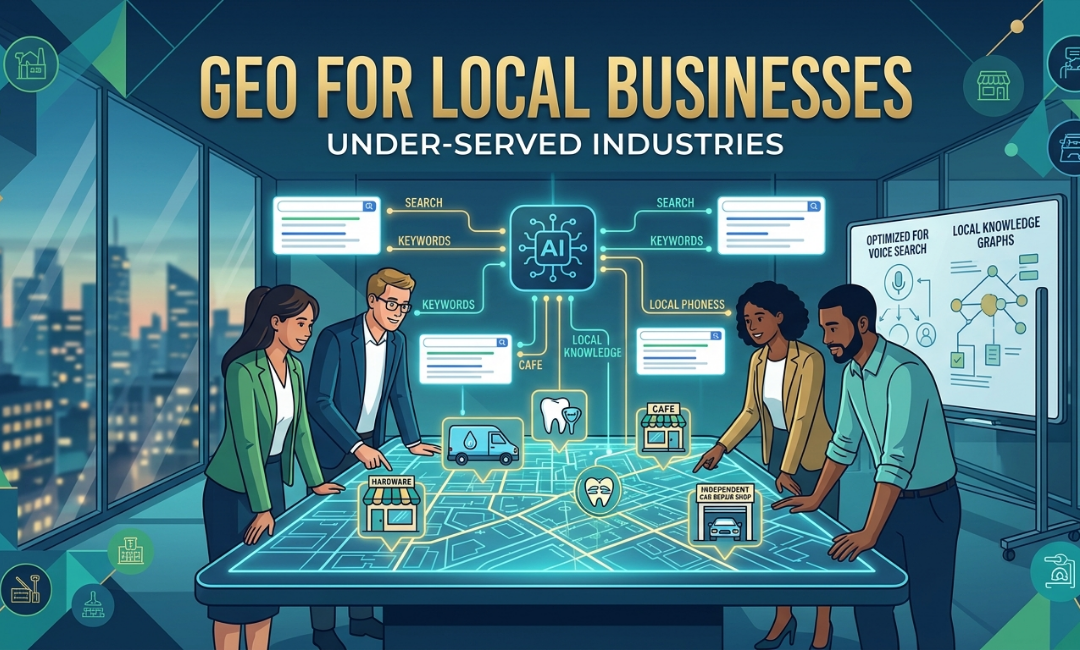
Most guides covering top GEO agencies dedicate every word to B2B SaaS, enterprise tech, and fintech. This section exists because those aren’t the only industries where generative engine optimization creates serious commercial value.
Local businesses and healthcare providers are, in many ways, more exposed to the impact of AI search than SaaS companies. When someone asks ChatGPT, “best pediatric dentist near me” or asks Perplexity, “which urgent care in [city] takes walk-ins on weekends,” they’re about to make an immediate purchasing decision. If your business isn’t cited in that answer, a competitor takes the appointment.
Why Local GEO Is Different from B2B GEO
The mechanics are different. B2B GEO is primarily about building category authority through thought leadership content, so AI models recommend your brand when buyers research solutions. Local GEO is about being the trusted, accurately represented entity in location-specific and service-specific queries that are one step away from a conversion.
The signals AI systems prioritize for local queries include:
- Google Business Profile accuracy and completeness. AI-powered search experiences pull structured business data when answering location queries. An incomplete GBP is one of the fastest ways to be invisible in local AI answers.
- NAP consistency across directories. Name, address, and phone number consistency across Yelp, Google, Apple Maps, Healthgrades, and other directories creates entity clarity that AI models use to recommend your business confidently.
- Review volume and sentiment. AI models factor third-party validation heavily when recommending local service providers. A dental practice with 300 five-star reviews citing specific procedures is far more likely to be recommended for those procedures than a competitor with thin or mixed reviews.
- Entity optimization for service-specific schema. LocalBusiness, MedicalClinic, Dentist, LegalService, and Physician schema types tell AI systems to understand exactly who you are, what you provide, and where you operate. Without these, AI tools default to less specific recommendations.
- Answer-first content for local queries. A page that directly answers “how much does a dental implant cost in Miami” in a structured, 40-60 word direct answer block has a significantly higher probability of being cited in AI-generated responses to that query.
The Industries Most GEO Guides Skip
These verticals have enormous GEO opportunities that almost no agency has built for properly:
| Industry | High-Intent AI Query Examples | Key GEO Signals |
|---|---|---|
| Dental practices | “Best cosmetic dentist near me,” “dental implant cost,” “emergency dentist open now” | GBP, review signals, procedure-specific content, Dentist schema |
| Medical clinics | “Urgent care near me accepting walk-ins,” “dermatologist for psoriasis treatment” | MedicalClinic schema, E-E-A-T signals, condition-specific FAQ content |
| Law firms | “Personal injury lawyer free consultation [city],” “immigration attorney near me” | Attorney schema, practice area FAQ blocks, local authority building |
| Chiropractors | “Chiropractor for lower back pain near me,” “sports injury specialist” | LocalBusiness schema, condition-led content, review aggregation |
| Home services | “Licensed plumber [city] emergency,” “best HVAC contractor near me” | Service area schema, review volume, local citation network |
| SaaS companies | “Best CRM for small business,” “affordable project management tool” | Entity optimization, comparison content, category authority building |
| E-commerce development | “Best Shopify development agency,” “custom ecommerce website builder” | Service-specific schema, case study depth, entity clarity |
For SaaS companies, GEO looks like building topical authority, so AI tools cite your platform when buyers ask evaluation questions. For a dental practice, GEO looks like being the entity that ChatGPT confidently recommends when someone in your city asks for your specific service. These are different problems requiring different strategies.
Most top GEO agencies on the market haven’t built for the local and medical use case. We have. Our local AI SEO and GEO strategy for medical practices are built natively for the query patterns, citation signals, and AI platform behaviors that drive appointments and leads in those specific verticals.
For more on how AI is changing local search specifically, check out our post on local SEO in the age of AI search.
Red Flags That Separate Real GEO Agencies from Rebranded SEO Shops
The GEO market in 2026 has a serious signal-to-noise problem. Here’s how to identify which agencies are actually built for generative search and which are traditional SEO agencies wearing new clothes.
- They can’t explain Retrieval-Augmented Generation. Ask any agency you’re vetting to explain how AI systems retrieve and cite sources. If they can’t explain RAG, query fan-out, or why Perplexity cites different pages than ChatGPT for the same query, their GEO knowledge is surface-level. Any legitimate generative engine optimization agency should be able to explain these mechanics fluently.
- Their reporting is identical to that of an SEO agency. Real GEO reporting tracks citation frequency across AI tools, AI share of voice, brand mention sentiment, and prompt-level visibility. If the only metrics in their reporting are keyword rankings, organic traffic, and backlinks, they haven’t built a GEO infrastructure. They’ve rebranded an SEO agency deliverable.
- They lead with on-site tactics as their entire strategy. Adding FAQ sections, restructuring H2s as questions, and implementing an llms.txt file are the bare minimum of GEO work. These tactics are valuable, but they’re table stakes, not a strategy. An agency that pitches these as their primary deliverables hasn’t developed a real approach to authority building, entity optimization, or off-site citation engineering, which is where the majority of GEO impact comes from.
- They ignore off-site signals entirely. AI models don’t just read your website. They draw from Reddit, YouTube, Wikipedia, G2, industry publications, and dozens of other surfaces. An agency that only optimizes what’s on your domain is missing most of the picture. If they don’t have a plan for where your brand gets mentioned across the broader web, their GEO strategy is incomplete.
- They don’t distinguish between platforms. ChatGPT, Gemini, and Perplexity use different retrieval mechanisms and favor different citation signals. A real GEO agency builds platform-specific strategies. If an agency treats all AI models as identical targets, they don’t understand how generative search engines actually work.
- They promise specific citation positions. There are no guaranteed “position one” citations in AI-generated answers. Responses change based on prompt phrasing, user location, conversation history, and model updates. Any agency guaranteeing a specific citation outcome is either lying or doesn’t understand what they’re selling.
- They use AI tools to create all their content. Mass AI-generated content is exactly what LLMs are trained on and have no incentive to cite. Agencies that rely on AI content creation as their primary production method are producing the precise type of undifferentiated content that generative search engines actively avoid citing. Original data, expert voice, and factual depth are what earn citations.
- They can’t show you AI visibility reports for current clients. Ask to see a sample report tracking brand mentions and citations across ChatGPT, Gemini, and Perplexity for an existing client. If they can’t produce one, they don’t have the monitoring infrastructure that real GEO requires.
For a deeper look at the broader context of how AI is changing search, our post on how AI Overviews will change SEO covers what’s actually at stake.
How to Choose the Right GEO Partner for Your Specific Goals

The right choice depends on three things: what industry you’re in, how big your business is, and what “winning in AI search” actually means for your revenue.
- If you’re a local or service-based business, including dental practices, medical clinics, law firms, contractors, or home service providers, almost none of the best agencies on this list were built for you. The query patterns your buyers use in AI tools are location-specific and transactional, not category education queries. You need an agency with dedicated local GEO and answer engine optimization expertise, covering GBP optimization, review signal management, local entity optimization, and conversational content for service-specific queries. Our GEO services and local AI SEO strategy were built specifically for this.
- If you’re a B2B SaaS company wanting AI models to recommend your platform during vendor evaluation research, agencies like First Page Sage, Omniscient Digital, and Directive Consulting have built their methodologies specifically for that buyer journey. Their content systems are designed to create content that earns category authority over time, which is how SaaS companies get cited when buyers ask AI tools for solution comparisons. Our SaaS SEO practice also serves this use case with a full-stack approach that includes both traditional SEO and GEO execution.
- If you have complex websites with technical barriers blocking AI crawlability, iPullRank or Go Fish Digital’s deep technical GEO expertise addresses architectural challenges that standard GEO agencies can’t solve. However, expect enterprise pricing to match that scope.
- If you need GEO integrated with paid search and full-funnel demand generation, Directive Consulting’s ability to connect generative search visibility to pipeline metrics through a unified growth system makes them a strong fit for SaaS companies that can’t separate their organic and paid strategy.
- If you’re building topical authority through content volume, Siege Media’s content marketing services and data journalism approach to GEO produce the kind of original, citable assets that AI systems prioritize when assembling answers in competitive content categories.
- If you want GEO, AI SEO, AEO, and full digital marketing under one roof without contracts, Doc Digital SEM serves every industry and business size with integrated GEO, LLM SEO, AEO, and traditional SEO execution. No long-term contracts, no cancellation fees, and no one-size-fits-all templates. Every strategy is built around how your specific buyers use AI tools to find a business like yours.
The question isn’t which generative engine optimization agency is objectively best. It’s which one is built for the specific way your target audience searches in AI, and which one can connect that visibility to real, qualified traffic and revenue for your business.
For more context on how GEO fits into the broader AI search landscape, check out our guides on what GEO SEO is, how to rank in ChatGPT, and AI search visibility.
Ready to Get Cited by ChatGPT? Doc Digital SEM Gets You There.
GEO isn’t a future investment you can defer. The brands appearing in ChatGPT, Gemini, and Perplexity right now are building citation authority that compounds every week. The agencies on this list represent the strongest options in 2026, but the right partner comes down to your industry, your goals, and who was actually built for you.
Key takeaways from this guide:
- GEO optimizes for AI citations and recommendations, not rankings. Traditional SEO and GEO are complementary, not competing
- Generative engines pull from 5 to 16 sources per answer, making multi-platform presence essential, not optional
- Most GEO agencies were built exclusively for B2B SaaS. Local businesses, medical practices, and service providers are almost entirely underserved
- Entity optimization, off-site authority signals, and content freshness are the three highest-impact GEO levers
- Red flags include agencies that can’t explain RAG, report only on traditional SEO metrics, or rely on AI-generated content as their primary production method
- GEO for local queries requires a fundamentally different strategy than category-level thought leadership content
- The right GEO partner depends on your specific industry, business size, and how your target audience actually uses AI tools to find a business like yours
Doc Digital SEM is one of the few agencies that delivers full-stack GEO, AEO, and LLM SEO across every industry, including local businesses, healthcare, SaaS, legal, and e-commerce, with no contracts, no fluff, and strategies built natively for how your specific buyers search in AI. Get your free GEO audit today.
Frequently Asked Questions
What is generative engine optimization (GEO), and how does it differ from SEO?
Generative engine optimization is the practice of structuring content and managing your digital presence, so AI platforms like ChatGPT, Gemini, and Perplexity cite your brand in their generated answers. Unlike traditional SEO, which optimizes for Google search rankings and clicks, GEO optimizes for citations and recommendations inside AI-generated responses.
Both disciplines are complementary: strong SEO creates the technical foundation that GEO builds on, while GEO extends your visibility into the AI answer layer, where buying decisions increasingly begin.
How do top GEO agencies measure success differently from traditional SEO agencies?
Traditional SEO agencies measure success through keyword rankings, organic traffic, and backlinks. Real GEO agencies track citation frequency across AI models, brand mention sentiment, AI share of voice, and prompt-level visibility across ChatGPT, Gemini, and Perplexity.
Advanced agencies also use synthetic query generation to simulate how real buyers phrase questions in AI tools, then track whether their client appears in the generated answers. Internal linking, entity optimization, and structured data are measured not just for Google search performance but for how well they help AI systems understand and cite your content.
How long does GEO take to produce results?
Most businesses see initial improvements in AI citation visibility within 60 to 90 days, with meaningful GEO results typically building over three to six months. Timeline depends on your starting point: brands with strong existing SEO foundations and good answer engine optimization practices in place tend to see faster citation gains. GEO results also depend on content freshness, as 50% of AI-cited content is less than 13 weeks old, making regular updates to your highest-value pages a critical ongoing practice.
Which GEO agency is best for local businesses and medical practices?
Most top GEO agencies are built exclusively for B2B SaaS and tech companies, leaving local businesses and healthcare practices significantly underserved. For dental practices, medical clinics, law firms, and local service providers, the best option is an agency that has built specific GEO frameworks for location-specific and service-specific AI queries, not adapted a SaaS content template.
Doc Digital SEM is one of the few agencies with a dedicated GEO strategy, answer engine optimization, and LLM SEO built natively for local businesses, medical marketing, and service verticals, covering every major AI platform without long-term contracts.


