


Everyone obsesses over Google. Meanwhile, 87% of ChatGPT’s citations match Bing’s top organic results, and Google only sees a 56% match. If your pages aren’t properly indexed in Bing, ChatGPT can’t find them. Period. That’s a blind spot most businesses don’t even know they have.
This guide explains exactly why Bing has quietly become the most important index for AI search, and what you need to do about it.
Here’s what we’ll cover:
- Why ChatGPT relies on Bing’s index for live search results
- How Bing and Google index content differently
- How to audit and fix your Bing indexing gaps
- Bing Webmaster Tools setup and best practices
- How to optimize for both Bing rankings and AI citations
- What this means for your broader AI SEO strategy
We help businesses navigate this exact shift at Doc Digital SEM. Our team optimizes for both traditional search engines and AI platforms like ChatGPT, Perplexity, and Gemini, so your brand stays visible no matter where people search.
Why ChatGPT Relies on Bing’s Index
The connection between ChatGPT and Microsoft Bing isn’t a rumor. It’s the foundation of how AI search works right now.
The Bing-ChatGPT Pipeline
When a user asks ChatGPT a question that requires current information, the system doesn’t crawl the web from scratch. It uses Bing’s index as its backbone for live search results. That means every time ChatGPT performs a web search to answer a query, it’s pulling from the same pool of web pages that Bing has already crawled and indexed.
This isn’t a minor technical detail. It’s the entire architecture. Over 87% of ChatGPT’s citations match Bing’s top organic results, with most appearing in the top 10 positions. Compare that to Google, where only 56% of results matched, with a median rank of 17.
The implication is simple. If your pages aren’t in Bing’s index, ChatGPT cannot cite them.
It’s Not Just ChatGPT
Microsoft Bing powers more than just one AI tool. Its index feeds into:
- ChatGPT Search for real-time answers with citations
- Microsoft Copilot which is embedded across Windows, Edge, and Office apps
- ChatGPT’s Shopping Assistant which uses Bing to crawl product listings and summarize them in natural language
Over 60% of Fortune 500 companies are already piloting or deploying Copilot in daily workflows. That’s a massive surface area of AI search that runs exclusively through Bing. And Gartner predicts that 25% of people will shift from traditional search to AI assistants by 2026.
So while everyone is still laser-focused on Google SEO, Bing is quietly becoming the gateway to the fastest-growing search channels on the planet.
Pro Tip: Don’t think of Bing SEO as a separate strategy. Think of it as your AI search strategy. Ranking well on Bing now directly impacts whether ChatGPT, Copilot, and other AI tools recommend your brand.
How Bing and Google Index Differently
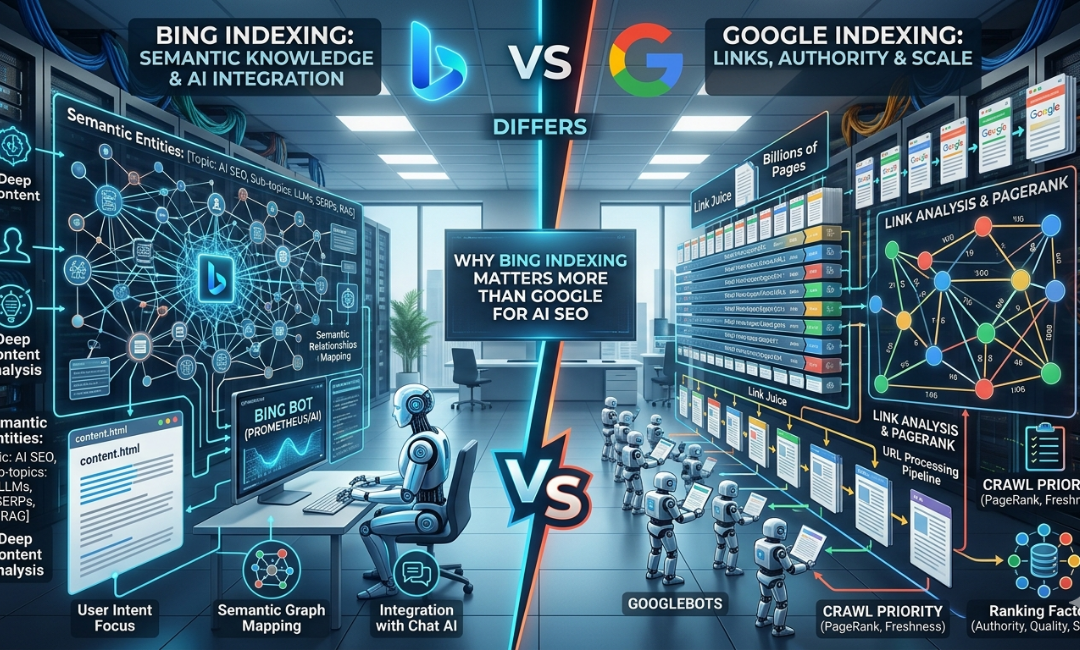
Understanding the key differences between these two search engines is critical if you want to show up in both traditional search results and AI-generated answers.
Crawling and Rendering
The first major difference hits at the crawling level. Google has fully embraced mobile-first indexing, meaning it predominantly uses the mobile version of a site for indexing and ranking. If your mobile version is weak, your Google rankings suffer.
Bing takes a completely different approach. It maintains a single index optimized for both mobile and desktop with no plans for a mobile-first policy. This device-agnostic approach means Bing evaluates your desktop content just as heavily as your mobile version, which can actually benefit businesses with desktop-heavy audiences.
Google’s crawlers also render JavaScript using a full browser engine, meaning they see your pages the way a human would. Bing’s crawlers? Not so much. They’re more dependent on what’s present in the raw HTML, making server-rendered content even more important for Bing SEO.
Ranking Factors Comparison
Here’s where things really diverge. While both search engines value relevant content and backlinks, their ranking algorithms prioritize very different signals:
| Ranking Factor | Bing | |
|---|---|---|
| Indexing approach | Mobile-first | Device-agnostic (single index) |
| Core Web Vitals | Direct ranking factor | Not a formal ranking factor |
| Keyword usage | Semantic understanding via NLP | Prefers exact match keywords in titles, H1s, and meta descriptions |
| Meta descriptions | Used for CTR, not ranking | Direct ranking factor |
| Social media metrics | Not a confirmed ranking signal | Confirmed ranking signal (shares, likes, engagement) |
| Backlinks | Heavy emphasis on quality and relevance | Values domain age, .gov/.edu domains, exact-match anchor text |
| Domain authority | Built through quality links and content | Leans on domain age and established link profiles |
| Local search | Google Maps and Google Business Profile | Bing Places and Bing Maps |
What This Means in Practice
Bing places more emphasis on exact keyword usage and high-quality backlinks, making it easier to predict ranking behavior. That’s actually good news. Where Google’s search algorithm has become increasingly complex with AI and machine learning models like RankBrain and BERT interpreting user intent, Bing’s algorithm is more straightforward.
For Bing SEO, your meta descriptions matter as a direct ranking factor. Your target keywords should appear in your title tags and headings. And your activity on social media platforms like LinkedIn and Facebook can directly influence your search rankings, something that doesn’t apply to Google anymore.
Auditing and Fixing Bing Indexing Gaps
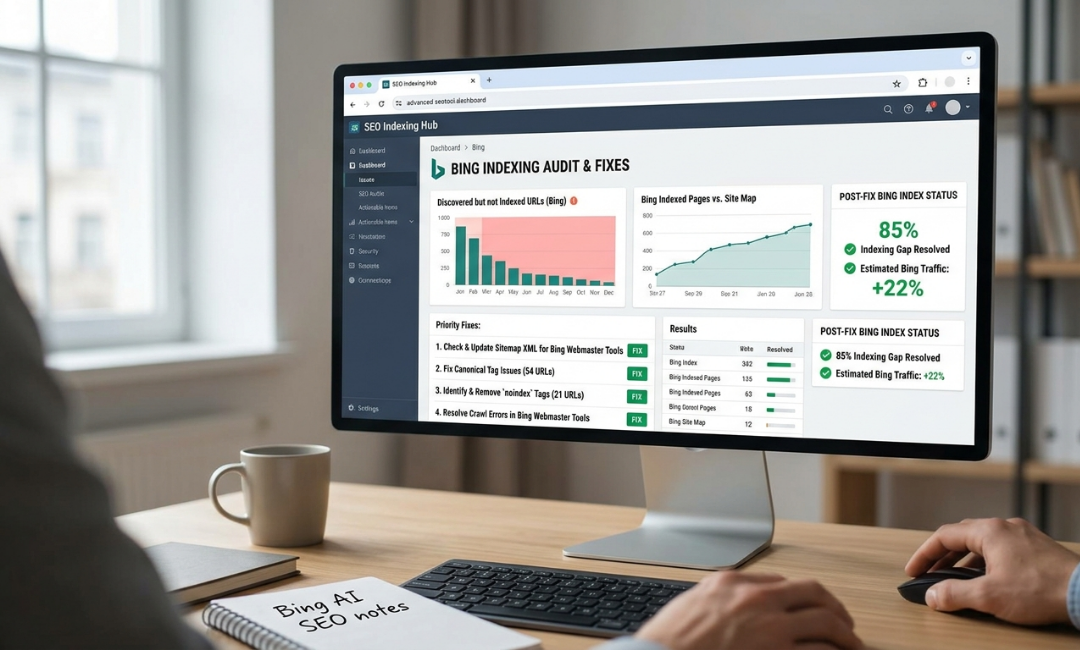
Most businesses have never audited their Bing index status. That’s a problem, because the pages driving your Google search traffic might not even exist in Bing’s index.
Step 1: Compare Your Indexed Pages
Start by checking what Bing actually has. Open Bing Webmaster Tools and look at your indexed page count. Then compare it against what Google Search Console reports. If there’s a significant gap, you’ve found your first opportunity.
A quick manual check works too. Type site: yourdomain.com into Bing’s search bar and see what comes up. Do the same on Google. If Google shows 500 pages and Bing shows 200, that’s 300 pages of web content that ChatGPT can’t access.
Step 2: Identify the Common Culprits
Most Bing indexing gaps come from a handful of issues:
- robots.txt blocking Bing’s crawlers without you realizing it
- Missing or outdated XML sitemaps that haven’t been submitted to Bing
- Thin or low-authority pages that Bing proactively removes from its index (unlike Google, which tends to keep more)
- Redirect chains or broken internal links that waste Bing’s crawl budget
- JavaScript-rendered content that Bing can’t see in the initial HTML
Step 3: Fix and Resubmit
Once you’ve identified the gaps:
- Submit your XML sitemap directly through Bing Webmaster Tools
- Use IndexNow to instantly notify Bing when content is updated, added, or deleted (Bing supports this natively, and it dramatically speeds up indexing)
- Fix any redirect chains and make sure all important pages have clean, crawlable URLs
- Review your robots.txt to confirm Bing’s crawler (Bingbot) isn’t accidentally blocked
- Ensure critical content is present in the raw HTML, not hidden behind client-side JavaScript
IndexNow is Bing’s secret weapon. Unlike Google, which requires you to wait for crawlers to find changes, IndexNow lets you push updates to Bing in real time. If you’re publishing frequently, this is a game-changer for keeping your content fresh in both Bing’s index and ChatGPT’s search data.
Bing Webmaster Tools: Setup and Best Practices
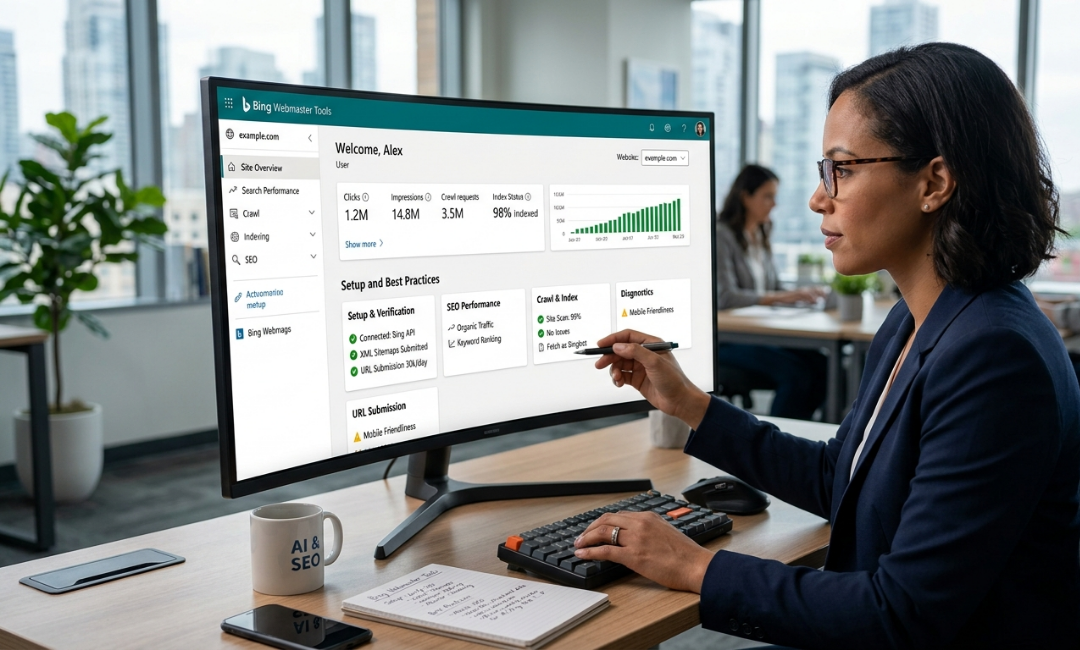
If Google Search Console is your command center for Google, then Bing Webmaster Tools is your mission control for AI search visibility. And surprisingly, many businesses have never even set it up.
Getting Started
Setting up Bing Webmaster Tools takes about five minutes:
- Go to bing.com/webmasters and sign in with a Microsoft account
- Add your site and verify ownership (you can import directly from Google Search Console to skip manual verification)
- Submit your XML sitemap
- Review your dashboard for any crawl errors or indexing issues
That last step is where most people stop. Don’t.
Features Worth Using
Bing Webmaster Tools has several features that are genuinely useful for both Bing SEO and AI visibility:
- URL Inspection Tool lets you check whether specific web pages are indexed and diagnose why they might not be
- Site Explorer shows your backlink profile from Bing’s perspective, including which domains link to you and the anchor text they use
- IndexNow Integration for pushing content updates to Bing instantly instead of waiting for Bingbot to recrawl
- SEO Reports that flag issues like missing meta descriptions, duplicate content, and broken links
- Crawl Control that lets you adjust how aggressively Bingbot crawls your site during different times of day
- Keyword Research Tool that shows actual search data from Bing users, giving you insight into a demographic that skews toward professionals and higher-income users
Best Practices for Ongoing Management
Don’t just set it and forget it. Here’s how to get the most out of the platform:
- Check your index coverage monthly. Look for sudden drops that might indicate crawl issues or accidental blocks.
- Monitor crawl errors. Bing is less forgiving than Google with redirect chains and broken URLs. Fix them quickly.
- Resubmit sitemaps after major content updates. Especially if you’ve added new landing pages, product pages, or blog posts that need to be discoverable fast.
- Use the URL submission tool for high-priority pages you want indexed immediately.
- Review your Bing-specific keyword data. The queries people use on Bing often differ from those on Google. Bing users tend to use more direct, exact keywords rather than conversational phrasing, so adjust your keyword usage accordingly.
Optimizing for Bing Rankings and AI Citations
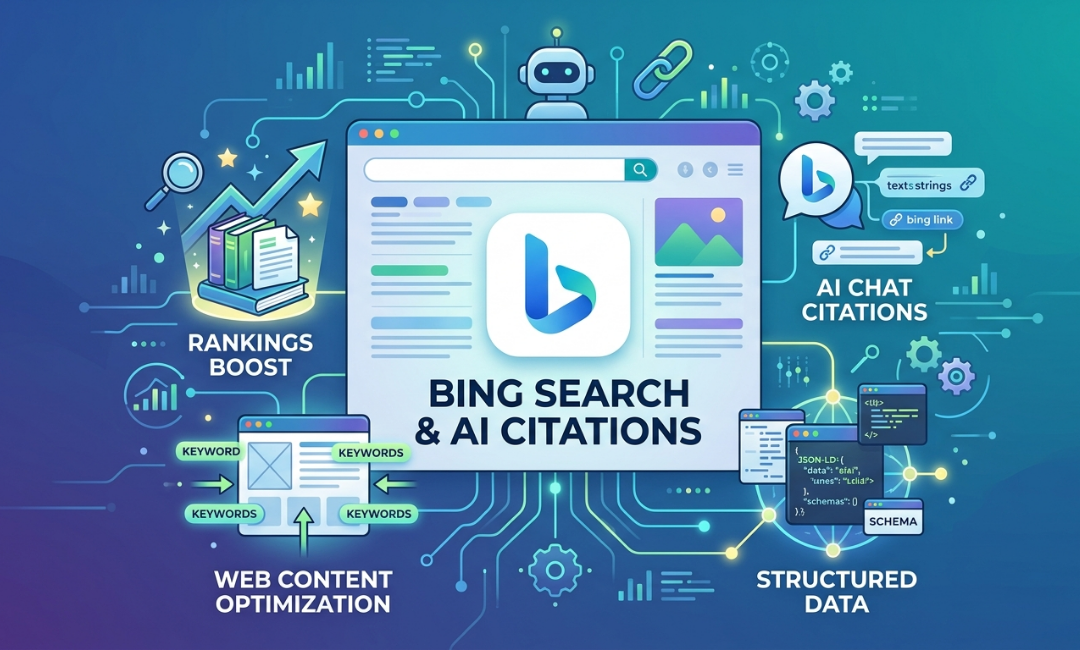
Now that your site is properly indexed and your webmaster tools are set up, it’s time to optimize for both Bing’s search engine results pages and AI-generated answers.
Write for Bing’s Algorithm First
Where Google has moved heavily toward understanding natural language and user intent through AI models, Bing’s search algorithm still rewards more traditional signals. That means your on-page optimization needs a slightly different touch:
- Include exact match keywords in your title tags, H1 headings, and meta descriptions. Bing treats these as direct ranking factors, unlike Google, which often rewrites them.
- Write keyword-rich meta descriptions. On Google, meta descriptions are mainly for click-through rates. On Bing, they actively influence where you rank in search results.
- Use exact keyword matches in anchor text for internal links. Bing values this more explicitly than Google does.
- Leverage social media platforms. Bing openly uses social signals as a ranking factor. Content that earns engagement on LinkedIn, Facebook, and X can directly boost your Bing rankings.
Optimize for AI Citations Simultaneously
The beauty of Bing SEO is that what helps you rank on Bing also helps you get cited by ChatGPT. But there are a few additional layers to consider for generative engine optimization:
- Structure content in clear, self-contained sections. ChatGPT’s retrieval system pulls content chunks from Bing’s index. If each section of your page answers a specific question cleanly, it’s more likely to be selected.
- Include original data and statistics. LLMs favor content with unique, verifiable claims. If your page has proprietary research or specific numbers, AI tools are more likely to reference it over generic competitors.
- Add structured data (schema markup). Both Bing and AI search engines use structured data to understand entities, products, and relationships on your web pages. This improves your chances of appearing in both traditional search results and AI-powered answers.
- Claim and optimize your Bing Places listing. For local search, Bing Places is the equivalent of Google Maps. Since ChatGPT uses Bing for local queries too, an optimized Bing Places profile means better visibility in both Bing’s local search and AI-driven local recommendations.
Build Domain Authority the Bing Way
Bing values domain age and established link profiles more heavily than Google. The better its authority signals, the more likely your content is to rank on Bing’s search results page and surface in ChatGPT’s citations.
Focus on:
- Earning backlinks from high-authority domains (especially .gov, .edu, and industry-leading directory sites)
- Maintaining a consistent publishing cadence so Bing sees your site as active and relevant
- Building brand mentions across third-party review platforms, forums, and social media
- Keeping older, high-performing content updated rather than letting it decay
What This Means for Your AI SEO Strategy
If you’ve been treating Bing as an afterthought, it’s time to rethink that. The global search market is shifting, and Microsoft Bing is positioned at the center of AI-driven discovery in ways that most businesses haven’t fully grasped.
The Bigger Picture
Here’s the reality of search engine usage in 2026. Google still dominates the global search market with roughly 90% market share. But when you look at how AI search engines source their information, the picture flips.
ChatGPT uses Bing. Copilot uses Bing. Even many other search engines and AI tools that aren’t directly powered by Bing still rely on similar indexing infrastructure. Google’s AI Overviews and Google Gemini pull from Google’s index, yes. But the majority of standalone AI tools are feeding from Bing’s pipeline.
That means a complete SEO strategy in 2026 needs to cover three layers:
- Google SEO for traditional search rankings, Google’s AI Overviews, and Google AI Mode
- Bing SEO for Bing rankings, ChatGPT citations, Copilot recommendations, and AI-driven commerce
- Generative engine optimization (GEO) for structuring content so that any LLM can crawl, chunk, and cite it effectively
Stop Treating Them as Separate
The smartest approach isn’t to run two separate strategies for Google and Bing. It’s to build one unified content strategy that satisfies both leading search engines while being optimized for AI retrieval.
That means:
- Server-rendered, semantically structured content that both Google’s crawlers and Bing’s crawlers can read
- Meta descriptions that are optimized for both click-through and Bing’s ranking algorithms
- A strong presence on social media platforms (which helps Bing rankings) and review sites (which helps AI citations)
- Regular content updates that signal freshness to both traditional search results and AI retrieval systems
- Active management of both Google Search Console and Bing Webmaster Tools
Where Doc Digital SEM Comes In
This is the dual-engine approach we build for every client. Our team doesn’t just optimize for one search engine or one AI platform. We create strategies that ensure your brand is indexed, ranked, and cited across the entire online search ecosystem, from Google to Bing to ChatGPT to Perplexity and beyond.
No long-term contracts. No hidden fees. Just a team that understands where AI search is going and knows how to get your business there first.
Get Found by AI Search With Doc Digital SEM
The search landscape isn’t what it was two years ago. If your SEO strategy only accounts for Google, you’re invisible to the AI tools that millions of people now use to make buying decisions every single day.
Key takeaways from this guide:
- ChatGPT pulls over 87% of its citations from Bing’s top organic results, making Bing indexing essential for AI visibility
- Bing treats meta descriptions and exact match keywords as direct ranking factors, unlike Google
- Bing uses a device-agnostic index instead of mobile-first indexing, giving desktop-optimized content more weight
- Social media engagement on platforms like LinkedIn and Facebook directly influences Bing rankings
- IndexNow lets you push content updates to Bing in real time, dramatically speeding up indexing
- If a page isn’t in Bing’s index, ChatGPT, Copilot, and other AI tools simply cannot find it
Doc Digital SEM builds search strategies that cover both sides of the equation. We optimize your content for Google and Bing so your brand ranks in traditional search results and gets cited in AI-generated answers. No guesswork, no long-term contracts, just a team that knows where search is heading and how to get you there.
Ready to close the gaps in your AI search visibility? Get a free digital marketing analysis and find out exactly where Bing indexing issues are costing your business leads.
FAQs
How does Bing indexing affect my SEO?
Bing indexing is now a core part of search engine optimisation for AI visibility. If your pages aren’t in Bing’s index, they won’t surface in ChatGPT, Copilot, or Bing Chat responses. Unlike Google, Bing still rewards exact match domains and places a heavier weight on meta descriptions as a ranking signal.
For local SEO, claiming your Bing Places listing is just as important as Google Business Profile, especially since ChatGPT uses Bing for location-based queries. Start with Bing Webmaster Tools, submit your sitemap, and compare your indexed pages against Google Search Console to catch gaps early.
Does ChatGPT use its own search index or Bing’s?
ChatGPT doesn’t maintain its own web index. When a user’s question requires current information, it queries Bing’s index through OAI-SearchBot and returns results with citations. This is why Bing indexing directly determines whether your content can appear in ChatGPT’s answers.
Before Bing Chat launched, most businesses ignored Bing entirely. Now, with ChatGPT processing billions of queries, that’s no longer an option. If your content ranks on relevant sites through Bing, ChatGPT can find it. If it doesn’t, you’re invisible to the most popular search engine in the AI space.
How is Microsoft shaping AI search in 2026?
Microsoft has positioned Bing as the backbone of the AI search engine market. Its index powers ChatGPT Search, Copilot across Windows and Office, and Bing Chat’s conversational results. The company has come a long way from the days of MSN Search.
Today, Bing delivers a visually immersive search experience with strong image search capabilities and AI-generated summaries. For mobile search, Copilot is integrated into Edge on mobile devices, expanding Bing’s reach beyond desktop. Microsoft’s strategy is clear: own the infrastructure layer that AI tools depend on, and let user engagement drive adoption organically.
Should I optimize for Bing differently from Google?
Yes, but not dramatically. The fundamentals overlap, though the emphasis shifts. Bing values exact keywords in titles and headings more than Google, which leans on natural language understanding. Bing also treats social media signals as a direct ranking factor, so strong user engagement on LinkedIn and Facebook can boost your Bing rankings.
Google released Core Web Vitals as a ranking factor; Bing hasn’t followed suit, though fast-loading pages still perform better. For local SEO, optimize both Google Maps and Bing Maps. And don’t overlook Bing’s official search documentation for guidance on how its algorithm evaluates content. The smartest move is one unified strategy that satisfies both engines while keeping AI retrieval in mind.


