


Someone just asked ChatGPT which company to hire for your exact service. Your competitor’s name came up. Yours didn’t. No ad spend, no SEO campaign, no content piece you published changed that outcome. ChatGPT simply doesn’t know you well enough to recommend you.
Brands in the top 25% for web mentions get 10 times more AI visibility than others, and 90% of AI citations driving brand visibility originate from earned and owned media, not paid placements. That’s the playbook in one sentence. But knowing the principle and executing it systematically are two very different things.
This article gives you the step-by-step process to close the gap.
Here’s what we’ll cover:
- How to audit your current brand visibility across ChatGPT, Perplexity, and Gemini
- The content strategy that makes AI systems want to mention your brand
- How to build the third-party presence that drives AI recommendations
- Platform-specific tactics for ChatGPT, Perplexity, and Gemini
- How to manage and correct what AI says about your brand (not just whether it appears)
- How to measure progress and track brand mentions across AI platforms over time
This is exactly the kind of strategy the team at Doc Digital SEM builds for clients, and it sits at the core of their AI search visibility and LLM SEO services. If you want your brand to show up where your customers are already asking questions, you’re in the right place.
Audit Your AI Brand Visibility First
Before you optimize anything, you need to know exactly where your brand stands right now across the AI platforms your customers are already using. Most businesses skip this step. They start publishing content or chasing backlinks without understanding which AI systems mention them, how they’re described, or which competitors are owning the conversations that matter.
The audit is your baseline. Without it, you’re improving blind.
Build Your Prompt Set
The most important thing to understand about this audit: branded queries are not the test. Asking ChatGPT “tell me about [your brand]” is informational but not diagnostic. The real test is whether your brand appears when users search non-branded, category-level questions, the same questions your potential customers are actually asking.
Build 20-30 prompts across these four categories:
Discovery prompts: Broad category questions people ask early in research.
- “What are the best [your service category] companies?”
- “Who are the top [your industry] agencies in [your location]?”
Comparison prompts: Queries where users are evaluating options side by side.
- “[Your service] vs [competitor service]: which is better?”
- “Best [your category] for [specific use case]”
Problem-solving prompts: Questions your target audience asks when they have a specific problem you solve.
- “How do I [problem your business solves]?”
- “What’s the fastest way to [outcome you deliver]?”
Evaluation prompts: Decision-stage queries where users are close to choosing a vendor.
- “Is [your brand] worth it?”
- “What do people say about [your brand]?”
Run the Audit Across All Three Platforms
Don’t test on just one platform. Being visible on one platform doesn’t mean you’re visible on all three. ChatGPT, Gemini, and Perplexity all have different data sources. Always measure across all major engines.
For each prompt, record:
- Does your brand appear?
- Where does it appear (first mention, supporting mention, not mentioned)?
- How is it described? Positive, neutral, or negative framing?
- Which competitors are mentioned instead of you?
- Which third-party sources does the platform cite?
The last point is especially important. The sources AI platforms cite when answering category questions in your space are the exact sources you need to get mentioned in.
What Good Results Look Like vs. What to Fix
| Status | What It Means | Priority Action |
|---|---|---|
| Not mentioned at all | AI has insufficient data about your brand | Build entity foundation + third-party mentions |
| Mentioned but not cited | AI knows you exist, but doesn’t trust your content | Restructure content for AI extraction |
| Cited but described inaccurately | Conflicting data across sources | Fix entity consistency + create authoritative fact page |
| Mentioned with negative sentiment | Review and mention problems feeding AI | Reputation repair across third-party sources |
| Mentioned positively and cited | Strong AI visibility | Maintain and expand to new prompt categories |
Run this audit manually first. Then set up automated tracking to monitor changes weekly. Tools like Otterly.ai, Peec AI, and Topify can automate this process and surface competitive benchmarks automatically.
Content Strategy That Gets Your Brand Mentioned

Getting your brand mentioned in ChatGPT and AI search is primarily a content problem before it’s anything else. AI systems pull from what exists on the web. If your content doesn’t clearly, consistently, and directly answer the questions your customers ask, AI systems can’t surface you, even if they know you exist.
Unlike traditional SEO, where keyword density and backlink count drove rankings, AI search rewards content that is extractable, factual, and comprehensive. Here’s how to build it.
The Answer-First Format
44.2% of all LLM citations come from the first 30% of content. LLMs are trained on journalism that leads with the bottom line. Put critical information early, not after long introductions.
Every blog post and service page needs to open with a direct, self-contained answer. Not context. Not background. The answer. Then follow with depth, evidence, and supporting data.
For example, if you’re targeting the query “what is LLM SEO”, your page shouldn’t spend three paragraphs explaining why AI is important before defining the term. It should define it in the first sentence, then elaborate.
This matters because when someone asks an AI system a conversational query about your topic, the AI retrieves your answer paragraph first. If that paragraph is buried, it gets skipped.
Content Types That Drive AI Mentions
The highest-performing content types for getting your brand mentioned in ChatGPT and AI search results:
- “Best of” listicles and comparison guides: Listicles are the most common citation type in AI Mode, ChatGPT, and Perplexity at 21.9% of citations. Create content like “Best [your service] for [specific use case]” that naturally positions your brand alongside relevant alternatives. Include your own brand with honest, specific information.
- Original research and data: Data that exists nowhere else is among the most-cited content across all AI platforms. If you publish a survey, an internal analysis, or a proprietary dataset, AI systems have no choice but to cite you as the source. This is one of the fastest paths to building topical authority.
- Comprehensive guides on your core topics: Comprehensive guides that cover a topic from definition through advanced application build the kind of topical depth AI systems associate with authority. Publish a pillar page on your primary topic area, then build cluster content around it. Our LLM SEO guide and semantic SEO for LLMs are built on exactly this model.
- Case studies and specific outcome content: Case studies drive the highest AI referral traffic of any content type. Specific, verifiable outcomes (we grew traffic 1,200% in 6 months, we reduced response time by 40%) are exactly the kind of factual anchors AI systems look for when they generate answers.
- FAQ sections targeting conversational queries: Structure FAQ sections as real questions your audience asks, followed by 40-60 word direct answers. Each Q&A pair is a pre-packaged citation block that AI systems can extract and use verbatim.
Build Topical Authority, Not Isolated Pages
AI systems favor brands that cover their topic area comprehensively, not brands that have one strong page. Building topical authority by creating interlinked content clusters helps search engines and AI systems recognize your expertise on a particular topic.
For every primary service or topic area, build:
- One comprehensive pillar page covering the broad concept
- 5-10 cluster pages going deep on specific subtopics
- Strong internal links connecting them with descriptive anchor text
This content architecture tells AI systems: this brand doesn’t just mention this topic once. It owns it.
Implement schema markup across every piece of this content. Use Article schema with author credentials, FAQPage schema on FAQ sections, and Organization schema sitewide. Schema markup makes your content machine-readable in a way that directly increases citation probability.
Our guide to structured data for LLM optimization covers the specific implementation for AI visibility.
Building Third-Party Presence for AI Recommendations
Your own website content is almost never the primary reason AI systems mention your brand. LLMs cite Reddit and editorial sites for over 60% of brand information, not corporate websites.
Getting your brand mentioned in ChatGPT and AI search is primarily an off-site problem. You need to be where AI systems look for information, which is rarely your own domain.
The Consensus Signal
AI platforms scan for agreement across multiple independent sources before confidently citing a brand. If your brand appears consistently across Reddit discussions, YouTube tutorials, industry publications, review sites, and your own website, all with similar positioning and messaging, AI systems gain confidence in recommending you.
That consensus is what triggers confident mentions. A brand that appears on five authoritative sources saying the same thing will beat a brand with a better website but no external presence every time.
Review Platforms: Your Fastest Win
Review platforms like G2, Clutch, Trustpilot, and industry-specific directories are among the most cited sources across all major AI platforms. G2 is the most cited software review platform on ChatGPT, Perplexity, and Google AI Overviews.
For local businesses, Google Business Profile is non-negotiable. AI systems use Google’s structured local data heavily when answering location-based queries. Keep yours fully completed with current hours, services, photos, and regular posts.
Action steps for review platforms:
- Claim and fully build out your profiles on G2, Clutch, Trustpilot, and at least two industry-specific directories
- Use your exact brand name consistently across all profiles (no variations)
- Encourage detailed reviews that mention specific services, outcomes, and use cases
- Respond to every review to demonstrate an active business presence
Industry Publications and Digital PR
Editorial brand mentions across credible publications tell AI models that your brand is a recognized entity in its category. It’s one of the most underinvested areas in most SEO programs today.
The goal is to get your brand mentioned in context in authoritative sources. Not just linked to. Mentioned with relevant category associations.
Practical paths to editorial coverage:
- Guest articles in industry blogs and publications where your audience reads
- Expert commentary pitched to journalists covering your space
- Podcast appearances where you’re named and described as an authority
- Industry roundups and “best of” lists that name your brand alongside category leaders
- Speaking engagements that generate press coverage and event site mentions
For every piece of coverage you earn, make sure your brand is described consistently. Same name. Same core positioning. Same category language. Inconsistency confuses AI systems and reduces how confidently they can recommend to you.
Reddit and Community Presence
Perplexity cited Reddit for 24% of all citations in January 2026, and ChatGPT’s Reddit citation share has grown significantly. Community platforms capture 52.5% of citations across all AI platforms.
This is the off-site signal most brands completely ignore. Authentic participation in relevant Reddit communities, Quora threads, and industry forums builds brand presence in exactly the uncontrolled environments AI systems treat as most trustworthy.
The key is authentic. Answering real questions helpfully, contributing genuine expertise, and mentioning your brand only when naturally relevant. Promotional posts get removed. Genuine expertise gets cited.
Platform-Specific Tactics That Work
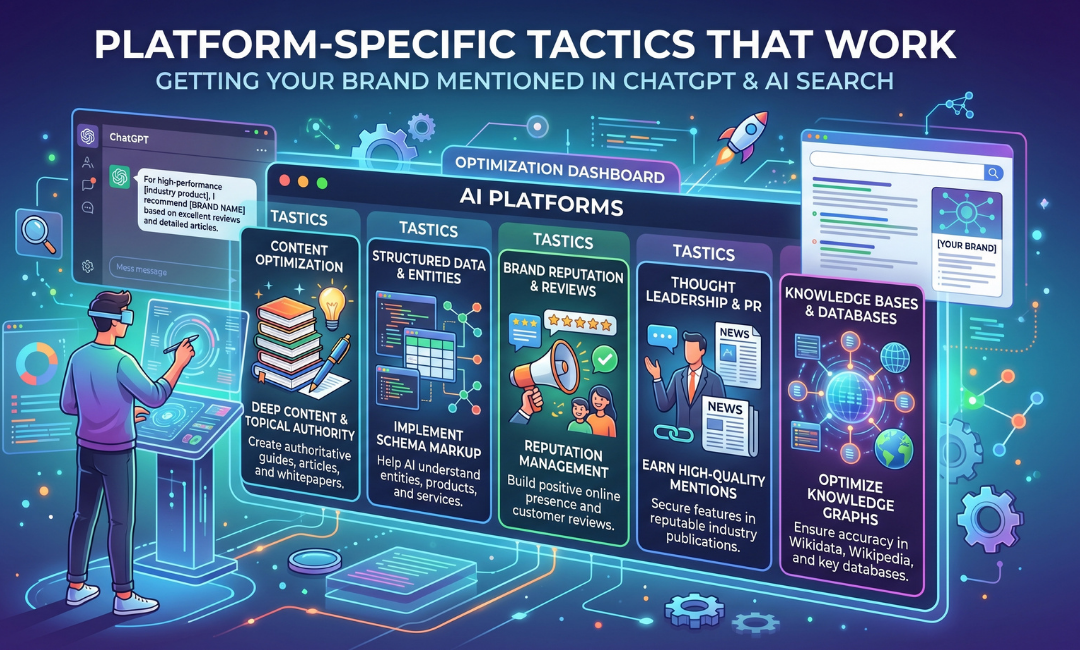
A single “get mentioned in AI” strategy doesn’t work because ChatGPT, Perplexity, and Gemini operate on fundamentally different logic. Each platform has a distinct data source, citation preference, and retrieval mechanism. Here’s the specific playbook for each.
ChatGPT: Win on Bing and Third-Party Authority
ChatGPT decides what to cite primarily based on what Bing indexes and ranks, combined with training data from authoritative sources. 71.7% of ChatGPT citations come from pages with organic search presence, and brand mentions and branded search volume correlate more strongly with ChatGPT visibility than backlink counts or Domain Rating.
ChatGPT-specific tactics:
- Submit to Bing Webmaster Tools immediately. Most businesses only track Google Search Console, ignoring Bing entirely. Since ChatGPT pulls from Bing’s index, your Bing indexing status is a direct ChatGPT visibility signal. Submit your sitemap and verify your site at Bing Webmaster Tools. Our guide on Bing indexing for AI search covers the full setup.
- Get mentioned in Wikipedia’s category articles. Wikipedia accounts for 47.9% of ChatGPT’s top citation sources. You can’t create a Wikipedia page for your brand without meeting notability standards, but appearing in existing Wikipedia category articles through legitimate editorial coverage is achievable for established businesses.
- Earn editorial mentions in major publications. News sites like Forbes, Business Insider, and industry trade publications are among ChatGPT’s most cited sources. Digital PR campaigns that generate editorial coverage in these outlets directly improve ChatGPT’s visibility.
- Ensure GPTBot and OAI-SearchBot can crawl your site. Check your robots.txt file for any rules that might block OpenAI’s crawlers. Many sites inadvertently block these bots, making it impossible to get your brand mentioned in ChatGPT search results.
Perplexity: Win on Reddit and Freshness
Perplexity operates as a real-time research tool that places enormous weight on community validation and content freshness. It cites more sources per response than any other platform, and its citation behavior is uniquely tied to community signals.
Perplexity-specific tactics:
- Build an authentic Reddit presence in your niche. Reddit’s citation share on Perplexity grew 73% from October 2025 to January 2026, with Reddit accounting for 24% of Perplexity’s citations in that period. Find the subreddits where your target audience asks questions. Contribute genuinely. Build a reputation over weeks, not in a single post.
- Update your content monthly, minimum. Content older than 60-90 days loses ground on Perplexity rapidly. Add a visible “last updated” date to key pages and actually update them with fresh data regularly.
- Include data with clear attribution. Perplexity’s users are typically research-oriented. Content containing statistics with named sources performs significantly better than opinion-only content.
- Allow PerplexityBot in your robots.txt. Verify your site explicitly allows PerplexityBot to crawl. Blocking it removes all Perplexity citation potential instantly.
Gemini: Win on Google Quality Signals
Gemini is built on Google’s infrastructure, which means it inherits Google’s ranking signals more directly than any other AI platform. Gemini’s optimization lever is ranking well on Google, and 93.67% of Gemini citations link to domains already ranking in Google’s top search results.
Gemini-specific tactics:
- Treat traditional SEO as your Gemini strategy. Organic rankings, E-E-A-T signals, and a well-structured Google Business Profile all feed directly into Gemini’s citation selection. This is the one AI platform where your existing SEO efforts pay off most directly.
- Build your Google Knowledge Panel. A Knowledge Panel is Google’s public confirmation that your brand is a verified entity. It directly influences how Gemini understands and describes your brand.
- Our entity SEO guide covers how to earn and build your panel.
- Implement the Organization schema comprehensively. Gemini uses Google’s Knowledge Graph heavily. Schema markup that clearly defines your brand’s entity, services, contact details, and related entities makes your brand more citable in Google AI answers.
- Keep your Google AI Overviews presence strong. Google AI Overviews prefer websites with strong brand signals like brand mentions and branded searches more than ChatGPT and Perplexity do. This means branded search volume, brand mentions in editorial content, and a strong Google presence all compound together for Gemini visibility.
Managing What AI Says About Your Brand
Getting your brand mentioned in AI search is one problem. Managing what AI says when it mentions you is an entirely separate challenge that most brands completely ignore.
72% of brands have at least one factual error in AI-generated responses. These are not subtle interpretive differences. They are demonstrably wrong facts: incorrect founding dates, wrong pricing, discontinued products listed as current, features attributed to the wrong product tier, and fabricated company details that never existed.
Being mentioned inaccurately can be worse than not being mentioned at all. If ChatGPT tells a prospect your pricing is lower than it is, you generate unqualified leads. If it describes services you don’t offer, you damage trust on the first call.
The Three Types of AI Brand Errors
Error types cluster by platform. ChatGPT tends toward feature conflation and fabricated details because it relies more heavily on training data. Perplexity, which uses more real-time web search, tends toward outdated pricing errors because it pulls from stale sources. Gemini shows higher rates of competitive misattribution, possibly due to how it synthesizes information from multiple comparison articles.
The most common errors brands encounter:
- Wrong pricing: AI cites old pricing from outdated review sites or articles
- Discontinued products/services: AI recommends something you no longer offer
- Inaccurate feature descriptions: AI credits you with features you don’t have
- Wrong founding details: AI fabricates founding years, locations, or founders
- Competitive misattribution: AI attributes a competitor’s capability to your brand
How to Fix What AI Says
You can’t directly edit what AI says about your brand. The most reliable correction strategy is source-level repair, not direct model feedback. Change the sources AI learns from, and AI eventually follows.
Step 1: Create a Company Facts page
Build a dedicated, clearly structured page on your own website with your brand’s authoritative information. Use simple tables and clear formatting. Include:
- Official brand name and founding year
- Current service categories and what you don’t offer
- Current pricing ranges or pricing page link
- Location and contact details
- Leadership and key team members
Implement the Organization schema on this page. This single page often becomes a reference that AI systems start citing. When you have one authoritative source of truth that’s clearly structured, AI prefers to cite it over piecing together information from multiple articles.
Step 2: Update every platform where your information appears
Go through every directory, review platform, and profile where your brand appears. Update pricing, services, team, and any other details that have changed. Inconsistency across sources is the primary cause of AI hallucinations. The more inconsistent your brand information is across the web, the more likely AI is to get something wrong.
Step 3: Publish correction content
If AI is citing a specific piece of misinformation, publish fresh content that clearly states the correct information, referencing the specific claim. AI systems, especially Perplexity, weight recent content heavily. Getting quoted in recent news articles or press releases with correct information is highly effective because AI systems heavily weight recent content when constructing answers.
Step 4: Use platform feedback mechanisms
Both ChatGPT and Gemini have mechanisms for reporting incorrect information. Submit feedback with evidence when you find errors. This won’t fix things instantly, but it contributes to model correction over time.
Step 5: Expect a 4-12 week correction timeline
Meaningful corrections take 2-6 months. You need to update information across multiple authoritative sources, wait for AI systems to recrawl or retrain on that data, and continuously monitor to ensure corrections stick. This is ongoing work, not a one-time project.
Measuring and Tracking AI Brand Mentions

The final step, and the one that makes every other step accountable, is systematic measurement. Without it, you’re doing a lot of work, but you can’t prove it’s making any difference, or course-correct when something stops working.
Your Core Measurement Framework
Move beyond traditional SEO metrics. The signals that matter for AI brand visibility are fundamentally different:
| Metric | What It Measures | How to Track |
|---|---|---|
| Brand mention rate | % of relevant prompts where your brand appears | Manual prompt testing + automated tools |
| AI citation rate | % of appearances where your content is cited as a source | Platform-specific audits |
| Sentiment score | Whether AI describes your brand positively, neutrally, or negatively | Manual review + brand monitoring tools |
| Share of AI voice | Your mentions vs. competitors across target prompts | Competitive benchmarking |
| Platform coverage | Presence across ChatGPT, Perplexity, and Gemini separately | Multi-platform tracking |
| Accuracy rate | How often AI describes your brand correctly | Manual fact-checking against AI responses |
Manual Testing: Your Free Baseline
Before investing in any paid AI search tools, run manual testing to establish your starting position. The real test is non-branded queries: “best [category] for [use case]” where AI has to decide who to recommend.
Open ChatGPT, Perplexity, and Gemini in separate tabs. Run your 20-30 prompt set across all three. Log every response in a spreadsheet with columns for: platform, prompt, brand mentioned (yes/no), position in response, competitors mentioned, sources cited, and sentiment.
Do this at the start, then again 30 days after making changes. The comparison gives you directional evidence of impact.
Tracking AI Referral Traffic in GA4
Set up custom referral source filters in Google Analytics 4 to monitor traffic from AI platforms:
- chatgpt.com → ChatGPT mentions driving direct traffic
- perplexity.ai → Perplexity citations
- gemini.google.com → Gemini references
This gives you the business impact layer: not just whether you’re mentioned, but whether those mentions are sending high-converting users to your site. AI traffic converts at rates 4-5x higher than Google on average. When someone asks ChatGPT for recommendations, and your company shows up, they’re already pre-qualified.
The Monthly Review Cycle
Set up a monthly cadence that includes:
- Prompt audit: Run your standard 20-30 prompts across all three platforms and compare to last month
- Citation source check: Which third-party sources are being cited for your category? Are any new ones appearing that you should target?
- Sentiment review: Is the framing of your brand improving, stable, or declining?
- Accuracy check: Are AI descriptions of your brand still factually correct?
- Competitor gap analysis: Are competitors gaining ground in specific prompt categories?
For brands managing this at scale, AI tools like Otterly.ai, Peec AI, Topify, and Semrush’s AI Visibility Toolkit automate the monitoring layer while you focus on the action side.
Our how to track prompts in ChatGPT and Gemini guide covers the specific setup for each platform. And prompt tracking vs. rank tracking explains why these two measurement systems serve completely different strategic purposes, and why you need both.
The brands that build this measurement infrastructure now will have compounding data advantages over competitors who start later. Every month of tracking is a month of competitive intelligence about what’s working in your category across AI search.
Get Your Brand Mentioned in AI Search With Doc Digital SEM
Getting mentioned in AI search isn’t a one-time fix. It’s a system: audit your visibility, build citation-worthy content, earn off-site authority, fix what AI says about you, and measure it all consistently. The brands doing this now are building a competitive advantage that compounds with every AI model update.
Key takeaways:
- Audit your brand across ChatGPT, Perplexity, and Gemini using non-branded, category-level prompts, not branded queries
- Answer-first content structure puts 44.2% of citation opportunities in the first 30% of your page
- Third-party sources like Reddit, review platforms, and editorial publications drive 60%+ of AI brand mentions, not your own website
- ChatGPT favors Bing-indexed pages, Perplexity favors Reddit and fresh content, and Gemini favors Google-ranked brand-owned content
- 72% of brands have at least one factual error in AI-generated answers, and fixing it requires updating the sources AI learns from
- Track brand mention rate, sentiment, citation rate, and share of AI voice monthly as your core measurement framework
Doc Digital SEM builds the full system for brands that want to get mentioned in ChatGPT and across AI search engines, from content restructuring and off-site authority building to AI search visibility strategy and LLM SEO. Get your free AI visibility audit today and see exactly where your brand stands.
FAQs
How do you get AI to mention your brand?
To get AI to mention your brand, build strong authority signals across multiple platforms: create high-quality content structured for AI extraction, earn brand mentions in authoritative content on editorial sites and review platforms, implement structured data on your own website, and ensure AI bots can crawl your pages.
Machine learning systems cite brands they encounter consistently across trusted sources. Small businesses can compete by owning a niche topic area and building topical depth rather than trying to rank for everything.
How can my brand appear in AI search?
AI search visibility requires three things working together: authoritative content that directly answers the questions people search for, a strong presence across third-party sources that AI search engines trust, and technical access that lets AI bots crawl and index your pages. Optimize your site for Bing (which feeds ChatGPT), build review platform profiles, and publish leadership content that positions your brand as the expert answer in your category.
How can my brand appear in answers from ChatGPT?
To appear in ChatGPT answers, submit your site to Bing Webmaster Tools, create answer-first content with structured data, and build brand mentions across the authoritative sources ChatGPT pulls from most: Wikipedia category pages, news sites, G2, and industry publications.
ChatGPT responses favor brands mentioned alongside recognized authorities in their space. Machine learning systems develop stronger associations with brands that appear in multiple credible knowledge bases over time.
How do you make your company appear on ChatGPT?
ChatGPT answers are driven by Bing indexing and training data from authoritative sources. To make your company appear in ChatGPT responses: verify your site in Bing Webmaster Tools, allow GPTBot in your robots.txt, implement Organization schema, and earn editorial mentions in publications that ChatGPT cites regularly. Build authority signals through high-quality content and genuine community participation. AI search visibility on ChatGPT typically improves within 4-8 weeks of consistent effort across different AI platforms.
How do you list your brand on ChatGPT?
There’s no direct way to “list” your brand on ChatGPT like a directory. Instead, you build the signals that machine learning systems use to include you in ai generated answers. Create structured data on your own site, earn mentions in authoritative content across review platforms and industry publications, and build a strong presence in places people search for recommendations, like Reddit and G2. Small businesses gain the most competitive advantage by dominating a specific niche rather than trying to build broad online visibility across every category.


