


Half the internet declared websites dead the moment ChatGPT started answering questions. The other half is quietly watching their AI-driven traffic outperform every other channel they own.
Microsoft reports that website traffic from LLMs converts three times higher than other channels, and AI referrals to top websites jumped 357% year-over-year in June 2025. Your site isn’t dying. It’s quietly becoming the source document AI uses to decide who gets recommended.
Here’s what we’ll discuss:
- The honest answer to whether websites still matter in AI search
- How ChatGPT, Gemini, Claude, and Perplexity actually pull from your site
- The “AI visibility gap” between ranking high and getting cited
- What makes a website mention-worthy in AI engines
- Why your site closes the deal even when AI made the introduction
If any of this feels like a maze, Doc Digital SEM lives in it daily. We help businesses get cited inside ChatGPT, Gemini, Claude, and Perplexity through our LLM SEO services, so your website does the heavy lifting in the answer and the click.
The Answer: Yes, Websites Matter More
Websites are not dead. They’ve just stopped being the destination and started being the source. AI engines don’t invent answers from thin air. They scrape, parse, rank, and cite from real web pages, yours included, before generating a single line of response.
Without websites, AI search would have nothing to feed on. That’s the part too many marketers miss when they panic about declining clicks.
What’s Actually Happening Right Now
The data tells a more interesting story than the doomsday headlines suggest:
| Metric | What the Data Shows |
|---|---|
| Traditional search volume | Gartner forecasts a 25% decline by the end of 2026 |
| AI referral conversion | Microsoft reports LLM traffic converts 3x higher than other channels |
| AI traffic growth | Up 357% year-over-year as of June 2025 |
| ChatGPT citation source | 88% of cited URLs come directly from search results |
| AI Overview citations | 99% come from pages already ranking in the organic top 10 |
Read that last row twice. Ranking in traditional search is the prerequisite for getting cited in AI search. Your website is doing double duty now.
The Myth That Needs to Die
The “websites are dead” crowd points to falling click-through rates and concludes the web is over. They’re half right and fully misleading.
Yes, click-through rates on traditional results drop from about 15% to 8% when AI Overviews appear. Yes, informational query traffic is bleeding. But here’s the part nobody puts on a LinkedIn slide:
The clicks that matter, the ones tied to bookings, calls, sales, and consultations, are still happening. They’re just happening later in the funnel, after AI made the recommendation.
Visitors arrive on your site already half-sold. They came to validate, not browse. That’s a fundamentally better visitor than the cold organic clicker of 2019.
Why Websites Got More Important, Not Less
Three things shifted the moment AI engines started generating answers:
- Your site became a fact-checker for AI models. When ChatGPT or Gemini decides which business to recommend, it cross-references your website against your Google Business Profile, directories, and reviews. Inconsistencies get you skipped.
- Structure now beats sprawl. AI engines parse content into chunks. Pages with clean headings, schema, and direct answers get pulled into responses. Walls of fluff get ignored.
- Authority got compounded. Sites with over 32K referring domains are 3.5x more likely to be cited by ChatGPT than those with fewer than 200. The rich got richer in AI search.
Where Doc Digital SEM Comes In
Most agencies are still running the 2022 playbook, hoping AI is a phase. We’re not. Our LLM SEO services are built specifically for this hybrid era, where your site has to rank in Google and earn citations across ChatGPT, Gemini, Claude, and Perplexity at the same time.
📊 Case Study: O2Pure
When O2Pure launched their new Hollywood, FL hyperbaric wellness facility, they needed visibility fast, not just on Google but inside AI-driven answers. We rebuilt their site from the ground up and layered in AI SEO. The result: a major lift in ChatGPT rankings, 1,000+ qualified leads generated, and 10 integrations completed to streamline their funnel.
Read the full case study →
The TL;DR Before We Go Deeper
Websites haven’t lost their job. They’ve been promoted. Your site is now:
- The source document AI engines use to recommend you
- The validation layer prospects hit before booking or buying
- The conversion engine that closes deals AI introduced
Anyone telling you otherwise is selling something, or about to lose their lunch when their traffic rebalances.
How AI Engines Pull From Your Site
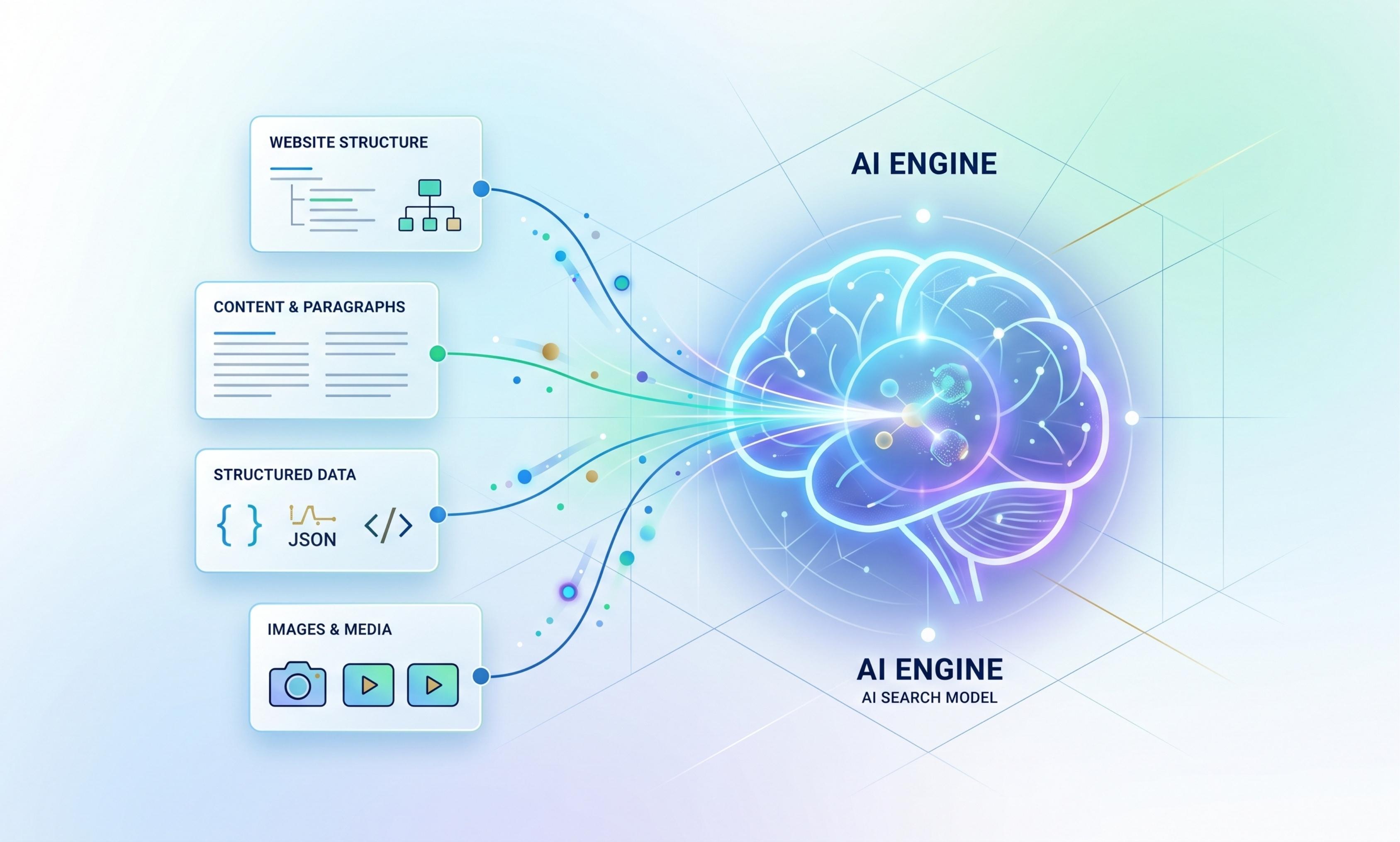
Each AI agent has its own personality when it comes to choosing sources. They don’t share notes. Only 11% of cited domains appear across multiple AI platforms, which means a citation strategy built for ChatGPT won’t automatically work on Perplexity.
Here’s how the four big players actually behave.
The Four Models, AI Tools Side by Side
| AI Tool | Retrieval Method | Source Preference | Citation Behavior |
|---|---|---|---|
| ChatGPT | External retrieval layer + cached training data | Wikipedia, top Bing results, branded official sites | 88% of cited URLs come directly from search results |
| Gemini | Heavily grounded in Google search | Authoritative, well-structured first-party sites | Inherits Google ranking logic |
| Claude | Brave Search + supplied corpus | Cites user-generated content 2 to 4 times more than other models | Cites only when asked or when search is enabled |
| Perplexity | Live web retrieval, every query | Mix of official sites and directories | Cites by default, multiple sources per claim |
The common thread? Every one of these AI systems needs a crawlable, parseable, well-structured website to pull from. No website, no citation. It really is that simple.
What Happens Behind the Curtain in the AI Era
Picture the process in plain English:
- A user types a question.
- The AI agent breaks the question into sub-queries (a method called “query fan-out”).
- It retrieves candidate pages from its index or live search.
- It parses those pages into chunks, paragraphs, tables, lists, FAQs.
- It selects the most extractable, trustworthy chunks.
- It generates the AI summary and (sometimes) cites the sources it used.
Notice where your website lives in that flow? Steps 3, 4, and 5. If your content can’t be retrieved, parsed, and trusted, you’re invisible from step 3 onward.
The Catch Most Brands Miss
If your robots.txt blocks GPTBot or ClaudeBot, if you have no structured data, or if your content is not formatted for extraction, AI models will ignore you regardless of your domain authority. We see this constantly in audits. A perfectly good site, beautifully ranked on Google, locked out of every major AI agent because of a single line in robots.txt.
💡 Pro tip: Allow GPTBot, ClaudeBot, PerplexityBot, GoogleOther, and Bingbot in your robots.txt before you do anything else. You can’t get cited if you can’t get crawled.
If this technical layer feels overwhelming, our AI SEO agency team handles crawl access, schema markup, and content structuring as part of every engagement. Want a deeper read on how indexing works for these AI tools? Our breakdown on how LLMs index the web covers it end-to-end.
The AI Visibility Gap
Ranking #1 on Google no longer guarantees you’ll show up in AI answers. Welcome to the AI visibility gap: the painful space between traditional ranking and AI citation.
Ranking and Citation Are Two Different Games
Yes, they overlap. 99% of Google AI Overview citations come from pages already ranking in the organic top 10, and 87% of ChatGPT citations correspond to top Bing search results. So traditional rankings are still the prerequisite. They’re just no longer the finish line.
The truth is, you can rank in the top 10 and still get skipped by the AI summary if your page can’t be cleanly extracted into a citation-worthy chunk.
Why the Gap Exists
There are four real reasons your top-ranked page might be getting passed over:
- Your content is too vague. AI systems pull specific claims, not flowery prose. Pages packed with “we’re committed to excellence” type language get ignored.
- No clear headings or structure. AI parses content section by section. Walls of text without clear headings give the AI agent nothing to grab.
- Bulleted lists and tables are missing. AI models love structure they can lift verbatim. Comparison data written as paragraphs is wasted opportunity.
- The page doesn’t directly answer the query. AI search tools want the answer in the first 100 words, not buried in paragraph nine.
The Real Question to Ask
Stop asking “where do I rank?” Start asking “is my content easy enough for an AI agent to lift, attribute, and trust?” That’s the question that closes the AI visibility gap.
Every page should be auditable against three checks:
- Can a search engine crawler access it?
- Can an AI system extract a clean, factual chunk from it?
- Does the page have enough authority signals (author bio, citations, schema markup) to be trusted?
📊 Worth knowing: Sites strong in authority, structure, and freshness dominate AI answers; sites weak in any one of them are effectively invisible to generative engines.
If you’re seeing strong rankings but flat AI visibility, the problem isn’t your SEO. It’s the gap. We close it through Generative Engine Optimization and Answer Engine Optimization, two disciplines built specifically to make your content extractable by AI tools.
For a deeper dive, our guide on GEO vs AEO explains how the two work together.
What Makes a Website Mention-Worthy on Google Search or AI Overviews
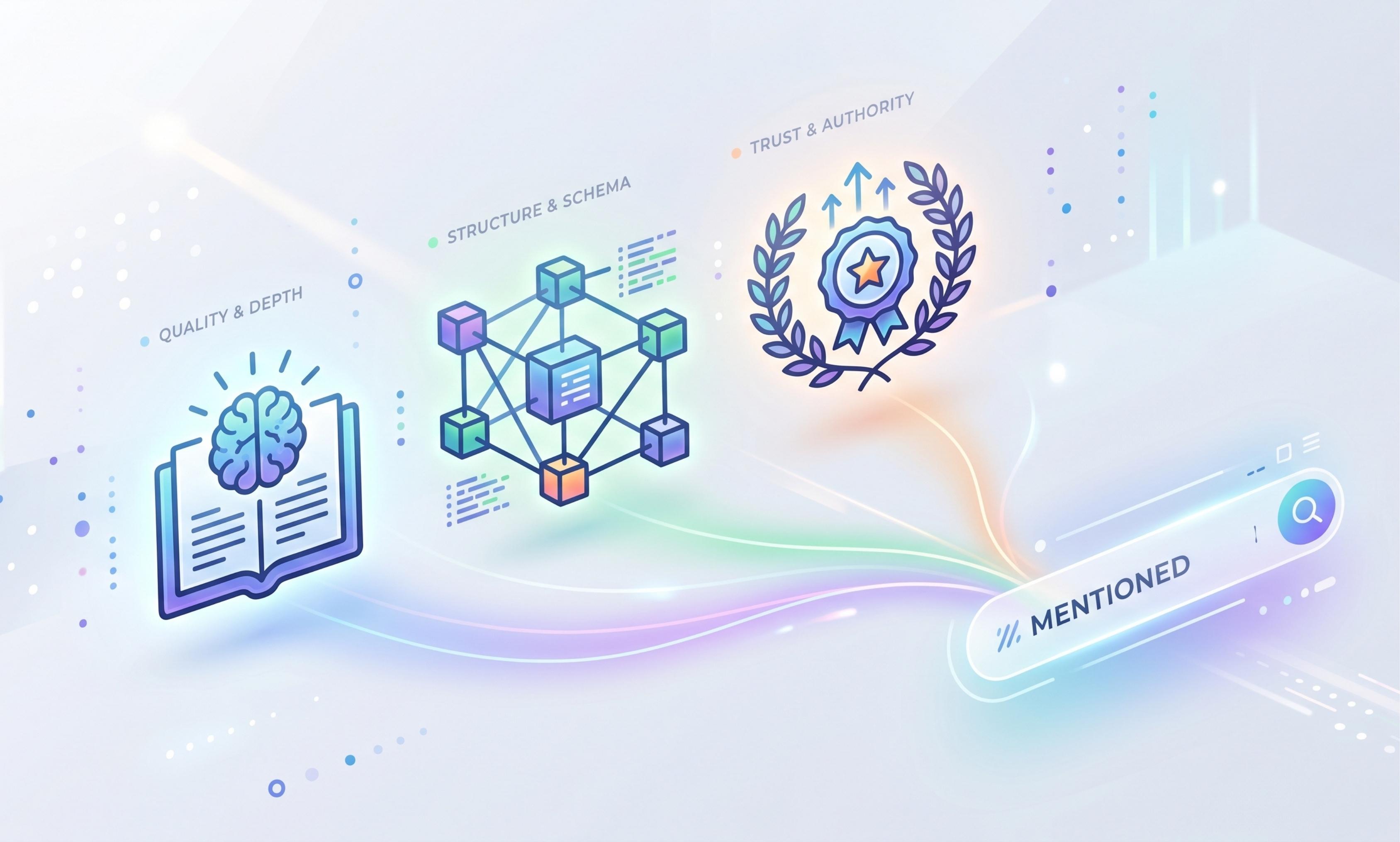
If AI engines are picky guests, your website is the dinner party. Here’s how to make sure they keep coming back and bringing their friends.
The Four Ingredients of AI Citation Eligibility
After analyzing what gets cited and what doesn’t, the pattern boils down to four pillars:
| Pillar | What It Means | Why It Matters |
|---|---|---|
| Authority | Backlinks, brand mentions, author credentials | Sites with 32K+ referring domains are 3.5x more likely to be cited than those with under 200 |
| Structure | Clear headings, schema markup, FAQ blocks | AI tools extract chunks, not pages |
| Freshness | Recently updated content with explicit dates | Content updated in the past 12 months earns 3.2x more citations than content older than 24 months |
| Specificity | Concrete facts, numbers, named entities | Vague claims get skipped; verifiable claims get cited |
Practical Strategies That Actually Move the Needle
These are the moves we deploy across every AI SEO engagement:
- Front-load every page with a direct answer. First 50 to 100 words should answer the question in plain, natural language. Save the backstory for later.
- Use clear headings as question prompts. H2s like “How does X work?” outperform abstract titles like “The Mechanics.”
- Break content into citable chunks. Each section should make sense on its own. AI doesn’t read top to bottom.
- Add schema markup. Article, FAQPage, Organization, and Person schemas all help AI systems understand context.
- Build comparison tables and bulleted lists. AI tools extract structured data nearly verbatim.
- Cite your own sources. Link to credible third-party data. AI engines reward content that proves its claims.
- Show the author. A real human byline with credentials signals trust to AI systems and humans alike.
The Format AI Loves Most
If we had to pick the single most underused format, it’s the TL;DR + supporting detail combo. Open every section with a one-sentence answer. Follow with the proof. AI agents will lift the TL;DR straight into the AI summary and credit your page as the source.
💡 Pro tip: Use concrete nouns in headings, keep dates explicit, and put any measurement (percentage, dollar figure, time saved) in the same paragraph as its context. That paragraph becomes a clean citation unit.
Don’t Forget the Off-Page Signals
Your website is the home base, but AI systems triangulate. They cross-reference your site against directories, Google Business Profile, reviews, Reddit threads, and Wikipedia mentions. If your brand only exists in one place, you’re a single point of failure.
The brands winning AI visibility have:
- Consistent NAP (name, address, phone) across the entire web
- Active presence on Reddit, Quora, and industry forums
- Reviews on Trustpilot, G2, Capterra, or category-specific platforms
- A Wikipedia mention (where genuinely warranted)
- A consistent brand name across every touchpoint
Our LLM SEO services cover both layers, your on-site optimization and the off-site brand signal building that makes your domain a trusted source for AI systems. Need to nail the local angle too? Local SEO for AI search is its own beast and deserves a dedicated playbook.
Why Your Site Closes the Deal
Even when AI made the introduction, your website closes the sale. Always has, always will.
The Validation Funnel Nobody Talks About
When someone asks ChatGPT “who’s the best dentist in Miami?”, the AI recommends a few names. What does the user do next?
They open a new tab and Google the recommended brand. They click the website. They check reviews, services, pricing, and credentials. They book.
That second step, the validation, is where deals are won and lost. AI got you in the door. Your site has to do the rest.
Why AI Traffic Converts Higher
The numbers here are eye-opening:
| Source | Conversion Rate |
|---|---|
| ChatGPT referral | 15.9% |
| Perplexity referral | 10.5% |
| Claude referral | 5% |
| Gemini referral | 3% |
| Google organic | ~1.76% |
Why so much higher? Because users do their research inside the AI tool first. By the time they hit your site, they’re not browsing. They’re buying. Fewer clicks, higher intent, faster conversions.
What Your Site Has to Do at the Validation Stage
The visitor coming from an AI agent has a different mindset than the cold organic clicker of the past. They’ve already heard your brand mentioned. Now they want proof. Your site needs to deliver it in seconds:
- Match the claim. If the AI summary said you’re “the top-rated chiropractor in Fort Lauderdale,” your homepage better confirm it visibly.
- Show social proof. Reviews, testimonials, case studies, awards. Front and center.
- Make conversion easy. Click-to-call, instant booking, short forms. Don’t make them work for it.
- Reinforce trust signals. Credentials, certifications, real team photos, real client names.
- Stay consistent. Your hours, services, location, and pricing approach should match Google Business Profile, directories, and AI mentions.
If any of those break, the user bounces and books with the next name on the AI’s list.
The New Role of Your Website
Your site now wears two hats:
- Source document for AI systems deciding who to recommend
- Conversion engine for visitors who already heard the recommendation
Both roles require strong website fundamentals: fast load times, clean structure, mobile-first design, persuasive copy, and clear calls to action. This is exactly why our web design services are built around an “AI-first, conversion-second” philosophy. Beautiful, fast, scalable, and structured to be cited and to convert.
💡 Pro tip: Audit your homepage through the lens of an AI summary. If a user landed on your site after seeing your name in ChatGPT, would the first screen confirm everything the AI said about you? If not, that’s a leak in your funnel.
The bottom line is simple. AI search didn’t replace your website. It made your website work harder, smarter, and more profitably than ever before. The brands treating their site as a relic are the ones losing. The brands treating their site as the core asset of their AI visibility strategy are the ones quietly running away with the digital landscape.
How to Future-Proof Your Site for AI Search

Knowing AI matters is one thing. Knowing what to do about it is another. The brands pulling ahead aren’t waiting for the dust to settle. They’re shipping changes now, while everyone else is still debating whether the AI era is real.
We’re past the early days of guessing. The data is in, the tools are mature, and the playbook is clear.
Build for AI Readiness, Not Just Rankings
The real question isn’t “do I rank for these keywords?” anymore. It’s “is my site ready to be read, parsed, and cited by AI tools?”
That readiness comes down to seven moves we apply across every client account:
- Write in natural language. Stop writing for keyword density. Write the way your customer asks the question, then answer it cleanly. Large language models reward clarity over cleverness.
- Optimize every page for one primary intent. One page, one job. If a page tries to rank for ten things, it’ll rank for none in AI search.
- Create content that solves a specific problem. Generic “ultimate guide” articles get ignored. Specific, contextual answers get cited.
- Add alt text to every image. AI systems read alt text to understand visual context. A missing alt tag is a missed citation opportunity.
- Publish dynamic content, not static brochure pages. Update your top pages quarterly. Stale dates kill citation rates.
- Use video content with transcripts. AI agents are starting to pull from transcribed video. A YouTube embed with no transcript is invisible to most AI tools.
- Link internally with intent. Every internal link should signal a topical relationship. Random “click here” links pass zero value.
Don’t Forget the Channels AI Doesn’t Touch (Yet)
AI search is reshaping how you get found, but it’s not the only place your brand should live. The smartest digital strategies in 2026 layer multiple channels so a slowdown in one doesn’t sink the whole ship:
- Email marketing still owns the highest ROI of any digital channel. Use it to nurture the higher-intent leads AI search delivers.
- Reddit, Quora, and forums influence what AI chatbots cite. Show up where your audience already talks.
- Branded YouTube and TikTok videos create the kind of dynamic content AI engines are learning to surface.
- Local SEO assets matter more than ever, since AI recommends businesses based on location signals from Google Business Profile and directory consistency.
If you’re a multi-location brand, our email marketing services and marketing automation builds are designed to capture and convert the higher-intent traffic AI search sends your way.
Track What Actually Matters Now
The metrics that mattered in 2022 don’t tell the full story. Google Analytics still has its place, but it can’t show you whether ChatGPT is mentioning your brand or whether Perplexity is citing your blog.
Smart teams now track a layered set of signals:
| Metric | What It Tells You | Where to Find It |
|---|---|---|
| AI referral traffic | Visitors arriving from AI agents | Google Analytics 4 (custom channel group) |
| Citation frequency | How often AI summaries name your brand | GEO probe tools (Profound, Goose, Rankeo) |
| Branded search volume | Whether AI exposure is driving demand | Google Search Console |
| Zero click visibility | When you’re cited but not clicked | AI summary tracking tools |
| Conversion rate by channel | Which AI tool sends the highest-quality traffic | GA4 channel reports |
Zero click traffic is the metric most teams ignore at their peril. Even if fewer people are clicking through, your brand is still being recommended inside the AI summary, and that recommendation drives offline conversions, branded searches, and direct visits later.
Where Most Teams Get Stuck
The pattern we see, again and again, is teams trying to bolt an AI strategy onto a website that wasn’t built for it. New tools, new dashboards, new agencies, but the same broken site underneath.
The truth is, you can’t optimize your way out of weak fundamentals. A slow, poorly structured site won’t get cited, no matter how many AI tools you throw at it. Effective ways to fix this start with the foundation:
- Run a technical audit on crawl access (GPTBot, ClaudeBot, PerplexityBot, GoogleOther)
- Restructure your top 20 pages with clear headings, schema, and TL;DR summaries
- Write more articles that answer specific questions instead of broad topics
- Build authority through guest posts, podcast features, and trusted third-party mentions
- Track citations weekly across at least three AI engines
This is exactly the work our LLM SEO agency team handles end to end. We audit, restructure, write, and measure across ChatGPT, Gemini, Claude, and Perplexity, with one clear example of success after another.
A Quick Reality Check
If you’re wondering whether your site is AI-ready, ask yourself five honest questions:
- Can an AI agent crawl my site without hitting a wall?
- Does my homepage answer “what do you do, who do you serve, and where?” in the first screen?
- Are my top pages structured with clear headings, FAQs, and tables?
- Is my brand mentioned consistently across Google Business Profile, directories, and review sites?
- Am I tracking AI citations alongside Google rankings?
A “no” on any of those is a leak. Five “no’s” means your site is invisible to the systems shaping how customers find you in 2026.
The good news? None of this is unfixable. Just don’t wait until your competitors fix it first.
Win the AI Search Era With Doc Digital SEM
Websites aren’t dead. They’ve been promoted to the most important asset in your digital strategy. AI engines need them, customers validate through them, and conversions still happen on them. The brands ignoring this shift will lose visibility quietly, then suddenly.
Here’s what to remember:
- Websites are now the source document that AI systems use to recommend brands
- ChatGPT, Gemini, Claude, and Perplexity each pull content differently
- Ranking high doesn’t guarantee citation; the AI visibility gap is real
- Authority, structure, freshness, and specificity decide who gets cited
- AI traffic converts up to 9x higher than traditional Google organic
- Your website still closes the deal, even when AI made the introduction
Getting cited in AI answers takes more than wishful thinking and a refreshed homepage. It takes a website built to be crawled, parsed, and trusted. That’s exactly what Doc Digital SEM does every day. Get your free AI visibility audit (valued at $1,500) or explore our LLM SEO services and start earning citations across ChatGPT, Gemini, Claude, and Perplexity today.
FAQs
What is the 10 20 70 rule for AI?
The 10/20/70 rule splits AI success: 10% algorithms, 20% data and tech, and 70% people, processes, and adoption.
Is SEO dead or evolving in 2026?
SEO isn’t dead, it’s evolving into generative engine optimization. Traditional rankings still feed Google’s AI overviews and remain the foundation for AI citations.
Are AI search results accurate?
AI generated responses are mostly accurate but not flawless. Always verify critical facts, since AI tools can hallucinate or pull from outdated sources.
How to increase visibility in AI search?
Structure content with clear headings, schema, and direct answers. Build authority through relevant backlinks, and keep AI generated content sections fresh and citation-ready.


