


Your competitor just got cited by ChatGPT. Again. Not because they have more backlinks than you, or a better content calendar, or a bigger ad budget. It’s because AI systems know who they are, and they’re not sure who you are yet.
A study analyzing AI Overview ranking factors across 15,847 results found that pages with 15 or more connected entities in Google’s Knowledge Graph show 4.8 times higher selection probability for AI Overview inclusion. Domain authority, by contrast, now shows only an r=0.18 correlation with AI Overview citation, down from 0.23 in 2024. Entity density is the rising signal. Domain authority is the declining one. That’s the shift. And most brands haven’t caught up.
Here’s what we’ll cover:
- What entity SEO actually is and why it’s replaced the keyword-only strategy
- How Google’s Knowledge Graph works and why it decides who gets cited
- What trust signals do AI systems actually measure when evaluating brand authority
- The role of E-E-A-T in entity-based visibility and how to strengthen it
- How to build brand authority across the web so AI systems recognize and recommend you
- The compounding effect of entity authority and why brands that delay are falling permanently behind
At Doc Digital SEM, this is the work we do every day. From LLM SEO and AI SEO strategy to semantic SEO for LLMs, the team helps brands build the kind of entity presence that AI systems trust, cite, and recommend consistently.
What Entity SEO Actually Is
For over a decade, SEO was a keyword game. Find the phrase people search. Repeat it in the right places. Get ranked. That model worked, right up until search engines got smart enough to understand meaning instead of just words.
Entity SEO is the evolution that replaced it. Instead of optimizing for strings of text, you’re optimizing for things: defined, recognizable concepts that search engines and AI systems can identify, categorize, and connect to other related entities in a structured web of meaning.
An entity, in SEO terms, is any distinct, uniquely identifiable thing. A brand. A person. A product. A location. A concept. Google treats entities as real-world things with identity, while keywords are just text strings. An entity has attributes, relationships, and a stable meaning. A keyword can mean different things depending on context. When Google understands your entity clearly, it can surface your brand confidently across search features and AI responses.
From Strings to Things
Google’s history with entity recognition stretches back to 2012, when the Knowledge Graph was first introduced with the tagline “things, not strings.” That single change set in motion a shift that’s now fully matured.
Search engines now interpret queries based on meaning, context, and user behavior rather than exact keyword usage. In 2026, SEO is no longer just about ranking pages. It’s about becoming a trusted source that search engines and AI assistants choose to reference.
The difference matters enormously for how you create content and build your brand online. Keyword SEO asks: what words are people typing? Entity SEO asks: what does our brand stand for, and how clearly do AI systems understand that?
Why Entities Are Important Now
The shift to entity-based understanding isn’t just a Google preference. It’s driven by the entire architecture of modern AI SEO. Large language models don’t retrieve pages by matching keywords. They retrieve entities, named people, brands, and concepts, that they’ve learned to recognize and trust from training data and real-time web crawls.
A page that ranks #1 on Google might never get mentioned by ChatGPT if it lacks the signals AI models prioritize. These models evaluate authority differently. They look for entity clarity, consistent information across sources, structured data that clarifies relationships, and content depth that establishes expertise.
That’s the core problem entity SEO solves. It makes your brand legible to AI systems, not just findable by search engines.
What entity SEO covers in practice:
- Defining your brand clearly across your own website with consistent naming, descriptions, and structured data
- Connecting your brand to related entities in your niche through content and semantic relationships
- Building external signals so AI systems encounter your brand mentioned consistently across the web
- Implementing schema markup so search engines can extract and understand entity attributes
- Earning a Google Knowledge Panel as proof that your entity is verified and recognized
The brands winning in AI search today aren’t just doing more keyword research. They’re thinking like an entity: building a recognizable, verifiable, consistently described identity that AI systems can confidently recommend.
How Google’s Knowledge Graph Works
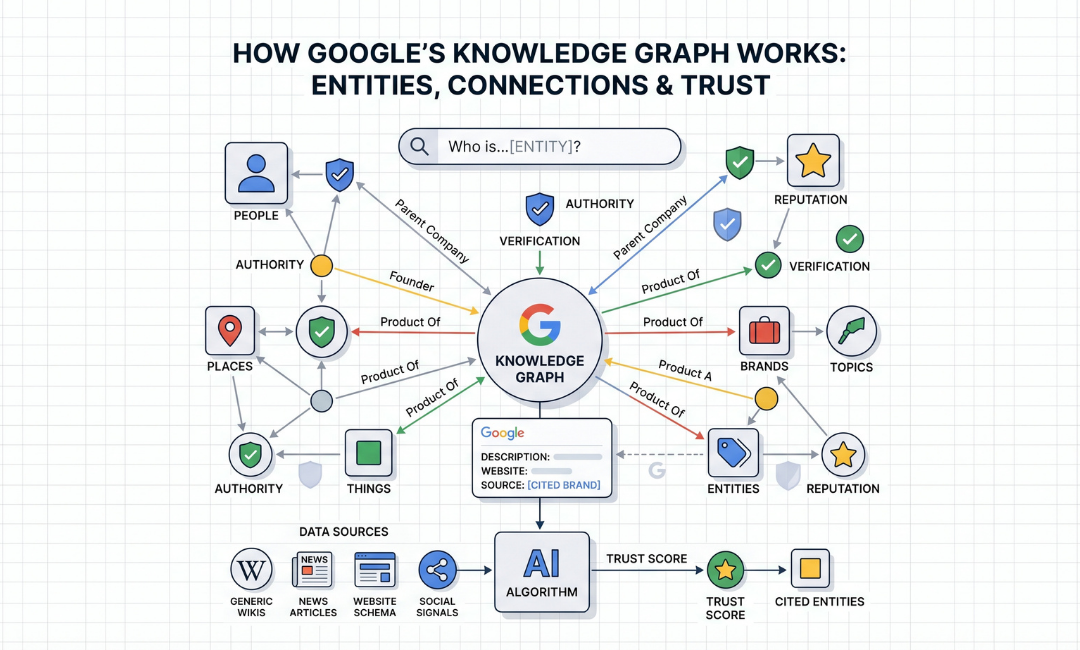
Google’s Knowledge Graph is the backbone of modern entity recognition. Understanding how it works, and why it determines who gets cited, is non-negotiable for any brand serious about visibility in AI-driven search.
The Knowledge Graph in Plain Language
Think of Google’s Knowledge Graph as a vast map of the world’s known entities and their relationships. Every person, organization, location, product, and concept with enough verified information about it gets represented as a node. Those nodes connect to each other through defined relationships, creating a web of meaning that Google uses to understand context across billions of queries.
When someone searches “who is the best LLM SEO agency in Florida,” Google isn’t just matching keywords. It’s navigating a map of entities, connecting “LLM SEO agency” to geographic entities, reputation signals, and brand entities it already recognizes.
AI citations depend on entity authority because AI systems prioritize credible, well-defined entities. Authority is determined by consistency, external validation, and relationship strength. If an entity lacks trust or shows conflicting signals, AI avoids citing it.
What Gets a Brand Into the Knowledge Graph
Entry into Google’s Knowledge Graph isn’t automatic. It requires your brand to be verified, documented, and referenced consistently across enough trusted sources that Google can build a confident picture of who you are. Key signals include:
- Wikipedia and Wikidata presence: ChatGPT cites Wikipedia at 7.8% of total citations, while Wikipedia is the most-cited domain in Google AI Overviews at 18% of all citations. A single mention on an existing Wikipedia article covering your category creates a structured relationship in the Knowledge Graph between your brand entity and your category entity, which is exactly what AI systems need to resolve your brand during query time.
- Structured data on your own website: Implementing Organization schema, LocalBusiness schema, and related markup tells Google exactly what attributes define your brand entity.
- Consistent NAP data: Your business name, address, and contact details must be identical across every platform. Inconsistency signals conflicting data points and reduces AI confidence.
- Cross-platform brand presence: Your brand name connecting the same attributes across LinkedIn, Google Business Profile, Crunchbase, industry directories, and review platforms builds the network of connected entities that Google uses to validate your identity.
Why the Knowledge Graph Decides Who Gets Cited
Competitive entity analysis focuses on how competitors are represented as entities, not just which keywords they rank for. In modern SEO, winning means owning more entity space in Google’s Knowledge Graph than competitors. Entity dominance becomes self-reinforcing, making your brand the default answer.
This is why earning a Knowledge Panel matters far beyond vanity. A Knowledge Panel is Google’s public declaration that it recognizes your brand as a verified entity. It signals to AI overviews, Google Gemini, and every AI system that accesses Google’s index that your brand is a known, trusted source worth recommending.
Our guide on structured data for LLM optimization breaks down the specific schema types that feed the Knowledge Graph most effectively. And if you want to understand how this all connects to your search rankings specifically, what is E-E-A-T in SEO is the next logical read.
What Trust Signals AI Systems Actually Measure
Here’s where most brands get confused. They assume AI systems measure the same signals as traditional search engines: backlinks, domain authority, and keyword rankings. They don’t. Not entirely.
AI systems don’t “trust” like humans, but they do measure patterns that correlate with credibility: consistency, verification, external validation, and user satisfaction. If your brand signals are fragmented, AI becomes uncertain, so it favors brands with a clear identity and repeated confirmation across the ecosystem.
The practical implication is significant. A brand with modest traditional SEO metrics but strong entity clarity and consistent third-party mentions can outrank a high-authority competitor inside AI-generated summaries.
The Four Core Trust Signal Categories
Here are the four core trust signals:
1. Entity Clarity
Does AI know who you are with confidence? This is the foundational signal. It includes:
- Consistent brand name across all platforms
- Clearly defined business category and service area
- Verified contact details on your own website and across directories
- Structured data that explicitly defines your entity attributes
- A Knowledge Panel confirming entity recognition
2. Authority Validation
Who vouches for you? A mention in a respected publication carries more weight than dozens of posts on your own website. This external validation helps separate real experts from the rising tide of AI-generated content. As Ahrefs’ Tim Soulo notes, brand mentions have become “the new backlinks for the AI search era,” meaning citation frequency matters more than link acquisition alone.
Third-party mentions across news articles, research papers, industry publications, and reputable sources are among the strongest authority signals AI systems measure.
3. Content Quality and Extraction Readiness
Trusted citation sources tend to share structural traits: they use clear heading hierarchies that allow AI to extract specific sections, they support claims with verifiable statistics, and they’re referenced across multiple third-party domains rather than only on their own properties. Content that’s structured for extraction consistently outperforms high-authority content written in dense, undifferentiated prose.
4. Sentiment and Reputation
If your brand is consistently associated with trust, usefulness, and positive sentiment, AI systems are more likely to elevate your name in summaries. If the tone skews critical or negative, large language models may instead favor citing a competitor, even if you have more mentions overall. Mentions form the dataset, while sentiment determines your role in the story.
What AI Systems Ignore
Traditional SEO metrics that AI systems deprioritize or largely ignore:
| Signal | Traditional SEO Impact | AI Citation Impact |
|---|---|---|
| Domain Authority | High | Low to moderate |
| Exact-match keywords | High | Minimal |
| Backlink volume | High | Moderate (quality matters more) |
| Meta descriptions | Moderate | Low |
| Page rank position | High | Moderate |
| Entity clarity | Low historically | Very high |
| Brand mention frequency | Low historically | Very high |
| Sentiment of mentions | Low | High |
Research shows that brand mention frequency correlates with AI visibility at a coefficient of 0.664, versus only 0.218 for backlinks. The authority signals AI systems use aren’t the same ones Google uses.
Understanding this gap is exactly what separates brands that are visible on Google but invisible in AI answers from those who’ve built presence on both. AEO vs SEO breaks down these different optimization frameworks in detail.
E-E-A-T’s Role in Entity Visibility
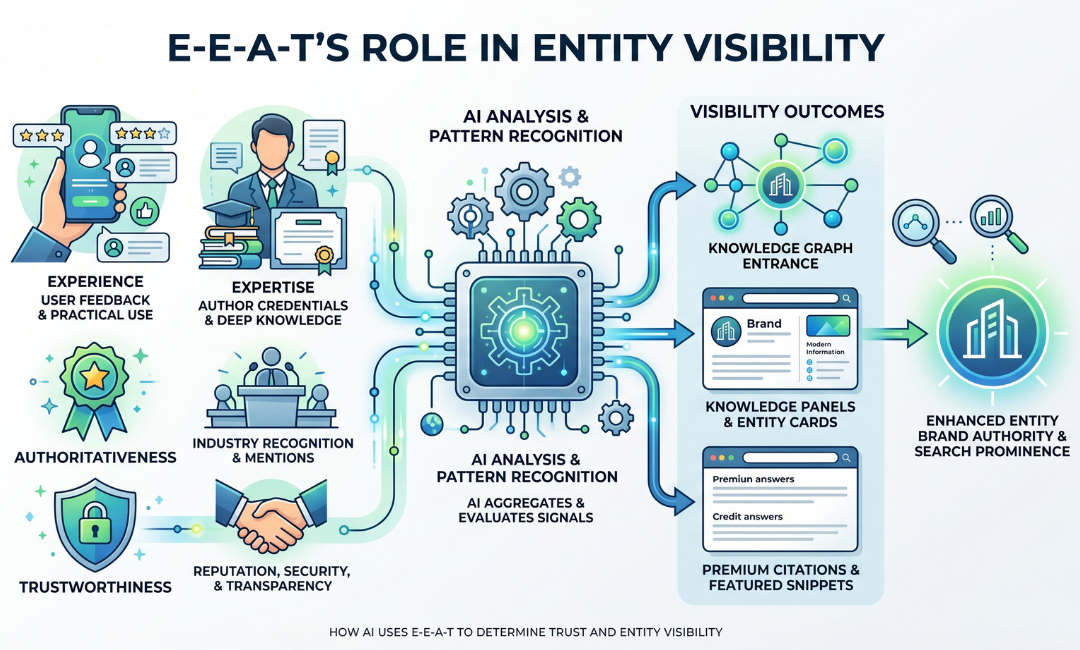
Entity recognition gets your brand identified by AI systems. E-E-A-T is what makes that identified entity trustworthy enough to cite. The two work together, and understanding the distinction changes how you approach building authority.
Search engines can identify entities using text and schema markup, but E-E-A-T signals tell AI systems which entities deserve visibility. Strong E-E-A-T helps Google validate whether an entity is credible, knowledgeable, and connected to real-world signals such as authorship, brand recognition, citations, and reputation. Without E-E-A-T, entity recognition exists, but visibility does not.
What E-E-A-T Means in 2026
E-E-A-T stands for Experience, Expertise, Authoritativeness, and Trustworthiness. With 52% of AI Overview sources coming from the top 10 search results, E-E-A-T has become the foundation for visibility in traditional SEO rankings, AI Overview citations, and cross-platform AI mentions.
Each pillar has a specific role:
- Experience: You’ve done the thing you’re writing about. Demonstrated through case studies, original data, screenshots, methodology documentation, and first-hand examples.
- Expertise: You understand it deeply. Demonstrated through author credentials, certifications, detailed analysis, and content depth that goes beyond beginner-level.
- Authoritativeness: Others recognize your expertise. Demonstrated through brand mentions, citations in reputable sources, media coverage, and consistent topical authority across multiple pages.
- Trustworthiness: Your information is accurate, and your brand is transparent. Demonstrated through factual accuracy, clear authorship, contact details, secure site infrastructure, and correction policies.
Actionable Tips to Strengthen E-E-A-T
On your own website:
- Add detailed author bios with real credentials, linked to LinkedIn profiles and other verifiable profiles
- Include your business name, contact details, and physical address on every relevant page
- Implement the Organization and Person schema on author pages and your About page
- Publish original research, case studies, and data-driven content that can’t be replicated by generic AI-generated articles
- Build a clear content hub with internal links connecting your pillar pages to supporting cluster content
Off your own website:
- Earn editorial mentions in industry publications relevant to your niche
- Pursue guest contributions, podcast appearances, and webinar slots that generate author mentions with your name attached
- Encourage reviews on G2, Clutch, Google Business Profile, and industry-specific directories
- Get your executives and key team members cited in news articles and research papers as named experts
E-E-A-T isn’t a one-time setup. It’s a system that must be measured, updated, and governed. In 2026, brands that treat trust like a KPI are the ones that stay visible in both Google Search and AI Overviews.
Our E-E-A-T in SEO guide walks through how to audit and strengthen each of these pillars systematically. And for brands in competitive spaces, semantic SEO for LLMs covers how semantic relationships between entities amplify E-E-A-T signals within AI systems.
Building Brand Authority Across the Web
Entity recognition and E-E-A-T don’t happen in isolation. They’re built through a deliberate, multi-platform strategy that makes your brand impossible for AI systems to ignore. Here’s how to do it.
Build Your Entity Foundation First
Before anything else, your brand needs a clean, consistent identity signal across every platform where it appears. This is your entity foundation:
- Your website: Organization schema with consistent business name, description, founding year, services, and contact details. This is the source of truth that AI systems reference first.
- Google Business Profile: Fully completed with accurate hours, services, location, and photos. This feeds directly into Google’s Knowledge Graph.
- LinkedIn Company Page: Matches the exact name and description from your website and schema.
- Crunchbase or industry directories: For B2B brands, especially, these platforms are heavily cited in AI-generated answers about companies and agencies.
- Wikidata: If your brand meets the notability threshold, a Wikidata entry creates a permanent, structured entity record that AI systems trust deeply.
Earn Brand Mentions at Scale
If your brand is consistently mentioned in editorial contexts across credible publications, review platforms, and industry sources, you build entity authority. This is what gets you cited in AI answers, not just ranked in blue links.
The most effective ways to earn brand mentions:
- Original research and data: Publish studies, surveys, or proprietary data that other writers cite in their content. Each citation is a brand mention with context attached.
- Digital PR: Pitch expert commentary on trending topics in your niche to journalists and editors. A quote in a relevant publication creates a high-authority brand mention with category context.
- Review platform optimization: Fully build out profiles on G2, Clutch, Trustpilot, and industry-specific directories. Reviews and ratings on these platforms are structured, high-credibility data points that AI tools treat as reliable sources.
- Podcast and webinar appearances: These create long-form brand mentions with rich topical context that AI systems can extract and associate with your entity.
- Forum participation: Reddit, Quora, and industry forums are among the most-cited sources in AI-generated answers. Consistent, helpful contributions build brand recognition in uncontrolled environments where AI actually listens.
Implement Schema Markup Throughout Your Site
Implementing schema on your own website is the single fastest way to make your entity legible to AI systems. Key schema types for building brand authority:
| Schema Type | What It Signals to AI |
|---|---|
| Organization | Brand identity, contact details, services, and founding |
| Person | Author credentials, expertise, social profiles |
| Article / BlogPosting | Content authorship, publication date, topic |
| FAQPage | Q&A content for direct AI extraction |
| LocalBusiness | Physical presence, hours, service area |
| BreadcrumbList | Site structure and content hierarchy |
For a detailed breakdown of how structured data feeds AI citation potential, our LLM SEO guide and how LLMs index the web both cover the technical architecture in depth.
Build Topical Authority Through Content Clusters
Increasing topical authority and relevance with related content boosts SEO because it signals to search engines that your site comprehensively covers a subject, not just isolated keywords. By creating interconnected, high-quality content around a core topic, you strengthen semantic relationships and entity associations in Google’s Knowledge Graph.
A content cluster for entity SEO looks like this: a pillar page covering the broad topic, surrounded by cluster pages that go deep on each subtopic, all connected through contextual internal links with descriptive, entity-rich anchor text. Every page in the cluster reinforces your brand’s association with the given entity. Over time, this makes your brand the default answer for that topic area in both traditional search and AI search results.
Doc Digital SEM’s work building this exact structure across AI-adjacent topics has been directly reflected in AI citations across ChatGPT, Gemini, and Perplexity. The team’s AI SEO agency services and GEO agency approach are built around this content cluster + entity foundation model.
The Compounding Effect of Entity Authority
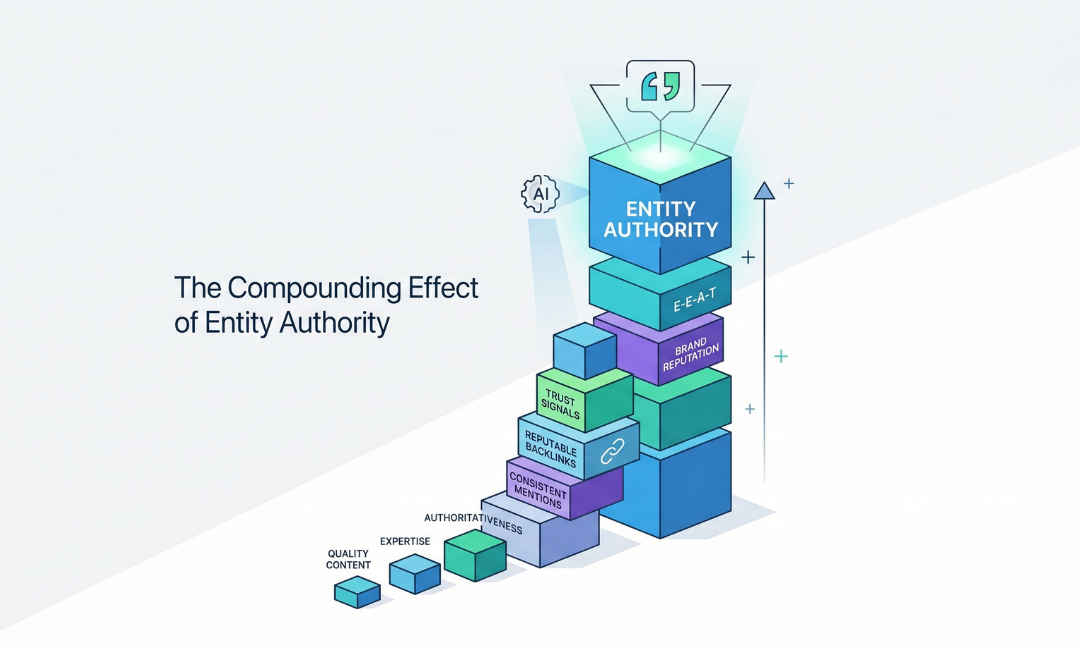
Entity authority doesn’t grow linearly. It compounds. And brands that delay building it aren’t just behind. They’re actively falling further behind with every AI model training cycle.
How Compounding Works in Practice
Most practitioners underestimate how entity authority compounds. AI citation preference creates positive feedback: AI systems that successfully retrieved accurate information about your brand in past responses are more likely to cite you again. LLM models retrain on data already weighted toward recognized entities. Shadow entities, brands not yet established in AI knowledge graphs, fall further behind with each model update.
In plain terms, the brands that get cited today are more likely to get cited tomorrow. Their presence in training data, Knowledge Graphs, and web mentions creates a self-reinforcing cycle. The brands that don’t build entity authority today are being trained out of AI responses, progressively and silently.
The AI Invisibility Gap Is Growing
AI platforms currently recommend only 1.2% of local businesses compared to 35.9% appearing in traditional Google local results. Brands optimizing for answer engines now are capturing 3.4 times more visibility than late adopters.
That gap between AI-visible and AI-invisible brands is widening every month. Traditional SEO efforts built over the years don’t automatically translate to AI visibility. The signals are different. The infrastructure is different. And the window for early-mover advantage is closing.
What Delayed Action Actually Costs
Consider a brand that has been building traditional SEO metrics for five years. Strong domain authority. Solid backlink profile. Good search rankings on non-branded queries. But no entity work. No Knowledge Panel. No schema. No systematic brand mention building.
That brand is invisible in AI-generated summaries right now, even for topics it dominates on Google. Every week, it delays building entity authority; its competitor gains more citations in AI responses, which feeds the next training cycle, which makes the competitor more recognized, which generates more citations. The gap compounds.
Instead of “search, evaluate options, click, read, decide,” modern search behavior is now “ask, receive synthesized answer, act.” This compression means brands either get mentioned in that initial AI response, or they don’t exist in the user’s consideration set at all.
What to Prioritize Right Now
If you’re starting from scratch or catching up, here’s the order of operations:
- Clean up your entity foundation: Consistent NAP, Organization schema, Google Business Profile
- Earn your Knowledge Panel: Wikipedia category mentions, Wikidata entry, and consistent cross-platform presence
- Build your content cluster: Pillar pages + cluster pages + strong internal links around your core entity areas
- Launch a brand mention campaign: Original research, digital PR, directory listings, review platforms
- Implement E-E-A-T signals: Author bios, credentials, external citations, case studies
- Track AI citations: Use tools like Perplexity, ChatGPT, and Google Gemini to monitor whether your brand appears in AI-generated answers for your target queries
For brands that want to monitor and accelerate this process, our AI citations guide and LLM visibility strategy are the right starting points. And if you’re unsure where your brand currently stands in AI search, our AI search visibility assessment provides a clear baseline.
The brands building entity authority today are the ones AI systems will cite by default in 2027 and beyond. Every month of delay isn’t just lost time. It’s a compounding ground given to competitors who moved first.
Build Your Entity Authority With Doc Digital SEM
Search has shifted from ranking pages to recognizing trusted entities. Brands that understand this distinction and build accordingly don’t just rank, they get cited, recommended, and remembered by the AI systems their customers already use every day.
Key takeaways:
- Entity SEO replaces the keyword-only strategy by making your brand a recognizable, verifiable thing that AI systems understand
- Google’s Knowledge Graph determines who gets cited in AI-generated summaries by measuring entity clarity, consistency, and connected relationships
- AI systems measure trust through entity clarity, authority validation, content quality, and sentiment across the web
- E-E-A-T signals tell AI which identified entities deserve visibility, not just which ones exist
- Brand authority is built through schema markup, brand mentions, content clusters, original research, and multi-platform presence
- Entity authority compounds over time, and brands that delay are being trained out of AI responses permanently
Entity authority isn’t something you build once. It’s something you earn, maintain, and expand across every platform where your audience searches. Doc Digital SEM helps brands do exactly that, from LLM SEO and structured data optimization to a full AI search visibility strategy. Get your free AI visibility analysis today and find out exactly where your entity stands.
FAQs
What is entity SEO, and why is it important?
Entity SEO is the practice of optimizing your brand as a recognizable, defined thing in the current entity search system, rather than just targeting keywords. It’s important because search engines and AI systems use entity linking and named entity recognition to identify trusted sources. Brands with strong entity signals appear more consistently in AI-driven results, informational searches, and AI overviews across multiple platforms.
How does entity linking improve brand visibility?
Entity linking connects your brand to related entities within Google’s Knowledge Graph, creating semantic relationships that AI systems use to surface relevant content. When users search for topics in your niche, strong entity linking makes your brand more likely to appear in AI-driven search results. It builds brand visibility by signaling to AI that your brand belongs in the conversation around specific topics and user intent.
How do AI systems use named entity recognition to rank content?
Named entity recognition is how AI systems identify key entities within content, things like brand names, people, locations, and concepts. When an AI-driven search processes a query, it uses entity extraction to pull the most relevant entities and match them to trusted sources in its knowledge graph. Brands with consistent entity signals across multiple platforms are far more likely to appear in AI results than those relying on traditional SEO alone.
What role do brand mentions play in AI SEO?
Brand mentions are one of the most important trust signals in AI SEO. Unlike traditional backlinks, unlinked brand mentions also influence AI-driven results because large language models train on raw web text, not just hyperlink graphs.
Known brands that appear consistently with positive sentiment across reputable sources build brand strength and the brand’s reputation, which directly improves click-through rates and brand impact in AI-generated answers. Even without a link, each mention builds entity authority.
How can a brand improve its visibility in AI search?
Improving brand visibility in AI search starts with a clear entity foundation: consistent contact details, Organization schema, and verified business profiles. From there, brands should build topical authority through content clusters, capture semantic relationships through internal links, and earn brand mentions across authoritative sources.
Tracking search volume for branded terms alongside AI results gives you a better understanding of brand impact and helps you close the gap between just what users search on Google and what AI systems actually recommend.


