


Imagine a VP of Marketing opens Perplexity instead of Google and asks “what’s the best customer success platform for a 30-person team scaling toward Series B?” Within seconds, three vendors get named. The buyer reads the AI’s reasoning, picks two for evaluation, and books demos by lunchtime. Your competitor is in the shortlist. You aren’t. The deal you didn’t know existed just got decided without your team ever showing up.
This isn’t hypothetical. 55% of enterprise buyers now use AI to begin their search, and 90% of B2B buyers use ChatGPT to build vendor shortlists. The traditional SaaS funnel that started with a Google query and ended with a demo request has compressed into a single AI conversation. SaaS companies that aren’t visible in those conversations are losing the pipeline they never see in their CRM.
Here’s what we’ll go through in detail:
- Why GEO is now the highest-leverage channel for SaaS founders to invest in
- What CMOs and marketing leaders need to track to prove GEO’s ROI
- The category-defining content strategy that earns top-of-funnel AI citations
- How RevOps and growth teams should attribute an AI-influenced pipeline
- A 90-day execution roadmap any SaaS team can run
If your SaaS team needs to show up where buyers are now starting their evaluations, Doc Digital SEM builds GEO services for SaaS operators across verticals. Every section below addresses a specific role on your team. Skip to whichever one matches yours.
Why Founders Should Care About GEO First
If you’re a SaaS founder reading this between investor calls, here’s the unfiltered version: generative engine optimization is the highest-leverage channel you can invest in right now. Not because it’s trendy, but because the math has fundamentally shifted in ways your existing growth playbook hasn’t caught up to.
The Channel Math Has Changed
Traditional acquisition channels are getting more expensive while delivering less. Google CPCs hit all-time highs in 2025. Cold outbound response rates dropped to historic lows. Content marketing produces declining organic traffic as Google AI Overviews capture clicks.
Meanwhile, AI-driven search is creating an entirely new acquisition channel where the cost is essentially the work you do, and the conversion rate runs 2-3x higher than standard organic.
The brutal comparison most founders haven’t run:
| Channel | Average CAC trend (2024 to 2026) | Conversion rate |
|---|---|---|
| Paid search | Up 40% | 2-4% |
| Cold outbound | Up 25%, response down 60% | 1-2% |
| Traditional SEO | Stable, but traffic declining | 2-3% |
| GEO | Marginal cost (content investment) | 5-10% from AI-referred traffic |
GEO isn’t free. Content production, schema implementation, and AI visibility tracking still cost money. But the per-citation cost compounds downward over time, while every other channel’s costs trend up.
Buyers Aren’t Coming Back to Google
The most uncomfortable shift for founders to internalize: a meaningful chunk of your potential pipeline is making vendor decisions inside ChatGPT, Perplexity, and Gemini without ever visiting Google. 55% of enterprise buyers begin their search in AI tools. By the time they hit your website (if they hit it at all), the consideration set is already locked.
This means your CRM is increasingly missing the top of the funnel. The deals you don’t close aren’t being lost on your demo call. They’re being lost in an AI conversation you weren’t part of three weeks earlier.
First-Mover Advantage Has a Closing Window
Right now, most SaaS categories have shockingly thin AI citation competition. The same five vendors get cited repeatedly because they happened to publish category-defining content first. Once an AI model establishes its preferred sources for a category, displacing them becomes exponentially harder.
The window for first-mover advantage in your category is probably 12 to 18 months. SaaS companies that invest in GEO now will own the AI citation share for years. Companies that wait will spend years trying to displace incumbents who got there first.
Why This Matters More Than Your Next Feature Release
Here’s the founder math: a single AI citation in “best project management tool for engineering teams” delivers more qualified pipeline over 12 months than most one-off features ship in a year. The compounding effect is real. AI engines that cite you once tend to cite you again. Brand mentions feed branded search volume, which feeds organic traffic, which feeds more brand mentions.
For founders allocating limited resources, GEO often delivers higher leverage than another engineering hire or another paid acquisition test. Our breakdown of why most SEO agencies will fail in the AI era covers the structural shift in more detail.
What CMOs Need to Track for GEO ROI
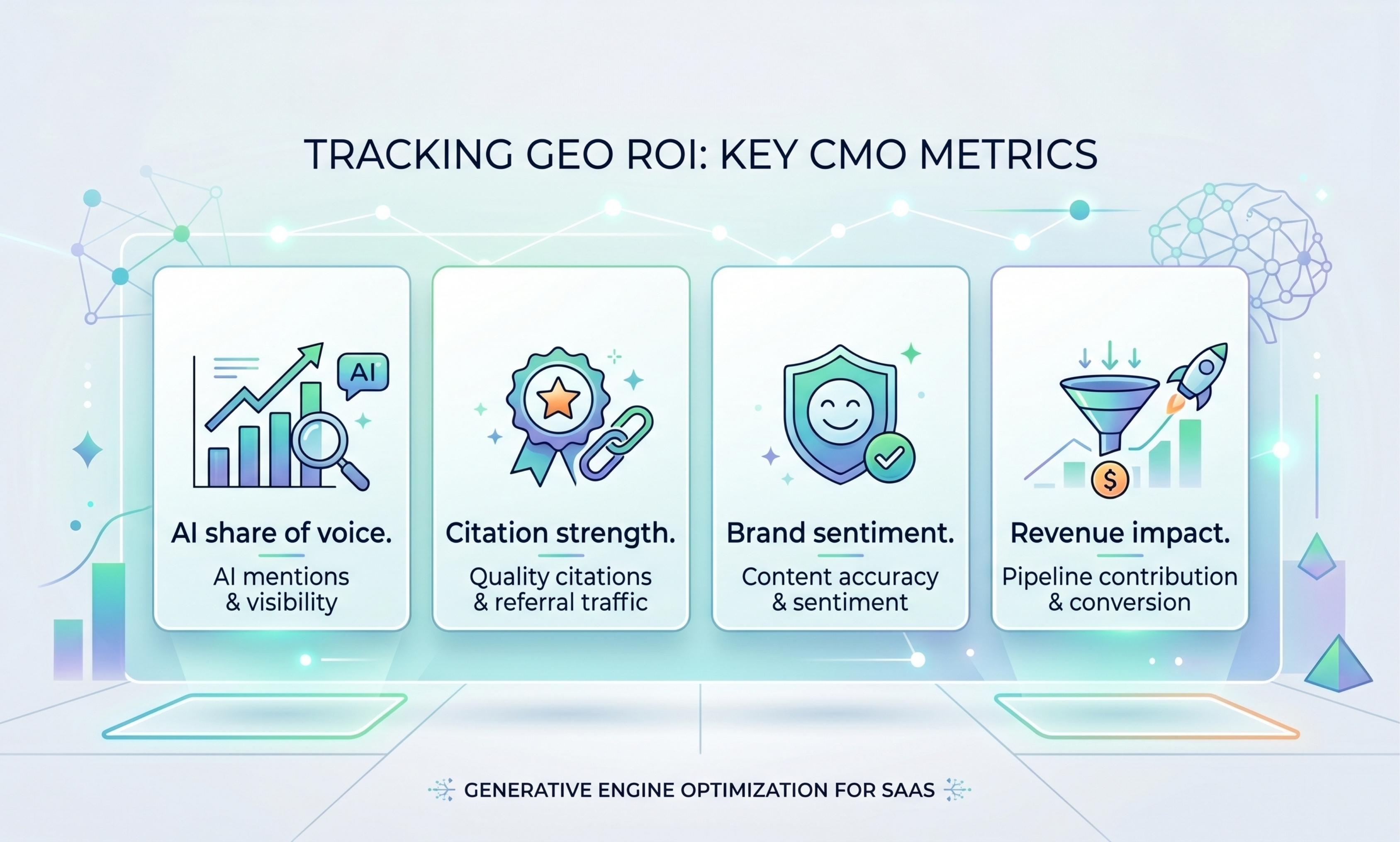
If you’re a marketing leader trying to prove GEO ROI to a skeptical CFO or board, you have a measurement problem. Traditional marketing dashboards don’t capture AI visibility, AI-influenced pipeline, or the leading indicators that predict GEO success. Here’s the metrics framework that actually moves the conversation.
The North Star: Share of Model
Forget keyword rankings as your primary GEO metric. The number that matters is Share of Model: the percentage of relevant AI prompts in your category where your brand appears. Track this across ChatGPT, Perplexity, Gemini, Claude, and Google AI Overviews.
How to calculate Share of Model:
- Build a list of 50-100 prompts that mirror how buyers in your category actually ask questions
- Run those prompts across the major AI platforms weekly
- Calculate the percentage where your brand is mentioned
- Track the trend over 90-day periods
A SaaS brand moving from 8% to 35% Share of Model in their category over six months has a story to tell. A brand stuck at 5% has work to do.
Leading Indicators That Predict Pipeline
Share of Model is the headline metric. These leading indicators tell you whether GEO is feeding the pipeline:
| Metric | What it measures | Where to track |
|---|---|---|
| Citation rate | How often AI cites your domain as a source | AI Clicks, Profound, Otterly.ai |
| Mention rate | How often AI names your brand in answers | Same tools, separate metric |
| Branded search volume | Direct demand created by AI mentions | Google Search Console, Ahrefs |
| AI-referred traffic | Sessions from chatgpt.com, perplexity.ai, gemini.google.com | Google Analytics 4 with custom segments |
| Citation diversity | Number of different AI engines citing you | Multi-platform tracking tool |
| Sentiment | How AI describes your brand (positive, neutral, negative) | Semrush AI Visibility Toolkit, Profound |
Lagging Indicators That Prove Revenue Impact
Once GEO is feeding the pipeline, these metrics prove the revenue impact:
- Pipeline contribution from AI-referred sources: Track in your CRM with proper attribution
- Self-reported AI source attribution: Add “how did you hear about us” fields to demo intake forms
- Sales velocity for AI-influenced deals: AI-influenced leads often close 30%+ faster
- Deal size correlation: AI-influenced deals tend to be larger in B2B SaaS
The Reporting Framework That Works
Build a monthly GEO report with three layers:
Layer 1: Visibility scorecard
- Share of Model trend across major AI platforms
- Citation rate change quarter over quarter
- Mention rate by platform
- Top 10 prompts where you gained or lost ground
Layer 2: Pipeline indicators
- Branded search volume growth
- AI-referred traffic by platform
- Direct traffic correlation with AI visibility gains
- Self-reported AI source attribution from intake forms
Layer 3: Revenue impact
- Pipeline contribution from AI-influenced sources
- Win rate on AI-influenced deals
- Sales cycle length comparison
- Customer LTV from AI-referred sources
This three-layer framework gives your CFO the metrics they need to justify continued GEO investment, while giving your team the leading indicators to know whether tactics are working before pipeline shows up.
What to Stop Reporting
Stop reporting these metrics in GEO contexts because they’re either misleading or irrelevant:
- Pure organic traffic volume: AI Overviews tank organic CTR even when GEO is working
- Keyword rankings alone: A page can rank #1 and still be invisible in AI answers
- Total impressions: Useful for diagnosis, useless as a success metric
- Bounce rate on informational content: AI users get answers without clicking, which is the new normal
For deeper measurement frameworks, our breakdown of AI search visibility covers the complete tracking infrastructure.
The Category-Defining Content Play
If you’re on the content team, this section is for you. The single highest-ROI activity in GEO for SaaS companies is owning category-defining content. AI engines that need to explain a category cite the most comprehensive, authoritative definition. Whoever owns the definition owns the top-of-funnel citation for every related query.
Why Category Definition Content Wins
When a buyer asks ChatGPT “what is a customer success platform” before asking “what’s the best customer success platform,” the AI’s answer to the first question shapes the answer to the second. The vendor cited as the source for the category definition often shows up in the recommendation answer that follows. This is the most reliable path to consistent AI citation share.
What Category-Defining Content Looks Like
A category-defining article does five things AI engines reward:
- Defines the category clearly in the first 100 words with a quotable definition
- Explains who the category is for with specific persona examples
- Breaks down the key features that differentiate the category from adjacent ones
- Compares major vendors with structured comparison tables
- Addresses common questions in an extractable FAQ format
The article isn’t a marketing piece for your product. It’s an authoritative resource on the category as a whole. Your product appears as one option among several, which paradoxically increases AI trust because the content reads as objective rather than promotional.
The Content Categories to Own
For most SaaS companies, the category-defining content stack includes:
- “What is [category]?”: The foundational definition piece
- “How does [category] work?”: Technical explanation of the underlying mechanics
- “Best [category] tools for [persona]”: Comparison content for specific buyer types
- “[Category] vs [adjacent category]”: Differentiation between similar tool types
- “How to choose a [category] tool”: Buyer’s guide content
- “[Category] pricing guide”: Honest breakdown of pricing models in the category
- “[Category] implementation guide”: How to deploy and adopt the tool
Each piece earns citations independently. Combined, they create category authority that compounds across hundreds of related queries.
Content Structure That Earns Citations
Beyond category selection, the structure within each piece matters:
- TL;DR-first format: First 200 words completely answer the implied question
- Sub-question H2s: Section headings phrased as questions buyers actually ask
- Statistics density: Articles with 15+ data points get cited at higher rates
- Comparison tables: HTML tables comparing options get extracted directly
- Expert quotes: Attributed quotes from industry experts feed AI trust signals
- Original research: Surveys, benchmarks, or proprietary data become citation magnets
The Information Gain Principle
AI engines reward content that provides information not already widely available on the web. The Princeton GEO research that defined this concept identified three tactics with disproportionate impact:
- Citing credible sources to back claims
- Adding relevant statistics throughout the content
- Including expert quotations from named individuals
Content that does all three sees citation rates increase by up to 40% compared to content optimized only for traditional SEO. The structural overlap with proven SEO fundamentals is significant, but the emphasis differs. SEO rewarded keyword density. GEO rewards information density.
Content Velocity vs Content Quality
A common SaaS content debate: publish more frequently or invest in fewer, deeper pieces. For GEO, the answer leans heavily toward depth. A handful of category-defining pieces refreshed quarterly outperforms 50 thin posts that cover the same topics shallowly. AI engines trust comprehensive sources over high-volume publishers.
For a deeper content strategy, our guide on how to structure content for AI search covers the formatting principles that earn citations.
How RevOps Should Attribute the AI Pipeline
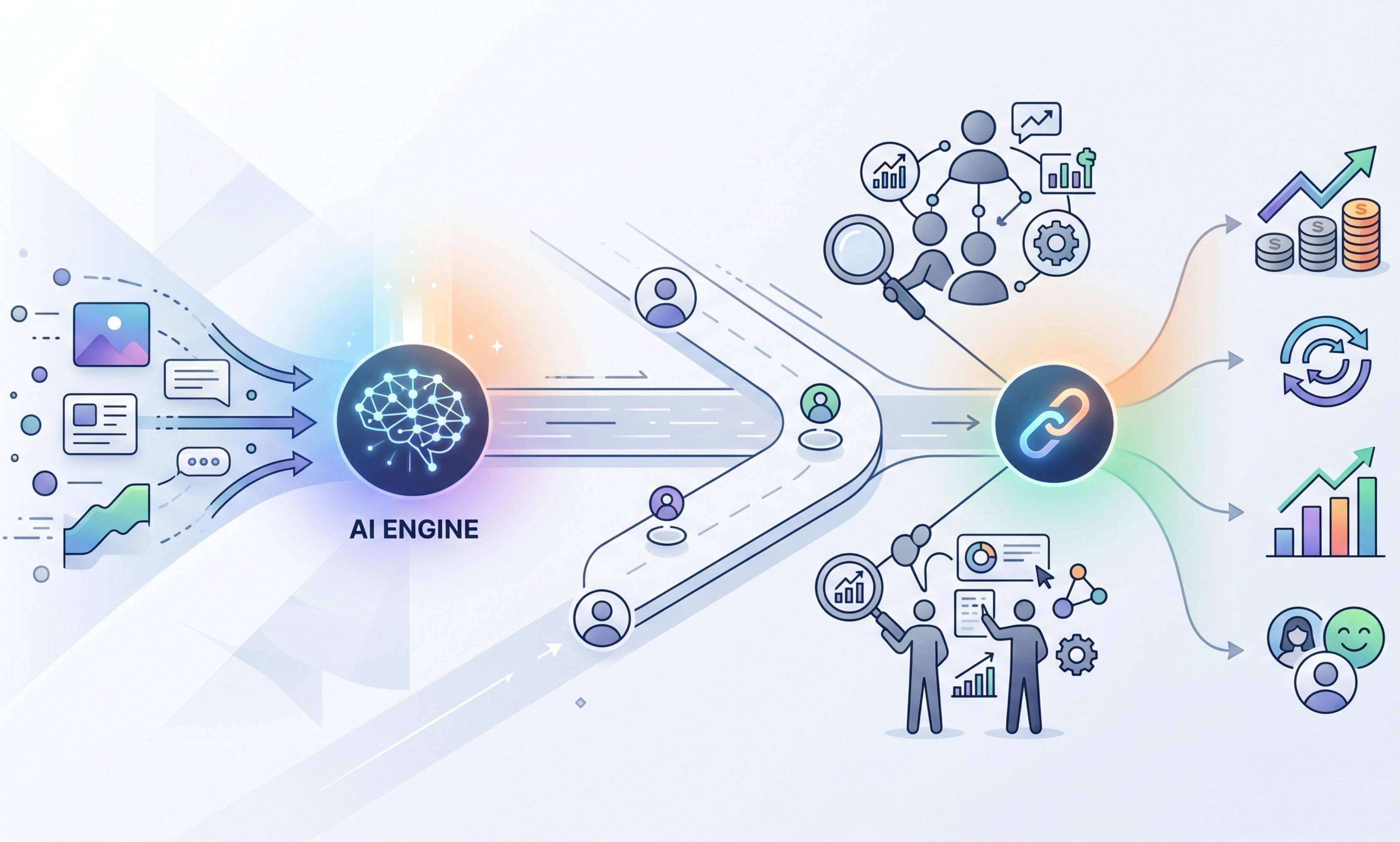
If you’re on the growth or RevOps side, you have the hardest job in GEO: attributing the pipeline that comes from AI conversations you weren’t part of. Here’s the attribution framework that actually works for SaaS companies.
Why Standard Attribution Falls Apart
Traditional B2B SaaS attribution assumes a click. AI search increasingly skips the click entirely. A buyer asks Perplexity for vendor recommendations, sees your brand cited, then types your URL directly into the browser two days later. That session shows up as direct traffic in your dashboard with zero credit to the AI mention that drove it.
The result: GEO creates a pipeline that looks like it came from somewhere else. Branded search lift, direct traffic spikes, and unexplained pipeline acceleration all hint at AI-driven discovery without proving it.
The Five-Layer Attribution Model
A practical framework for attributing an AI-influenced pipeline:
Layer 1: Direct AI referrals (the small visible slice)
Filter Google Analytics 4 referral source for chatgpt.com, perplexity.ai, gemini.google.com, copilot.microsoft.com, and claude.ai. This captures the small percentage of AI users who actually click through. Conversion rates here often run 5-10x higher than standard organic, which makes the small volume worth tracking.
Layer 2: Branded search lift (the leading indicator)
When AI engines name your brand consistently, prospects search your brand directly. Track:
- Branded keyword impression growth in Google Search Console
- Direct traffic increases that correlate with AI visibility gains
- Branded search volume growth in Ahrefs or SE Ranking
A 30-60% lift in branded search within 90 days of AI visibility gains is a strong signal that mentions are converting to demand.
Layer 3: Self-reported attribution (the human signal)
Add a question to every demo request, free trial signup, and intake form: “How did you first hear about us?” with options including:
- Google search
- ChatGPT
- Perplexity
- Gemini / Google AI
- Recommendation from a colleague
- Industry publication
- Other (please specify)
The self-reported data is messy but directionally correct. Track it monthly to see how the AI source mix evolves.
Layer 4: Sales velocity correlation (the deal signal)
AI-influenced leads tend to close faster because prospects arrive pre-educated. Track:
- Average days from lead to close for AI-source vs traditional-source leads
- Demo show-up rates by source
- Pipeline conversion rates by source
- Deal size correlation with AI source attribution
Layer 5: Cohort analysis (the long-tail signal)
Run quarterly cohort analyses comparing customers acquired before vs after major GEO investments. Look for:
- Shorter sales cycles in newer cohorts
- Higher win rates from inbound deals
- Lower CAC trending downward
- Larger deal sizes for AI-influenced cohorts
The CRM Setup That Captures AI Attribution
Configure your CRM to support GEO attribution from day one:
- Custom field for “first AI source” on lead records
- Custom field for “AI-influenced” boolean on opportunity records
- Pipeline stages tagged with originating source
- Attribution model that includes AI sources alongside traditional channels
- Quarterly cohort reports comparing AI-influenced vs traditional pipeline
Most SaaS CRMs (HubSpot, Salesforce, Pipedrive) support custom fields and reporting easily. The setup takes a few hours and pays back across every quarterly review thereafter.
What Realistic Attribution Looks Like
Don’t expect perfect attribution. Set realistic expectations:
- 30 to 50% of AI-influenced pipeline will show up in clean direct attribution
- 30 to 40% will show as branded search or direct traffic that correlates with AI visibility gains
- 20 to 30% will only appear in self-reported attribution from intake forms
- 5 to 10% will remain unattributed but show up as faster sales cycles and lower CAC
The combined picture across all five layers gives you enough confidence to keep investing. Anything less leaves money on the table because you can’t prove the channel works.
For a deeper attribution strategy, our guide on how to track prompts in ChatGPT and Gemini covers the tracking mechanics in detail.
A 90-Day SaaS GEO Roadmap
If you’re the operator running execution, here’s the practical 90-day roadmap to launch GEO from scratch. This works for any SaaS team, from a 5-person startup to a 200-person growth org.
Days 1-30: Foundation and Audit
The first month focuses on understanding where you stand and putting foundations in place.
Week 1: Baseline measurement
- Run 30-50 prompts across ChatGPT, Perplexity, Gemini, and Google AI Overviews
- Document where you’re cited, where competitors win, and where the category has open ground
- Establish your baseline Share of Model across all major AI platforms
- Set up AI visibility tracking in AI Clicks, Otterly.ai, or your tool of choice
Week 2: Technical SEO foundations
- Audit site for crawlability, speed, and schema markup
- Implement Organization, Product, FAQ, Article, and SoftwareApplication schema
- Ensure key pages render server-side (AI crawlers struggle with heavy JavaScript)
- Submit XML sitemap to Google Search Console and Bing Webmaster Tools
- Configure robots.txt to allow GPTBot, PerplexityBot, ClaudeBot, and Google-Extended
Week 3: Content audit and gap analysis
- Inventory existing content against the category-defining content stack
- Identify which pieces need refreshes vs which need to be created from scratch
- Document the top 20 prompts where competitors dominate and you’re absent
- Map content gaps to specific pieces in your content roadmap
Week 4: Quick win refreshes
- Refresh your top 5 existing pages with TL;DR-first formatting
- Add FAQ sections with question-format H3s and concise answers
- Add comparison tables and structured lists where missing
- Update statistics with current data (Princeton research found this alone increases citation rates)
Days 31-60: Content Production and Authority Building
Month two focuses on producing the category-defining content and earning the authority signals that AI engines reward.
Week 5: Category definition pieces
- Write or refresh your foundational “what is [category]” article
- Build comprehensive comparison content for “best [category] tools” queries
- Address “how to choose a [category] tool” with detailed buyer guidance
- Each piece structured for both human readers and AI extraction
Week 6: Original research and data
- Launch a survey, benchmark study, or proprietary data analysis
- Original data becomes citation magnets that competitors can’t replicate
- Format findings as quotable statistics with clear methodology
- Publish on your blog with proper schema and shareable assets
Week 7: Digital PR and brand mentions
- Pitch original research to industry publications
- Contribute expert commentary to journalists covering your category
- Earn mentions in “best of” listicles and recommendation articles
- Active engagement on Reddit, LinkedIn, and category-specific communities
Week 8: Community and review presence
- Encourage detailed reviews on G2, Capterra, Trustpilot, and Sitejabber
- Active participation on relevant subreddits and Quora threads
- Maintain consistent product information across review platforms
- Build presence on YouTube and podcasts (AI engines pull from both)
Days 61-90: Optimization and Scale
Month three focuses on optimizing what works and scaling the playbook.
Week 9: Performance audit
- Compare 60-day Share of Model against baseline
- Document which pieces earned citations and which didn’t
- Identify pattern in successful content (length, structure, data density)
- Audit which AI engines drove the most growth
Week 10: Refresh and double down
- Refresh top-performing content with new data and expanded sections
- Build cluster content around pieces that earned citations
- Add internal linking between related category content
- Update meta descriptions and structured data based on what AI engines extract
Week 11: Attribution setup
- Configure GA4 segments for AI-referred traffic
- Add self-reported attribution to demo and trial signup forms
- Set up CRM custom fields for AI source tracking
- Build a monthly GEO report template
Week 12: 90-day review and next quarter planning
- Compile complete 90-day Share of Model and pipeline impact report
- Identify the 3-5 highest-leverage activities to scale in Q2
- Document SOPs for ongoing GEO execution
- Plan the next 90 days based on what worked
Expected Results at 90 Days
Realistic outcomes for a SaaS team executing consistently:
- First citations appearing in AI Overviews and ChatGPT for niche queries
- 20-40% lift in branded search volume
- Initial AI-referred sessions in Google Analytics
- Foundational technical SEO and content in place
- Tracking infrastructure providing clear visibility data
By 180 days, you should see:
- Category-defining content earning consistent citations across major AI platforms
- 50-100% lift in branded search volume
- Visible AI-referred traffic with higher-than-average conversion rates
- AI-influenced pipeline appearing in CRM reporting
- Share of Model growth that competitors can’t easily reverse
This is the kind of systematic execution we build into every engagement at our SaaS SEO agency, helping SaaS companies move from invisible in AI conversations to consistently cited across ChatGPT, Perplexity, Gemini, and Claude.
The bigger takeaway: GEO for SaaS isn’t theoretical anymore. The companies executing now will own the AI citation share for years. The companies waiting for clearer ROI signals will spend 2027 and beyond trying to displace incumbents who got there first.
Choosing the Right GEO Partner

Most SaaS teams will eventually face the build-vs-buy decision for generative engine optimization. Some build internal capabilities. Others partner with a specialized SaaS GEO agency. Both approaches work. The mistake is picking the wrong one for your stage, or hiring an agency that can’t actually deliver. Here’s how to evaluate the decision and choose the right GEO partner if you go the agency route.
When to Build vs Buy
A practical decision framework based on team size and stage:
| SaaS stage | Recommended approach | Why |
|---|---|---|
| Pre-seed to Series A | Founder-led with one freelancer | Limited budget, founder voice matters, learning compounds |
| Series A to Series B | Hybrid (in-house lead + agency execution) | Need velocity, but internal expertise still developing |
| Series B to Series C | Specialized geo agency engagement | Scale demands proven GEO methodology, attribution rigor |
| Series C and beyond | Agency partnership + dedicated internal team | Multi-product complexity, enterprise companies need dedicated capacity |
The wrong move at each stage is usually overinvesting too early or underinvesting too late. A pre-seed founder doesn’t need a $15K/month GEO program. A Series B SaaS brand absolutely does.
What to Look for in a SaaS GEO Agency
Not every agency claiming GEO services actually delivers. The flood of generative engine optimization geo agencies launching in 2026 created a predictable problem: many are traditional SEO shops repackaging old playbooks. Watch for these markers of a legitimate partner:
- Proven SEO fundamentals: Strong technical SEO foundations are non-negotiable. GEO builds on top of search engine optimization, not instead of it. Agencies that can’t handle on-page optimization, link building, and traditional SEO performance won’t deliver GEO success either.
- Proprietary tools or partnerships: The best agencies use proprietary tools or have qualified partnerships with major AI optimization platforms. We’re a Qualified AI Clicks Partner because tracking AI visibility across ChatGPT, Perplexity, Gemini, and Claude requires infrastructure most generalist agencies don’t have.
- GEO-specific case studies: Ask for measurable proof of citation rate growth across major AI platforms, not just traditional rankings. Vague success stories without AI visibility data should be a red flag.
- Multi-platform tracking capability: A real GEO partner monitors AI generated answers across multiple AI platforms simultaneously, not just Google AI Overviews.
- Understanding of how large language models work: Ask the agency to explain semantic relationships, retrieval mechanics, and the difference between training data and live retrieval. Vague answers signal surface-level expertise.
- SaaS-specific experience: SaaS companies have different buyer journeys than e-commerce or local services. Agencies that work primarily with other verticals often miss the nuances of SaaS GEO.
Red Flags When Evaluating GEO Agencies
A few warning signs that should end the conversation:
- Promises of guaranteed AI citations (impossible, AI engines don’t accept paid placement)
- GEO services that boil down to FAQ schema and llms.txt files (these tactics alone don’t move citation rates)
- Inability to show GEO analytics or geo performance reports for past clients
- Treats GEO as identical to traditional SEO without explaining the differences
- Cannot articulate a clear geo methodology beyond generic AI buzzwords
- No tracking AI visibility infrastructure or measurement framework
Questions Every SaaS Team Should Ask
Before signing with any GEO agency, ask:
- How do you measure geo success across multiple AI platforms?
- What’s your approach to category-defining content for SaaS verticals?
- Can you walk me through your geo strategies for a recent SaaS client?
- How do you handle the intersection of GEO, AEO, and traditional SEO?
- Which AI tools do you use for tracking and competitive analysis?
- How do you measure GEO ROI in terms of pipeline contribution?
- What’s your typical onboarding and reporting cadence?
- How do you handle content marketing alongside technical GEO work?
The answers reveal whether the agency understands GEO at a strategic level or is winging it.
The Cost Conversation
GEO agency pricing for SaaS companies typically falls into four tiers:
- Tactical execution ($2,000-$5,000/month): Limited scope, content production, basic tracking
- Mid-market GEO program ($5,000-$10,000/month): Full-stack content, technical SEO, multi-platform tracking, monthly reporting
- Enterprise GEO services ($10,000-$25,000/month): Dedicated team, custom dashboards, digital PR, advanced attribution, multi-product coverage
- Custom enterprise companies ($25,000+/month): Multi-brand, multi-region, complex implementations with deep AI optimization integration
Cheaper isn’t always worse. More expensive isn’t always better. The right price tier depends on your stage, complexity, and how aggressive your AI search visibility goals are.
Why GEO Should Be Treated as a Long-Term Investment
The biggest mistake SaaS teams make: expecting GEO results in 30 days, then pulling investment when results take 90-120 days to materialize. Generative engines don’t behave like Google’s traditional search. Citation rates compound over time as AI models trust your brand more with each piece of content you publish. Treat GEO like a 12-month commitment minimum, not a quarterly experiment.
This long-term mindset is what separates SaaS brands earning durable AI search visibility from those wondering why their geo program never produced results.
How We Approach GEO for SaaS
At Doc Digital SEM, we built our SaaS GEO services around the principles outlined throughout this guide. Our geo focuses span:
- Technical SEO foundations: Schema markup, site architecture, AI crawler accessibility, and on-page optimization that lets generative engines extract content cleanly
- Category-defining content: Comprehensive resources that AI models trust as the authoritative source for your category
- Multi-platform tracking: Real-time visibility across ChatGPT, Perplexity, Gemini, Claude, and Google AI Overviews using AI Clicks and our custom dashboards
- Digital PR and brand building: Earned mentions across trusted publications that AI engines reference when generating AI responses
- Attribution infrastructure: Connecting AI visibility data to pipeline and revenue, not just user queries and impressions
The combined approach treats GEO as one integrated strategy rather than a checklist of disconnected geo tactics.
So, choosing the right geo partner matters more than which tactics they use. The agencies that will deliver real results in 2026 understand that GEO sits on top of proven SEO fundamentals, requires dedicated tracking infrastructure, and compounds over months and years.
Pick a partner aligned with that mindset, and AI visibility becomes a durable competitive advantage. Pick wrong, and you’ll spend 12 months wondering why your traffic still comes from the same places it always did.
Win SaaS Pipeline With Doc Digital SEM
SaaS buyers stopped starting their evaluations on Google. They start in ChatGPT, Perplexity, and Gemini now. The companies winning AI citation share built foundations early, owned category-defining content, and treated GEO as a long-term commitment. The window for first-mover advantage is closing fast.
Key takeaways:
- GEO is the highest-leverage acquisition channel for SaaS founders right now
- Share of Model replaces keyword rankings as the new north star metric
- Category-defining content earns top-of-funnel AI citations that compound over time
- AI-influenced pipeline requires a five-layer attribution to capture the full impact
- A 90-day execution roadmap delivers visible Share of Model growth and pipeline indicators
- Choose a GEO agency with proprietary tools, SaaS experience, and proven citation results
If your SaaS team needs to show up in the AI conversations where buying decisions actually happen, Doc Digital SEM builds GEO services for SaaS operators across verticals. Want a free GEO audit? Let’s talk.
FAQs
Why Is GEO Important for SaaS Companies?
GEO matters because 55% of enterprise buyers start evaluations in AI powered search engines. A successful GEO gets your SaaS cited in AI generated responses where buying decisions now happen.
How Is GEO Different From Traditional SEO?
Traditional SEO focuses on ranking pages for organic search clicks. Unlike traditional SEO, GEO targets citations inside AI generated responses by optimizing content for machine learning models that synthesize answers.
Is GEO the Same as Answer Engine Optimization?
GEO and answer engine optimization overlap but differ slightly. AEO focuses on direct answers in featured snippets. GEO focuses on getting cited as a source by AI systems generating multi-paragraph responses.
How Long Does GEO Take to Show Results?
Most SaaS companies see initial citation growth in 60-90 days. Branded search traffic and pipeline impact typically follow within 90-120 days of consistent SEO implementation and content production.
Can I Run GEO Without Strong AI SEO Foundations?
No. GEO builds on traditional SEO. AI systems pull from sources that already rank well, so create content optimized for both organic search and generative engines simultaneously for best results.


