


Your Google rankings didn’t drop because your SEO got worse. They dropped because the game changed around you. 5 8.5% of Google searches now end without a single click to any website, and 77% of Americans who use ChatGPT treat it as a search engine. That’s not a future projection. It’s the search landscape your content is competing in right now.
GEO and SEO aren’t opposites. But they’re not the same thing either, and running one without the other means leaving visibility on the table across half the surfaces your buyers are using. This article breaks down exactly how they differ, where they connect, and what a strategy built for both actually looks like.
Here’s what we’re covering:
- What GEO and SEO each do and how they work
- The core differences in how they’re measured and optimized
- Why SEO alone is no longer enough in AI-driven search
- How GEO builds on your existing SEO foundation
- Which signals matter most for each strategy
- How to run both without doubling your workload
- What most brands get wrong when making the switch
We’ve been building strategies at the intersection of GEO and traditional SEO long before most agencies knew what to call it. Our GEO services and AI SEO approach are built for brands ready to compete on both fronts.
The Core Differences in How They’re Measured and Optimized
Most brands discover the GEO vs SEO measurement gap the hard way. Traffic starts dropping. Rankings look fine. Google Search Console shows nothing alarming. But AI summaries across ChatGPT, Perplexity, and Google’s AI Overviews are answering the exact questions their customers are asking, and their brand isn’t anywhere in those responses.
That’s the measurement blind spot. Traditional SEO metrics tell you how you’re performing in traditional search. They tell you nothing about what’s happening inside generative AI.
How SEO Is Measured
Traditional SEO optimizes for a set of signals that have been trackable for decades. The core metrics are familiar:
- Keyword rankings: Where your pages appear in search results for target queries
- Organic traffic: How many visitors arrive via unpaid search results
- Click-through rate: The percentage of people who click your result after seeing it
- Domain authority: A composite score reflecting the credibility of your site based on backlinks and site history
- Bounce rate and dwell time: Engagement signals that tell Google whether your content satisfied user intent
- Core Web Vitals: Site speed, visual stability, and interactivity scores that reflect technical optimization quality
These metrics are all click-based. Traditional SEO focuses on the moment a user sees your result and decides to visit. Every metric downstream flows from that click.
The tools that track them, Google Search Console, Ahrefs, Semrush, and Moz, are mature, reliable, and widely understood. SEO measurement is difficult, but at least it’s well-defined.
How GEO Is Measured
Generative engine optimization GEO operates in a fundamentally different measurement environment. There are no keyword rankings to check because generative engines don’t produce ranked lists. There is no position one. Your brand either appears in an AI-generated answer or it doesn’t, and the same query can produce a different response minutes later.
GEO success is measured through:
- Citation frequency: How often AI systems reference your brand when answering relevant queries across ChatGPT, Perplexity, Claude, and Google Gemini
- Share of voice: Your mention rate in AI answers compared to competitors for your category’s core queries
- Brand mentions across the web: How consistently your brand appears in third-party sources that generative AI platforms pull from, including review sites, industry publications, and community forums
- AI-referred traffic: Referral sessions in your analytics from domains like ai.chatgpt.com, perplexity.ai, and similar AI tools
- Sentiment in AI responses: Whether the context around your brand mentions is positive, neutral, or negative when AI models reference you
- Prompt coverage: The range of queries for which your brand is cited, mapped against your target topics
The challenge is that traditional SEO metrics don’t capture any of this. A brand can rank position one for twenty competitive keywords while being completely absent from every AI-generated answer in their category. To track GEO, you need dedicated AI visibility tools like Profound, Scrunch, or Ahrefs Brand Radar, combined with regular manual prompt testing across the major AI platforms.
You can go deeper on the measurement side through our guide on how to track prompts in ChatGPT and Gemini, which covers the practical mechanics of building an AI visibility strategy around real prompt data.
How Optimization Differs
The optimization process for each strategy runs on different logic from start to finish.
| SEO Optimization | GEO Optimization | |
|---|---|---|
| Starting point | Keyword research and search volume data | Prompt research and AI response auditing |
| Content goal | Rank for target queries in traditional search results | Earn citations in AI-generated answers |
| On-page priority | Meta tags, headings, keyword placement, internal links | Direct answers, semantic density, cited statistics, expert quotes |
| Technical priority | Site speed, crawlability, Core Web Vitals, schema markup | AI crawler access, structured data, entity markup |
| Off-page priority | Backlinks from authoritative domains | Brand mentions across publications, forums, and review sites |
| Content format | Long-form, keyword-optimized, pillar and cluster structure | Modular, answer-structured, source-cited, FAQ pages with schema |
| Freshness signal | Regular updates support ranking stability | AI models strongly prefer content updated within 90 days |
| E-E-A-T application | Author credentials, sourced claims, and trust signals for Google | Same signals, applied to earn trust from AI systems evaluating citation-worthiness |
The optimization overlap between the two is significant, which is actually good news. High-quality content, structured formats, credible sourcing, and technical health serve both. The divergence lives in the final layer: GEO adds entity building, prompt-specific content gaps, and off-site brand presence work that traditional SEO never prioritized.
Why SEO Alone Is No Longer Enough
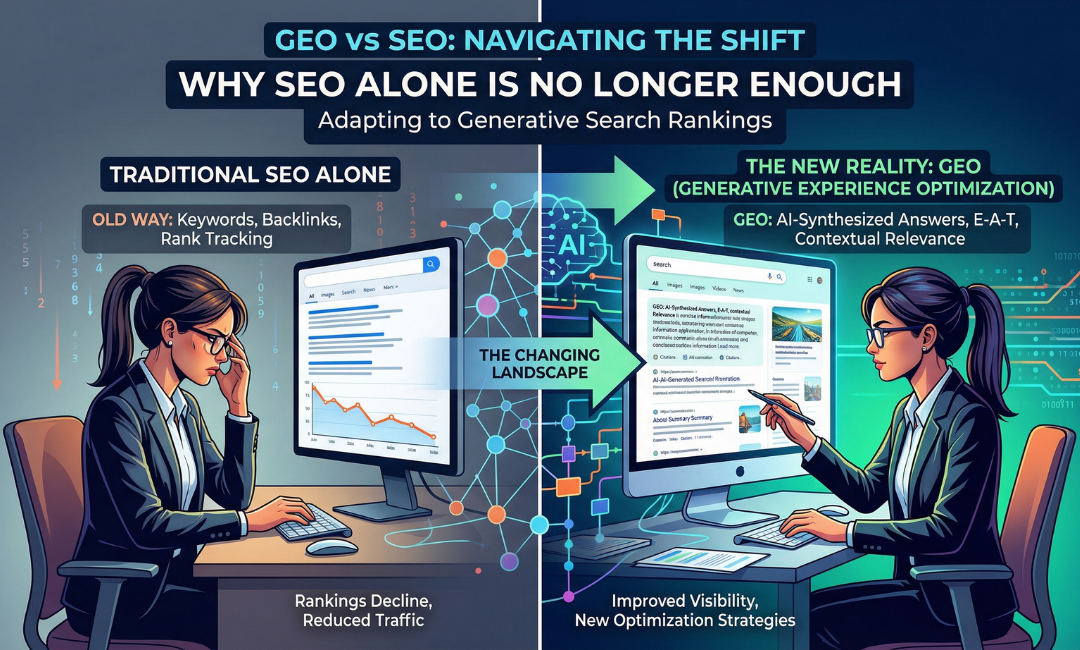
This isn’t a prediction about where search is going. It’s a description of where it already is.
People search differently now. A growing share of queries never reach a traditional results page at all. They go directly into ChatGPT, Perplexity, or Google’s AI Overviews, where a synthesized answer replaces the list of blue links entirely. If your brand isn’t inside those AI answers, you’re invisible at the exact moment a potential customer is making a decision.
The numbers that define the shift:
- Zero-click searches reached 69% of all Google searches by mid-2025
- AI-referred sessions to websites grew 527% year-over-year in the first half of 2025
- Google’s AI Overviews now appear on over 13% of all searches, up from 6.49% at the start of 2025
- 77% of Americans who use ChatGPT treat it as a search engine
- AI-referred visitors convert at 3-4x the rate of standard organic traffic
Traditional SEO focuses on capturing the user after they’ve decided to click. Generative AI captures the user before they’ve decided anything, shaping their understanding of the category, the options, and the right solution during the research phase itself. By the time an AI-referred visitor reaches your site, they’ve often already been pre-sold.
The Specific Gaps SEO Can’t Fill
Here are some of the gaps SEO can’t fill:
Gap 1: AI summaries are replacing clicks entirely
When someone asks Google’s AI Overviews “what’s the best approach to local SEO for a small business,” they get a comprehensive answer with cited sources. If your brand isn’t one of those sources, that user formed their entire understanding of the topic without encountering you. Traditional search rankings don’t fix this. Only GEO does.
Gap 2: Generative AI platforms operate outside Google’s index
Traditional SEO optimizes for Google’s algorithm. But ChatGPT, Perplexity, and Claude operate on their own retrieval and training logic. Ranking number one on Google does not guarantee you appear in a single AI-generated response on those platforms. The two systems overlap, but they are not the same. Brands that ignore GEO are optimizing for one channel while a parallel channel grows around them.
Gap 3: Brand recognition is being shaped without your input
When people search for category-level information using AI tools, the brands that appear in AI answers are the ones shaping perception. If competitors are consistently cited in responses to your core category queries and you’re not, those AI systems are actively building brand recognition for your competitors at your expense. You’re not just missing traffic. You’re losing the narrative.
Gap 4: Keyword rankings don’t reflect AI visibility
A page can hold the top spot in traditional search results for a competitive keyword while earning zero mentions across all major AI platforms. Keyword rankings measure one thing. AI visibility measures another. Treating them as the same metric is one of the most common and costly mistakes in modern digital strategy.
The brands navigating this transition well aren’t abandoning SEO. They’re recognizing that a solid SEO foundation is the prerequisite for GEO, not a substitute for it. Our AI search visibility guide outlines what the full picture looks like when both channels are measured together.
How GEO Builds on Your Existing SEO Foundation
Here’s the reframe that makes GEO far less daunting: if your SEO is already strong, you’ve done most of the foundational GEO work without knowing it. Generative engine optimization isn’t a replacement strategy. It’s the next layer.
The reason is structural. AI systems that retrieve content for generative answers pull from the same pool of authoritative, well-structured, credible web pages that Google rewards in traditional search. A site that is technically sound, topically authoritative, and trusted by credible external sources is already positioned to earn AI citations. GEO adds specificity on top of that base, not a parallel system from scratch.
The SEO Signals GEO Directly Inherits
- Technical health carries over completely. Site structure, site speed, clean crawlability, and proper schema markup matter for both traditional search rankings and AI crawler access. AI systems understand your content better when it’s technically accessible. A site with broken architecture, slow load times, or blocked crawl paths is invisible to both Google and generative engines. Technical optimization is shared work.
- Domain authority transfers to citation credibility. AI systems evaluate the credibility of sources before deciding whether to cite them. A domain with strong backlink authority, consistent E-E-A-T signals, and a history of accurate, well-sourced content earns more AI citations. The authority signals your SEO work built over the years directly translates into GEO credibility.
- Topical authority maps directly to AI trust. The content cluster strategy that drives SEO rankings, pillar pages supported by deep supporting articles, is the same structure that generative engines use to assess whether a brand genuinely owns a topic. A brand that has published twenty interconnected, well-researched articles on a subject is far more likely to be cited by AI models than one with a single page targeting the same keyword.
- High-quality content is the shared foundation. Both SEO and GEO reward content that is accurate, well-researched, and genuinely useful. The difference is in the details. GEO adds specific requirements on top of content quality: original data points, cited statistics, expert quotes with attribution, and structured formats that AI systems can parse passage by passage. But the base requirement of high-quality content is identical.
What GEO Adds on Top of SEO
GEO shifts the content equation in three specific directions that pure SEO never addressed:
- Off-site brand presence beyond backlinks: Traditional SEO focuses on backlinks as the primary off-page signal. GEO requires a broader footprint. Brand mentions in industry publications, appearances in Reddit discussions, reviews on G2 or Trustpilot, and citations in news articles all tell generative AI that your brand is credibly discussed across the web. This is the “earned media” layer that SEO never fully emphasized, but GEO depends on.
- Entity clarity and consistency: AI models build their understanding of your brand from every reference to it across the web. If your website describes you as a “digital marketing agency,” your LinkedIn says “growth consultancy,” and your press coverage calls you an “SEO firm,” language models receive a fragmented signal. GEO adds the discipline of maintaining consistent terminology, consistent brand descriptions, and consistent category associations across every surface where your brand appears.
- Answer-structured content at the passage level: SEO optimizes pages. GEO optimizes passages. AI systems often retrieve a single well-structured paragraph from a longer article rather than the article as a whole. GEO adds the habit of front-loading direct answers, structuring FAQ pages with schema markup, and writing every major section so it can stand alone as a citable answer without surrounding context.
Case Study: O2pure
O2pure came to us with a solid product and a visibility problem. Their content foundation was there, but it hadn’t been structured for how AI systems evaluate and cite sources. Once we layered GEO-specific optimizations on top of their existing content infrastructure, including answer-structured pages, cited data, and entity-clear brand signals across third-party sources, they saw a 550% improvement in ChatGPT rankings and generated over 1,000 qualified leads through their digital presence. The SEO foundation didn’t need to be rebuilt. It needed the GEO layer added on top of it. That’s exactly how these two strategies are supposed to work together. Read the full case study.
Which Signals Matter Most
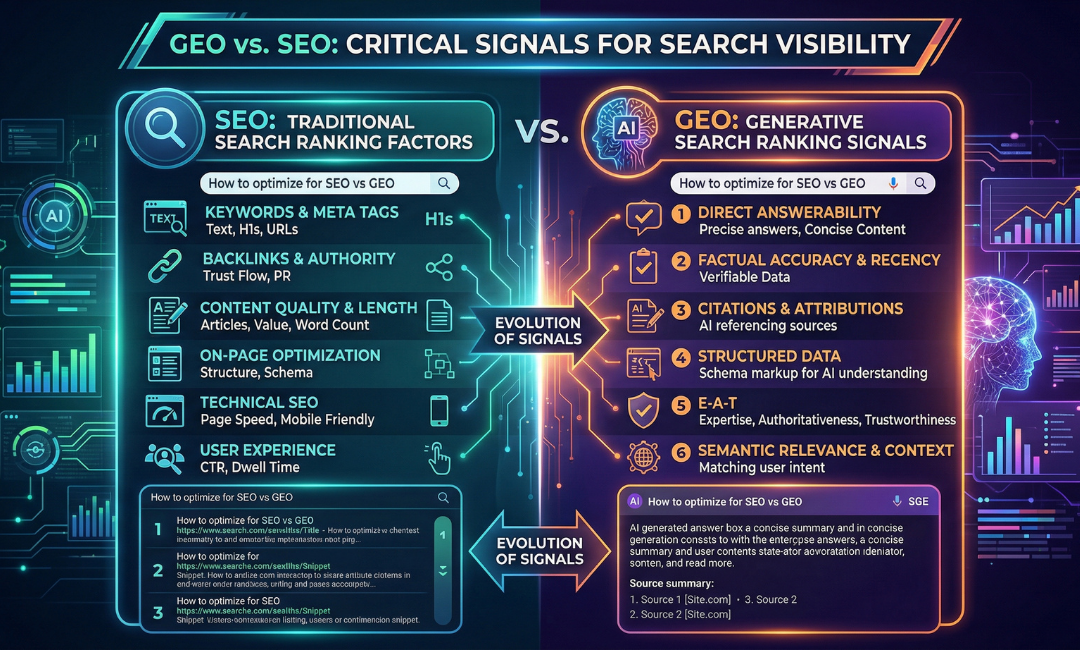
Search is moving fast. The signals that drive results are a mix of familiar SEO fundamentals and newer GEO-specific requirements. Getting the balance right is what separates brands that stay visible from those that gradually disappear from both traditional and AI-driven search.
Top SEO Signals
- Content quality and topical depth: Google continues to reward consistently published, genuinely helpful content that satisfies user intent comprehensively. Thin content, regardless of how well it’s technically optimized, performs worse year over year as Google’s ability to evaluate quality improves. Topical authority built through interconnected content clusters remains one of the strongest ranking levers available.
- E-E-A-T signals: Experience, Expertise, Authoritativeness, and Trustworthiness are more important than ever as AI-generated content floods the web. Author credentials, cited sources, transparent business information, and consistent publishing history all strengthen E-E-A-T. Google is actively working to distinguish credible human expertise from mass-produced synthetic content, and E-E-A-T signals are the primary mechanism.
- Core Web Vitals and site speed: Site speed and technical performance remain firm ranking signals. A slow, unstable site that frustrates users sends negative engagement signals that suppress rankings regardless of content quality. Mobile-first performance is the baseline expectation, not a differentiator.
- User engagement signals: Click-through rate, dwell time, and return visits all factor into how Google interprets whether your content genuinely satisfied a search query. Content that earns clicks but sends visitors back to the results page within seconds tells Google your page didn’t deliver.
Top GEO Signals
- Original data and cited statistics: The Princeton GEO research found that adding statistics improved AI visibility by up to 40%. Generative AI platforms favor content that contains verifiable, source-attributed data because it gives them material they can cite with confidence. Original research, proprietary data, and named citations outperform unsourced claims by a significant margin.
- Expert quotes with attribution: Named experts with clear credentials cited inside content carry substantial weight as GEO signals. AI models treat attributed expert quotes as authority signals, much like how editorial publications use them to establish credibility. Content that includes real expert perspectives, not just paraphrased information, consistently earns more AI citations.
- Brand mentions across trusted sources: Generative AI builds its model of your brand from every mention it encounters across the web. Track brand mentions in industry publications, monitor how your brand appears in review platforms and community forums, and actively pursue earned coverage in sources that AI systems already treat as authoritative. This is the off-site GEO layer that compounds over time.
- Schema markup and structured data: Structured data tells AI systems how to categorize and understand your content. FAQ schema, HowTo schema, and Article schema all improve how generative engines parse and store your pages. Brands that implement schema consistently across their content library give AI crawlers a cleaner, more confident picture of what they offer.
- Content freshness: AI models show a strong preference for recently updated content. Pages that haven’t been touched in over 90 days see measurably lower citation rates compared to regularly refreshed content. Updating existing high-performing pages with new data, current statistics, and fresh examples is one of the highest-ROI GEO activities available.
How to Run Both Without Doubling Your Workload
The most common objection to GEO is capacity. Running a full SEO operation already demands significant time and resources. Adding a parallel GEO program feels like a second full-time job. It doesn’t have to be.
The efficiency comes from recognizing that the two strategies share the same content infrastructure. You’re not writing two versions of everything. You’re writing one version that serves both, with deliberate additions that activate the GEO layer.
The practical integration framework:
Step 1: Audit existing content for GEO readiness
Before creating anything new, review your highest-traffic pages. Do they have a direct answer in the first 40-60 words? Do they include cited statistics? Are the headings structured as questions? Do they have an FAQ schema? For most brands, 30-40% of their existing content is close to GEO-ready with minor structural edits, not rewrites. Start there. It’s the fastest ROI available.
Step 2: Write new content with both layers built in
Every new piece of content should follow a structure that serves SEO and GEO simultaneously: a direct answer block at the top, keyword-optimized headings that also reflect how people search in AI tools, deep topical coverage for authority signals, cited statistics throughout, and an FAQ section with schema markup at the end. One piece. Both channels.
Step 3: Build a content refresh cycle
Rather than treating GEO as a separate content calendar, fold it into your existing refresh schedule. When a page gets its quarterly SEO update, add a fresh data point, update the cited statistics, and check whether the direct answer block still reflects the most current information. Content freshness serves both channels. It’s one effort with dual returns.
Step 4: Add off-site brand presence systematically
Dedicate a portion of your existing link-building and PR activity to sources that specifically drive GEO signals. Target industry publications that AI platforms already cite. Build a presence on platforms like Reddit, LinkedIn, and G2 where generative AI pulls authentic community-validated content. This doesn’t replace backlink building. It redirects a portion of the same budget toward sources that serve both SEO authority and GEO citation signals.
Step 5: Set up a simple GEO measurement routine
Once a month, manually test 10-15 of your target prompts across ChatGPT, Perplexity, and Google’s AI Overviews. Document whether your brand appears, how it’s characterized, and which competitors are being cited instead. This takes roughly an hour and gives you the directional data needed to adjust your content strategy without requiring expensive dedicated tooling at the start.
What Most Brands Get Wrong When Making the Switch
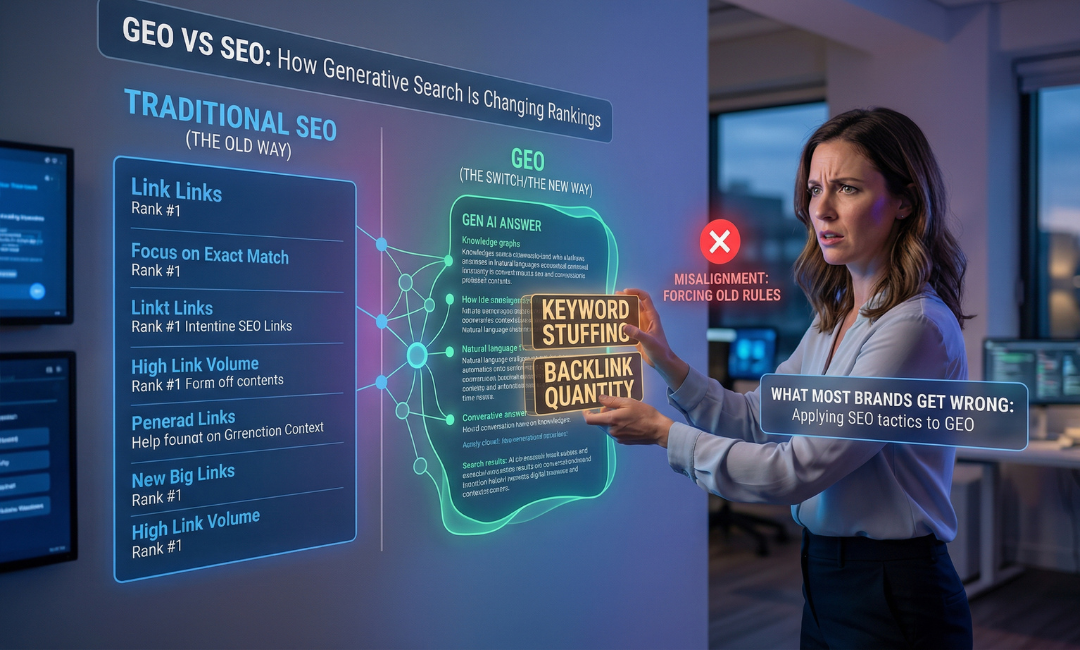
The transition from pure SEO to a combined GEO and SEO strategy is where most mistakes happen. Not because the strategies are hard to understand, but because old habits are hard to break.
Mistake 1: Treating GEO as a replacement for SEO
GEO shifts the conversation, but traditional SEO is still the foundation everything sits on. Brands that pivot entirely to GEO tactics without maintaining their SEO program typically see organic traffic erode while their GEO efforts fail to compensate, because generative engines still draw heavily from content that ranks well in traditional search results. SEO aims to build the authority that GEO inherits. Dropping one to fund the other is a false economy.
Mistake 2: Ignoring GEO until organic traffic drops
By the time a significant organic traffic decline is visible in analytics, competitors have already established citation patterns inside AI engines that compound daily. Generative AI tends to reinforce existing citation choices over time. Getting cited early makes it meaningfully harder for late entrants to displace you. The brands that ignore GEO the longest face the steepest catch-up cost.
Mistake 3: Assuming traditional search rankings predict AI visibility
A page that holds position one in Google search results for a competitive keyword can be completely absent from every relevant AI-generated response on ChatGPT and Perplexity. Traditional SEO metrics and GEO visibility are genuinely separate measurements. Brands that use keyword rankings as a proxy for AI visibility are making decisions based on incomplete data.
Mistake 4: Optimizing content for AI systems without fixing technical access
GEO optimizes for how AI systems read and retrieve content. But if AI crawlers are blocked by your robots.txt file, if your pages are slow to load, or if your site structure buries key content too deep for efficient retrieval, no amount of content optimization changes your citation rate. Technical optimization is a prerequisite, not an afterthought.
Mistake 5: Publishing original content without distributing it
GEO rewards content that exists across multiple trusted sources. A well-researched article published exclusively on your site is one data point for AI systems. That same research cited in three industry publications, discussed in a Reddit thread, and referenced in a partner blog is a pattern, and patterns are what AI models build authority associations from. Content strategy without distribution is half a GEO strategy.
Mistake 6: Expecting GEO results in SEO timelines
SEO results are slow. Most practitioners accept a 3-6 month window before meaningful ranking movement. GEO operates on a similar timeline for initial citation improvements, but brand recognition inside AI models compounds differently from keyword rankings. Some brands see AI citations emerge in weeks when their existing authority is strong.
Others invest for months before patterns become consistent. Expecting predictable, linear results from GEO in the way SEO produces them leads to premature abandonment of a strategy that was actually working.
Real World: Beep Beep Jeep
When Beep Beep Jeep came to us, they had six Jeeps, a thin digital presence, and no clear content strategy guiding either their SEO or their emerging AI visibility. We built the SEO foundation first: topical authority, technical health, and content structured around how their audience actually searches. With that base in place, the GEO layer had something real to work with. The results were anything but small. Organic traffic grew 1,800%, Jeep rental sales climbed 450%, and the fleet scaled from 6 to 24 vehicles. Sequencing matters. Get the foundation right first, and every layer you add on top compounds faster. Read the full case study.
Stop Choosing Between GEO and SEO With Doc Digital SEM
SEO and GEO aren’t rivals fighting for your budget. They’re sequential layers of the same visibility strategy, and the brands treating them that way are pulling ahead while everyone else is still debating which one matters more. Build the foundation. Add the layer. Measure both.
Key takeaways:
- Traditional SEO builds the authority and technical foundation that GEO directly inherits
- GEO optimizes for citations inside AI-generated answers, not rankings in search results
- Zero-click searches and AI summaries are already eating into organic traffic across every industry
- High-quality content, E-E-A-T signals, and structured data serve both strategies simultaneously
- GEO measurement requires tracking brand mentions and AI citations, not just keyword rankings
- Content freshness is a critical GEO signal, update high-performing pages at least every 90 days
- Brands that ignore GEO now face a compounding disadvantage that gets harder to close over time
- One well-structured content strategy, executed consistently, can run both channels without doubling your workload
At Doc Digital SEM, we build GEO strategies and AI SEO programs that sit on top of a solid SEO foundation, so your brand earns visibility in traditional search and inside AI-generated answers at the same time. Get your free audit and find out exactly where your brand stands across both channels today.
Frequently Asked Questions
What is the difference between SEO and GEO?
The short answer: SEO gets you ranked in traditional search results, GEO gets you cited in AI-generated answers. Search engine optimization focuses on keywords, backlinks, and technical signals that help Google rank your web pages.
GEO focuses on semantic depth, entity clarity, and brand visibility across the sources that large language models and generative platforms pull from when synthesizing responses. Both target search visibility. The channel they optimize for is what differs.
Is GEO replacing SEO?
No. GEO builds on search engine optimization rather than replacing it. The core principles behind both strategies overlap significantly: high-quality content, credible authority signals, and technical accessibility that helps AI understand your pages. What’s changing is user behavior. More people are getting answers from answer engines like ChatGPT and Perplexity instead of clicking traditional search results. GEO addresses that shift without making SEO irrelevant. You need both.
How to move from SEO to GEO?
Don’t move from one to the other. Layer GEO on top of your existing SEO foundation. Start by auditing your highest-traffic pages for answer engine optimization readiness: do they have direct answer blocks, cited statistics, and FAQ schema?
Then expand your off-site presence into sources that generative platforms already trust. Add prompt tracking alongside your existing rank tracking. That progression lets your SEO program keep running while GEO visibility builds in parallel.
Is GEO part of SEO?
GEO focuses on a distinct set of signals, but it sits within the broader umbrella of modern search optimization. Answer engine optimization, GEO, and traditional SEO all share the same foundation: content that helps AI understand your brand accurately, technical accessibility, and credible authority signals. Where GEO diverges is in optimizing for how content appears inside AI-generated responses rather than ranked lists. Think of GEO as the AI-era extension of SEO, not a separate discipline.


