


Ranking #1 on Google used to mean something. Now your top-ranking page can get buried beneath an AI-generated summary that cites your competitor instead. The rules changed, and 63% of businesses that adapted early report positive impacts on their visibility.
This guide covers exactly how to show up in AI Overviews on Google:
- What AI Overviews are and how Google selects sources
- Content structure and formatting that earns citations
- E-E-A-T signals that build AI trust
- Technical requirements your site must meet
- Schema markup that improves extraction
- Common mistakes that block inclusion
- Tools to track your AI Overview performance
Doc Digital SEM helps businesses earn visibility across both traditional search and AI-powered results. Our strategies focus on getting your brand cited where searchers actually look first.
What AI Overviews Are and How Google Selects Sources
Understanding how to show up in AI overviews on Google starts with knowing what you’re optimizing for. These aren’t your typical search results.
The Basics of Google’s AI Overviews
Google’s AI overviews are AI-generated summaries that appear at the top of search results for certain queries. Instead of showing you a list of blue links and letting you click through, Google search now synthesizes information from multiple sources into a single, scannable answer.
Think of it as Google doing the reading for you, then presenting the highlights.
AI Overviews now appear in over 50% of all searches as of August 2025, representing a dramatic increase from 18% in March 2025.
Here’s how AI overviews differ from what came before:
| Feature | Featured Snippets | AI Overviews |
|---|---|---|
| Sources | Single webpage | Multiple sources |
| Content | Direct excerpt | Synthesized answer |
| Format | Quote or list | AI-generated answer |
| Links | One citation | 3-8 citations average |
| Queries | Simple questions | Complex, multi-part |
The search generative experience fundamentally changed how search engines deliver information. Featured snippets pull from one source. AI overviews combine insights from several trusted pages into one cohesive response.
How Google’s AI Decides Which Sources to Cite
Google hasn’t published an official rulebook. But research reveals clear patterns in which pages earn citations in Google’s AI overviews.
The selection process works like this:
- A user enters a query in the search bar
- Google’s AI uses “query fan-out” to break complex questions into subtopics
- The system searches across Google search results for relevant content
- Gemini (Google’s AI model) evaluates sources for authority, clarity, and relevance
- The AI synthesizes information and selects which pages to cite
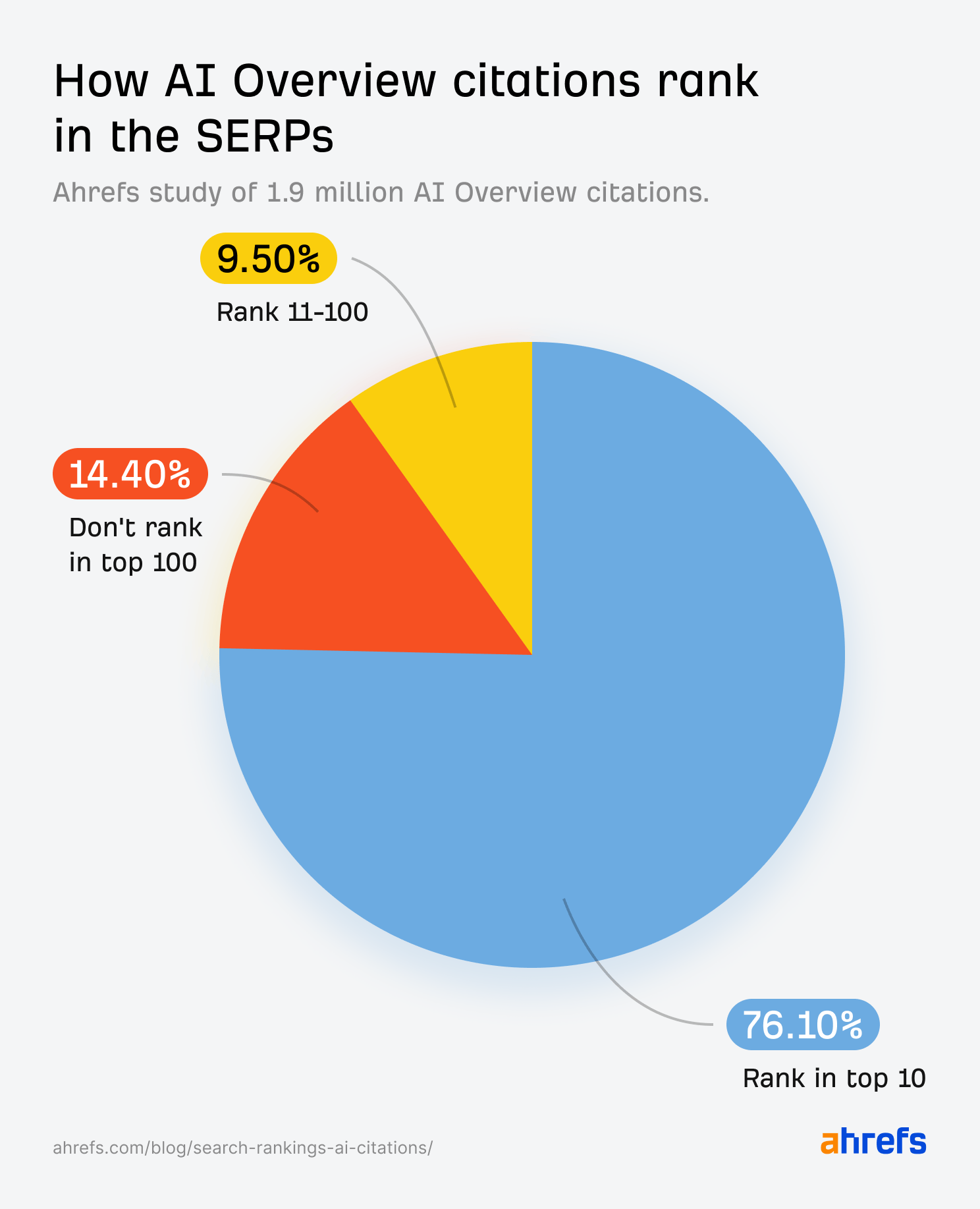
Research from Ahrefs shows that 76% of AI Overview citations come from pages ranking in the top 10 organic results, with 48-52% of citations overlapping traditional top-ranking pages.
Credit: Ahrefs
But here’s the twist: ranking in the top 10 doesn’t guarantee inclusion. 47% of AI Overview citations now come from pages ranking below position #5.
What Google’s AI Looks For
Based on analysis of thousands of AI search results, certain signals consistently appear in cited pages:
Content signals:
- Direct answers to search queries positioned early in the content
- Clear, scannable structure with logical organization
- Original data, research, or unique insights
- Comprehensive coverage of the topic
Authority signals:
- Strong E-E-A-T indicators
- Citations from and links to authoritative references
- Brand mentions across the web
- Recognized expertise in the subject area
Technical signals:
- Fast page load speeds
- Mobile optimization
- Proper indexing and crawlability
- Structured data implementation
Across nearly every industry, three domains dominate AI’s citations: YouTube (~23.3%), Wikipedia (~18.4%), and Google.com (~16.4%). Reddit, LinkedIn, and Facebook also earn significant citation share.
The pattern is clear: generative AI systems favor content that educates, provides unique value, and comes from sources with established credibility.
Why Some Pages Get Cited, and Others Don’t
Two pages can rank similarly in traditional search results, yet only one appears in Google’s AI overviews. The difference often comes down to “citation readiness.”
Think of it as building a page that a cautious system can safely reference. It doesn’t mean stuffing AI Overviews keywords everywhere. It means engineering pages that are easy to quote, technically eligible, and consistently monitored.
Google’s AI is making a risky decision. It needs sources it can trust not to make it look wrong. Pages with vague claims, outdated information, or unclear sourcing get passed over, even if they rank well in organic search results.
Content Structure and Formatting That Earns Citations

Knowing what AI overviews are is one thing. Getting your site to appear in them requires specific content engineering.
Lead With Direct Answers
Google’s AI prioritizes content that immediately addresses search intent. If your answer is buried under a long introduction, the AI may skip your page entirely.
Begin each article with a summary box or TL;DR that answers the primary query in 50-70 words. AI models prioritize content that immediately addresses user intent without requiring extensive reading.
The answer-first formula:
- Open with a 40-60 word summary that directly answers the main question
- Place this immediately under your H1 or primary H2
- Include one key data point if relevant
- Point to deeper detail below
This works for AI overviews because the system can extract a clean, quotable passage without parsing through paragraphs of context. Users searching through Google search get their answer fast, and your page becomes the trusted source.
Structure Content for AI Extraction
AI systems don’t read content as humans do. They scan for patterns, extract self-contained blocks, and evaluate how information connects.
Formatting that improves citation odds:
| Element | Why It Works | Implementation |
|---|---|---|
| Question-based H2s | Matches how users search | “How does X work?” headers |
| Short paragraphs | Easier to extract | 2-4 sentences max |
| Bulleted lists | Scannable format | Key points, steps, features |
| Tables | Comparison-friendly | Specs, options, data |
| FAQ sections | High citation rate | Common questions + answers |
AIO typically cites multiple sources (on average, ~8 per response), heavily biased toward pages already in the top 10 organic results, but not exclusively so. Structure and topical completeness decide who gets the nod inside the box.
Use Structured Data Strategically
Structured data helps Google’s AI understand what your content means, not just what it says. While Google states there’s no special “AI Overview schema,” proper markup improves machine readability.
Priority schema types:
- Article schema: Identifies content type, author, publish date
- FAQPage schema: Marks up question-and-answer content
- HowTo schema: Structures step-by-step processes
- Organization/Person schema: Connects content to recognized entities
A DemandSage report from 2025 found that websites implementing schema were 2.4x more likely to appear in AI-generated results.
Important note: markup must reflect what’s visibly on the page. Don’t add FAQ schema unless you have actual FAQs displayed. Google’s systems can detect mismatches.
Write in Extractable Blocks
The best content for AI summaries reads like a series of self-contained units. Each section should make sense on its own, even if pulled out of context.
Characteristics of extractable content:
- Specific rather than vague (“reduces load time by 40%” vs. “improves performance”)
- Complete thoughts in single paragraphs
- Clear cause-and-effect relationships
- Named entities (brands, products, concepts) for context
Content scoring above 8.5/10 on semantic completeness is 4.2x more likely to be cited. AI prioritizes passages that fully answer queries in 134-167 word self-contained units.
If you run content through search labs or test queries manually, you’ll notice that cited passages almost always function as standalone answers.
Avoid These Formatting Mistakes
Some common practices actively hurt your chances of appearing in AI overviews:
What to avoid:
- Burying the answer halfway down the page
- Over-optimizing with thin snippets that lack nuance
- Using vague language that requires context to understand
- Writing paragraphs that run 200+ words without breaks
- Neglecting image alt text and captions
If the first answer appears halfway down the page, models may favor a clearer source.
The search process has changed. Google’s AI rewards pages that make information easy to find and extract, not pages that force readers to hunt for answers.
E-E-A-T Signals That Build AI Trust
You can have perfect structure and still get ignored. Google’s AI overviews only cite sources it trusts. That trust comes from E-E-A-T: Experience, Expertise, Authoritativeness, and Trustworthiness.
Why E-E-A-T Matters More Than Ever
96% of AI Overview citations come from sources with strong E-E-A-T signals, while pages with 15+ recognized entities show 4.8x higher selection probability.
With generative AI flooding the internet with content, search engines need filters to separate real experts from imitators. E-E-A-T is that filter.
Google’s AI is making a risk decision every time it cites a source. Citing inaccurate information makes Google look bad. So the system defaults to sources with established credibility, especially for topics that could impact health, finances, or safety.
E-E-A-T determines eligibility, while SEO, GEO, and LLMO determine selection within the eligible content.
Experience: Prove You’ve Done the Work
The first “E” in E-E-A-T evaluates whether you have first-hand knowledge of your subject. AI systems favor content backed by real-world involvement, not just research.
How to demonstrate experience:
- Share case studies from actual projects
- Include photos, screenshots, or documentation from your work
- Reference specific situations you’ve handled
- Discuss lessons learned through hands-on involvement
- Add personal insights that couldn’t come from secondary research
A page about “how to optimize for ai powered search” written by someone who’s actually done it carries more weight than one written from a distance.
Expertise: Show You Know Your Subject
Expertise means demonstrable knowledge through credentials, education, or a proven track record. AI search results consistently favor content from recognized subject matter experts.
Ways to signal expertise:
- Author bios with relevant qualifications
- Professional credentials displayed on the page
- Detailed, nuanced explanations that go beyond surface level
- Technical accuracy that specialists would recognize
- Original research or data analysis
Experience: AI models favor content backed by first-hand knowledge. Brands that demonstrate real-world expertise through case studies, original research, and hands-on experience have a greater chance of being cited.
For YMYL (Your Money or Your Life) topics, expertise requirements are even higher. Content about health, finance, or legal matters needs qualified professionals behind it.
Authoritativeness: Get Others to Recognize You
Authority comes from external recognition. Other credible sources cite you, link to you, or mention you as a go-to resource.
Building authority signals:
| Signal | How to Build It |
|---|---|
| Backlinks | Earn links from industry publications |
| Brand mentions | Get quoted in news and expert roundups |
| Industry recognition | Win awards, speak at conferences |
| Social proof | Build following in your niche |
| Knowledge Graph | Ensure your entity exists in Google’s database |
Brands in the top 25% for web mentions earn over 10 times more AI Overview citations than the next quartile.
This matters because AI overviews cite multiple sources, and Google’s AI evaluates which sources other credible voices recognize. If nobody links to you or mentions your brand, you’re invisible to authority algorithms.
Trustworthiness: Be Safe to Quote
Trust is the foundation of all E-E-A-T components. Google’s Search Quality Rater Guidelines explicitly state that “Trust is the most important member of the E-E-A-T family because untrustworthy pages have low E-E-A-T, no matter how Experienced, Expert, or Authoritative they may seem.”
Trust signals that matter:
- Accurate, verifiable information with citations
- Transparent authorship and contact information
- HTTPS security
- Clear disclosure of affiliations or sponsorships
- Regular content updates
- Positive user signals (reviews, testimonials)
Pages lacking clear authorship, contact details, or source citations send warning signals to Google’s AI. The system won’t risk its credibility on sources it can’t verify.
Implementing E-E-A-T for AI Overviews
Turn AI overviews into an opportunity by systematically strengthening your E-E-A-T signals:
Quick wins:
- Add detailed author bios with credentials
- Include primary sources and citations throughout the content
- Update publish dates and refresh statistics regularly
- Implement Organization and Person schema markup
Long-term strategies:
- Build relationships with industry publications for earned media
- Conduct original research that others will cite
- Develop thought leadership through speaking and publishing
- Monitor brand mentions and work to increase them
E-E-A-T acted as a gatekeeper: Recognized expertise, authorship, and trust signals determined whether content was eligible for reuse by AI systems.
The brands succeeding with AI overviews are the ones willing to show, not just tell, why they’re qualified. In AI search, authenticity isn’t optional. It’s the price of admission.
Technical Requirements Your Site Must Meet

Learning how to show up in AI overviews on Google means nothing if your site isn’t technically eligible. Several factors determine whether Google can even consider your content.
Indexing and Crawlability Basics
To be eligible to be shown as a supporting link in AI Overviews or AI Mode, a page must be indexed and eligible to be shown in Google Search with a snippet, fulfilling the Search technical requirements.
If Google can’t crawl and index your page, it can’t cite you in ai overviews. Period.
Technical checklist for eligibility:
| Requirement | How to Check | Fix If Failing |
|---|---|---|
| Indexing | URL Inspection in Search Console | Remove noindex directives |
| Crawlability | Check robots.txt | Allow Googlebot access |
| Snippet eligibility | Search for site:yourpage.com | Remove nosnippet tags |
| Status code | Server logs | Fix 4xx/5xx errors |
Common blockers include noindex tags, nosnippet directives, and data-nosnippet attributes. Any of these prevents your content from appearing in AI overviews, even if you rank well in organic search results.
Core Web Vitals Performance
Google’s AI doesn’t just evaluate content quality. It considers user experience too. Poor performance signals an unreliable source.
Target metrics:
- LCP (Largest Contentful Paint): Under 2.5 seconds
- CLS (Cumulative Layout Shift): Under 0.1
- INP (Interaction to Next Paint): Under 200ms
Performance won’t magically earn citations, but poor UX can reduce eligibility and trust. Aim for good Core Web Vitals at the 75th percentile.
Run your pages through PageSpeed Insights and Lighthouse. Address image optimization, render-blocking scripts, and layout shifts. These ranking factors affect both traditional search and AI overview’s inclusion.
Mobile Optimization
Google uses mobile-first indexing. Your mobile experience determines how Google evaluates your entire site.
Mobile requirements:
- Responsive design that adapts to screen sizes
- Readable text without zooming
- Tap targets properly spaced
- No horizontal scrolling required
- Fast load times on mobile networks
Any seo expert will tell you that mobile optimization isn’t optional. If your mobile experience is poor, your chances of appearing in AI overviews drop significantly, regardless of desktop performance.
Security and Trust Infrastructure
HTTPS isn’t just about security. It signals trustworthiness to both users and Google’s AI.
Trust infrastructure checklist:
- Valid SSL certificate (HTTPS)
- Clear contact information
- Privacy policy and terms of service
- Transparent authorship
- Secure forms and data handling
Sites lacking these basics send warning signals. Google’s AI won’t risk citing sources that could compromise user safety or trust.
Schema Markup That Improves Extraction

Structured data helps Google’s artificial intelligence understand what your content means, not just what it says. While a schema isn’t required for AI overviews, it significantly improves your odds.
Priority Schema Types for AI Overviews
Different schema types serve different purposes. Focus on markup that helps machines parse your most valuable content.
High-impact schema:
| Schema Type | Best For | Citation Impact |
|---|---|---|
| Article | Blog posts, guides | Author and date clarity |
| FAQPage | Question-answer content | High extraction rate |
| HowTo | Step-by-step processes | Structured instructions |
| Organization | Company pages | Entity recognition |
| Person | Author pages | Expertise signals |
Websites implementing schema were 2.4x more likely to appear in AI-generated results.
Implementing FAQPage Schema
FAQ sections earn citations at high rates because they provide concise answers to specific queries. Proper markup makes extraction even easier.
Implementation tips:
- Only markup visible FAQ content (no hidden sections)
- Write questions the way people search for them
- Keep answers between 50 and 150 words
- Include one clear answer per question
- Validate with Google’s Rich Results Test
Note: Google restricted FAQ rich results in 2025, limiting them primarily to authoritative government and health sites. But the schema still helps AI systems parse your content, even without rich result display.
Article Schema Essentials
Article schema connects your content to recognized entities and establishes a publishing context.
Required properties:
- headline
- author (linked to Person schema)
- datePublished
- dateModified
- publisher (linked to Organization schema)
Recommended additions:
- image
- articleBody
- description
The author’s connection matters. Linking articles to Person schema with proper sameAs attributes (LinkedIn, industry profiles) strengthens E-E-A-T signals that Google’s AI evaluates.
Organization and Person Schema
These schemas establish entity identity. They tell Google who created the content and what organization backs it.
Organization schema should include:
- name
- url
- logo
- sameAs (social profiles, Wikipedia, industry directories)
- contactPoint
Person schema should include:
- name
- jobTitle
- worksFor
- sameAs (professional profiles)
- knowsAbout (areas of expertise)
This structured data feeds into Google’s Knowledge Graph. When your entity exists in Google’s database, AI overviews are more likely to recognize and cite your content.
Validation and Testing
Bad schema can hurt more than no schema. Always validate before deploying.
Testing process:
- Run pages through Google’s Rich Results Test
- Check Search Console for structured data errors
- Test with Schema.org validator for syntax
- Monitor Search Console for new warnings after deployment
Avoid deprecated types and restricted formats. Good seo practice means staying current with Google’s schema guidelines, which change frequently.
Common Mistakes That Block Inclusion
Even strong content gets ignored when these errors are present. Avoid these pitfalls to stay ahead in AI overview optimization.
Burying Your Answers
The most common mistake: hiding valuable information below lengthy introductions.
If the first answer appears halfway down the page, models may favor a clearer source.
Google’s AI scans for quick answer content near the top of pages. When your key information is buried under 500 words of context, the system moves on to clearer sources.
Fix it:
- Lead with a 50-70 word summary answering the main query
- Place primary answers immediately after relevant headers
- Save background context for supporting sections
Over-Optimizing With Thin Content
Some sites strip content to bare-bones snippets, hoping to win AI overviews and citations. This backfires.
If you strip nuance for a “snippet win,” you risk poor user engagement and lost long-tail rankings.
AI systems want comprehensive sources they can extract from, not thin pages that provide surface-level information presented without depth.
The balance:
- Provide concise answers for extraction
- Include detailed context for depth
- Cover related questions and subtopics
- Maintain content that serves both AI and human readers
Using Vague or Generic Language
Generic content doesn’t earn citations. AI systems prefer specific, concrete information.
- Vague (won’t get cited): “This approach helps a lot and improves results significantly.”
- Specific (citation-worthy): “This approach reduces page load time by 40%, improving Core Web Vitals scores and increasing mobile conversion rates.”
Use simple language, but be precise. Quantify claims when possible. Name specific tools, methods, and outcomes.
Neglecting Content Freshness
The web is full of outdated information, and AI systems know it. If your content hasn’t been updated in years, it’s unlikely to be chosen over a fresher, more relevant page.
Stale content signals neglect. Google’s AI prefers sources that demonstrate ongoing maintenance and current information.
Freshness strategy:
- Review top-performing content every 6-12 months
- Update statistics with current data
- Add new insights as your field evolves
- Refresh publish dates when making substantial updates
Blocking AI Crawlers Unintentionally
Some sites accidentally block the crawlers that feed AI overviews.
Check for these blockers:
- Overly restrictive robots.txt rules
- CDN or hosting configurations blocking Googlebot
- JavaScript-dependent content that doesn’t render server-side
- Nosnippet tags on pages you want cited
Use Search Console’s URL Inspection tool to verify Google can access and render your content properly. If Google can’t see it, Google can’t cite it.
Ignoring Multi-Format Content
Pages that combine text + images + video + structured data see 156% higher selection rates, with full multimodal integration delivering up to 317% more citations.
Text-only pages now compete at a disadvantage. Google’s AI evaluates multi-modal signals when selecting sources for complex queries.
Multi-format approach:
- Add relevant images with descriptive alt text
- Include video content with transcripts
- Use tables and bullet points for data presentation
- Ensure all formats support the same key messages
Manufacturing Fake Authority
Updated rater guidelines targeted fake authority, deceptive design patterns, and manufactured credibility.
Google’s systems detect artificial trust signals. Fake testimonials, purchased reviews, and exaggerated credentials can disqualify your content entirely.
Build real authority through:
- Genuine expertise demonstrated in content
- Authentic external recognition
- Verifiable credentials and experience
- Transparent relationships and disclosures
Tools to Track Your AI Overview Performance

You can’t improve what you can’t measure. AI overview tracking requires different tools than traditional SEO monitoring.
Manual Testing Methods
The simplest approach: check manually. This costs nothing and provides immediate insight.
How to test:
- Open Chrome in incognito mode (clears personalization)
- Search your target keywords in the search bar
- Note whether AI overviews appear
- Check if your content is cited in the links included
- Document which competitors appear instead
Test in incognito mode to avoid personalized results skewing your data. You can also adjust Chrome settings to see results as different user types would see them.
Testing checklist:
- Test 20-30 target keywords weekly
- Track which queries trigger AI overviews
- Note your citation frequency over time
- Document competitor presence for benchmarking
Google Search Console
Search Console doesn’t separate AI Overview data from traditional organic results. But it still provides valuable signals.
What to monitor:
- Impressions for informational queries
- Click-through rates for pages appearing in AI overviews
- Position changes that might indicate AI visibility shifts
- Query reports showing which search terms trigger impressions
We’ve seen that when people click to a website from search results pages with AI Overviews, these clicks are higher quality, where users are more likely to spend more time on the site.
Track engagement metrics alongside Search Console data. If clicks are down but time-on-site and conversions are up, AI overviews may be sending valuable traffic that’s more qualified traffic than raw volume suggests.
Specialized AI Visibility Tools
Several platforms now track AI overview performance specifically:
| Tool | Primary Function | Best For |
|---|---|---|
| Semrush AI Toolkit | Brand mentions, citations, SOV | Comprehensive monitoring |
| Otterly | Multi-platform AI tracking | ChatGPT + Google + Perplexity |
| Profound | Share of voice, sentiment | Competitive benchmarking |
| Peec AI | Position scoring, competitor analysis | Detailed analytics |
| Geneo | Visibility score, citation tracking | GEO-focused optimization |
These tools automate what manual testing can’t scale: tracking hundreds of queries across multiple AI platforms simultaneously.
Key Metrics to Track
Traditional SEO metrics don’t capture AI visibility. Focus on these instead:
AI Overview metrics:
- Citation frequency: How often your pages appear in ai overviews
- Share of voice: Your visibility vs. competitors in AI answers
- Brand mention rate: How often AI systems reference your brand
- Sentiment analysis: How AI characterizes your brand in responses
According to AirOps, the Brand Visibility Score, answers mentioning your brand divided by total relevant answers, is now the North Star metric for AI search.
Building Your Tracking Dashboard
Combine multiple data sources for complete visibility:
Dashboard components:
- Manual AI overview checks (weekly)
- Search Console query and click data
- AI visibility tool metrics
- Organic traffic and engagement analytics
- Competitor citation tracking
Set up regular reporting cadences. AI visibility changes faster than traditional rankings, so weekly monitoring beats monthly reviews.
What the Data Tells You
Use tracking data to refine your seo strategy:
- High impressions, low citations: Content is visible but not citation-worthy. Improve structure and E-E-A-T signals.
- Competitor citations, not yours: Analyze what they’re doing differently. Check content depth, authority signals, and formatting.
- Citation frequency dropping: Content may be outdated. Refresh statistics and add new insights.
- High citations, low clicks: Normal for AI overviews. Focus on conversion optimization for the qualified traffic you do receive.
Many seo agencies now include AI overview tracking as standard reporting. If your agency doesn’t, ask why. This data is essential for modern search visibility.
Final Thoughts on Measurement
AI overview tracking is still evolving. Tools improve monthly, and Google’s features change constantly. The key is establishing baseline measurements now so you can track progress over time.
Start with manual testing and Search Console. Add specialized tools as your budget allows. The brands that build tracking infrastructure today will have the data advantage tomorrow, allowing users and teams to make informed optimization decisions.
Focus on what matters: earning citations that drive valuable traffic, building authority that Google’s AI trusts, and creating content that serves both the search process and the people search brings to your site.
Get Cited in AI Overviews With Doc Digital SEM
Learning how to show up in AI overviews on Google isn’t complicated, but it requires deliberate effort. The brands earning citations today combine technical excellence, structured content, and genuine authority signals that Google’s AI trusts enough to reference.
Key takeaways:
- AI Overviews now appear in over 50% of searches, making citation optimization essential
- 76% of citations come from pages ranking in the top 10, but structure and clarity matter more than position alone
- Lead with direct 50-70 word answers immediately after relevant headers
- Implement the FAQPage, Article, and Organization schema to improve AI extraction
- Build E-E-A-T through author credentials, original research, and authoritative backlinks
- 96% of AI Overview citations come from sources with strong trust signals
- Track citation frequency and share of voice, not just traditional rankings
- Update content regularly to maintain freshness signals that Google’s AI evaluates
Doc Digital SEM specializes in helping businesses earn visibility in both traditional search and AI-powered results. Our team builds the technical foundation, content structure, and authority signals that get your brand cited where searchers actually look first. No long-term contracts, just strategies that drive real citations and qualified traffic.
FAQs
How do I get into Google AI Overview?
Focus on technical eligibility first. Your page must be indexed and eligible to show snippets before your content appears in the AI overview section. Create clear, direct answers in the first 50-70 words of each section.
Build strong E-E-A-T signals through author credentials and citations. Pages with multi-step reasoning coverage and comprehensive topic depth earn more citations than thin content. Most users won’t disable AI overviews, so this visibility matters.
How to get featured in Google AI Overviews?
Structure content for extraction. Use question-based headers, bullet points, and tables that Google’s AI can easily parse. Implement the FAQPage and Article schema to help machines understand your content.
Write in simple language with specific claims. Your site appears in Google search AI overviews when it demonstrates expertise and provides answers clearer than competitors. The planning capabilities of Google’s AI favor comprehensive sources.
How to get mentioned in the AI Overview?
Build authority signals that make you citation-worthy. Earn backlinks from credible sources, get brand mentions in industry publications, and create original research that others reference. Update content regularly to maintain freshness. Track which competitors appear in AI-generated responses and analyze their approach. Some users check the web tab for traditional results, but most see AI overviews first.
How to get listed on Google AI search?
Combine good SEO fundamentals with AI-specific optimization. Remove noindex tags, implement structured data, and ensure fast page speeds. Create content that answers specific queries comprehensively.
Cover related search features and subtopics within each piece. Monitor performance and iterate based on citation patterns. Being listed requires both technical eligibility and content that Google’s AI trusts more than a traditional web listing.


