


Everyone’s talking about AI SEO and LLM SEO like they’re the same thing. They’re not. And that confusion is quietly costing businesses real visibility in the search channels that matter most in 2026.
Over 60% of Gen Z and Millennials now use AI chatbots for product research before making a purchase decision. If you’re optimizing for the wrong thing, or worse, treating two distinct disciplines as one, you’re leaving citations, traffic, and revenue on the table. This guide draws a clear line between the two so you can build the right strategy.
Here’s what we’ll cover:
- What AI SEO and LLM SEO actually mean, defined clearly
- Where they overlap and where they fundamentally diverge
- Which one your business should prioritize right now
- How GEO and AEO fit into the picture
- The tools, tactics, and signals that matter for each
- A side-by-side comparison to cut through the noise
- Why chasing one while ignoring the other is the most common and costly mistake
Doc Digital SEM sits at the intersection of both disciplines, helping brands get cited in AI-generated answers while maintaining strong traditional search visibility. No jargon. No guesswork. Just results. Check out our AI SEO services and LLM SEO services to see how we approach both.
AI SEO and LLM SEO Explained
Before you can understand how they differ, you need a clean definition of each. Most content online uses these terms interchangeably, which is exactly why businesses end up building the wrong strategy.
What is AI SEO?
AI SEO is the broad practice of optimizing your website and content so that AI-powered systems across all platforms can understand, surface, and recommend your brand. That includes Google AI Overviews, Google AI Mode, ChatGPT, Perplexity, Gemini, and any other AI-driven search or discovery interface.
It encompasses a wide range of disciplines:
- Technical SEO fundamentals (site speed, crawlability, structured data)
- Content optimization aligned with how AI systems interpret user intent
- Generative Engine Optimization (GEO) for AI-generated responses
- Answer Engine Optimization (AEO) for featured snippets and direct answers
- Brand entity building across the wider web
- AI visibility tracking across multiple platforms
Think of AI SEO as the umbrella. It describes the full strategic shift happening in search right now.
What is LLM SEO?
LLM SEO (Large Language Model SEO) is a specific discipline within AI SEO. It focuses precisely on optimizing your content so that large language models, the AI systems powering ChatGPT, Gemini, Perplexity, Claude, and others, can parse it, trust it, and cite it in their generated responses.
LLM SEO specifically targets making your content easy for large language models to parse and cite, often in search-engine-related contexts. LLM optimization goes further, aiming to increase your brand’s overall visibility in AI-generated answers across platforms, not limited to search.
Where traditional SEO asks how do I rank?, LLM SEO asks how do I get cited?
How They Relate to Each Other
| Concept | Scope | Primary Goal | Success Metric |
|---|---|---|---|
| Traditional SEO | Google, Bing SERPs | Rank in search results | Rankings, organic traffic |
| AI SEO | All AI-powered platforms | Visibility across AI systems | Citations, AI share of voice, referral traffic |
| LLM SEO | Large language models specifically | Get cited in AI-generated answers | Citation frequency, brand mentions in AI responses |
| GEO | Generative AI search engines | Shape how AI presents your brand | AI-generated answer inclusion rate |
| AEO | Answer engines and featured snippets | Directly answer user queries | Featured snippet capture, People Also Ask presence |
The Key Distinction That Matters
The most important distinction is the difference between visibility and influence. You can have strong traditional visibility and still lack LLM influence. This is why some well-ranking sites are invisible in AI summaries, while others with modest traffic appear repeatedly in generated responses.
In plain terms: AI SEO is the strategy. LLM SEO is the layer of that strategy specifically aimed at making large language models understand, trust, and recommend your brand. You need both, and our LLM SEO services and AI SEO agency are built to deliver exactly that.
Where They Overlap and Where They Fundamentally Diverge
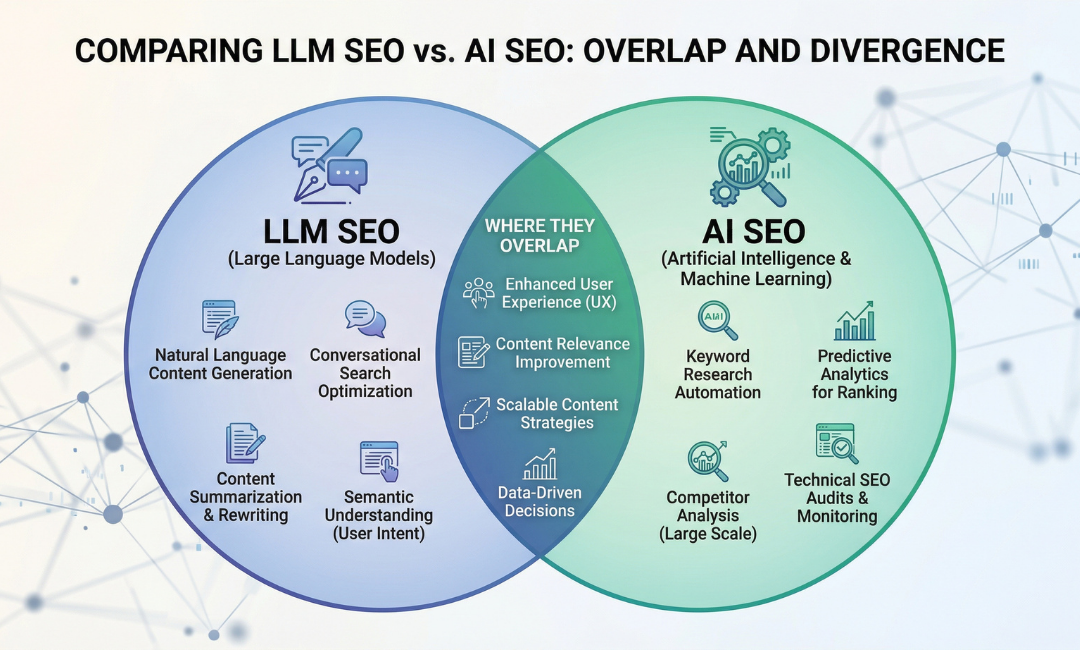
Understanding the relationship between AI SEO and LLM SEO is more useful than treating them as competing terms. They share a foundation. But where they go from there is very different.
Where They Overlap
Both AI SEO and LLM SEO build on the same core principles of search engine optimization that have always mattered:
- E-E-A-T signals (Experience, Expertise, Authoritativeness, Trustworthiness) are essential to both. Whether a Google algorithm or a large language model is evaluating your content, credibility drives inclusion.
- Technical health underpins both. A site that can’t be crawled, indexed, or parsed by AI tools won’t show up in traditional search results or AI-generated answers.
- Content depth and quality are rewarded by both systems. Thin pages and keyword stuffing actively hurt performance across every platform, old and new.
- Schema markup helps both. Structured data gives AI models and traditional search engines a cleaner signal about what your content means and how to use it.
- Keywords still matter for both. Not in the old keyword density sense, but as signals of semantic coverage and user intent.
Where They Fundamentally Diverge
This is where the confusion starts costing businesses real money.
| Factor | AI SEO | LLM SEO |
|---|---|---|
| Primary target | All AI-powered platforms and search engines | Large language models specifically (ChatGPT, Gemini, Perplexity, Claude) |
| Success signal | AI visibility, citations, referral traffic | Citation frequency, brand recall inside AI-generated answers |
| Content approach | Broad optimization across multiple AI systems | Structuring content for model extraction and synthesis |
| Machine learning focus | How AI interprets and ranks your pages | How AI models retrieve and assemble multi-source answers |
| User behavior goal | Capture AI-driven traffic across platforms | Be cited even in zero-click searches, where users never visit |
| Data analysis needed | Cross-platform visibility tracking | Prompt-level citation monitoring |
While traditional search engine optimization optimizes for ranking, LLM SEO optimizes for representation. The goal shifts from appearing at the top of search results to being accurately referenced, summarized, and recommended within AI-generated outputs.
The divergence comes down to what you’re optimizing for. AI SEO is about being visible across the AI-powered search landscape. LLM SEO is about being trusted and cited inside the responses those systems generate. You can rank in AI-assisted results and still be absent from AI answers. That’s the gap most businesses don’t see until it’s too late.
Which One Your Business Should Prioritize Right Now
The right priority depends on your business model, your competitive landscape, and how your customers currently search for solutions. Here’s a practical framework.
Prioritize AI SEO First If:
- You’re starting from scratch with no established search engine optimization foundation
- Your business relies heavily on organic traffic from Google and Bing
- You serve a broad audience using a mix of traditional and AI-powered search
- You’re a small or local business where Google AI Overviews and Maps visibility drive most leads
- Your budget is limited, and you need to build visibility across the widest surface area first
AI SEO covers the most ground. A well-executed AI SEO strategy builds the technical foundation, content depth, and authority signals that both traditional search and AI models need to trust your brand.
Prioritize LLM SEO First If:
- Your customers already use AI assistants like ChatGPT or Perplexity for research and purchasing decisions
- You’re in B2B, SaaS, legal, finance, or healthcare, where decision-making increasingly starts with an AI-generated answer
- Competitors are already appearing in AI-generated responses, and you’re not
- You have strong traditional rankings, but your brand is invisible in AI answers
- You want to capture the next wave of high-intent, high-converting AI referral traffic
The Honest Recommendation for Most Businesses
Don’t frame it as either/or. Traditional and LLM SEO serve different systems, but you can’t neglect one for the other. To be found by people and machines, you need to support both.
The practical sequence for most businesses:
- Fix technical SEO and content foundation first (AI SEO base layer)
- Add structured data and schema markup for AI model readability
- Build semantic content clusters that support both ranking pages and LLM citations
- Layer in LLM-specific tactics, including prompt tracking, entity optimization, and citation monitoring
- Track AI visibility alongside traditional search performance
That’s the sequence Doc Digital SEM follows with every client, regardless of size or industry.
How GEO and AEO Fit Into the Picture
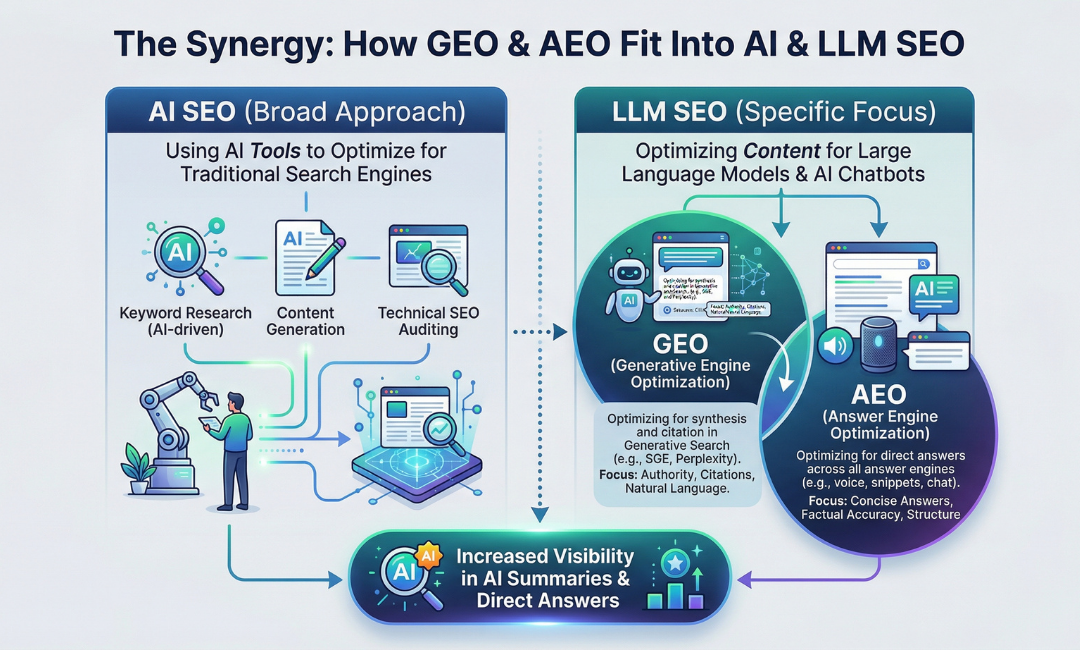
The terminology around AI-powered search has multiplied fast. GEO SEO, AEO, LLM SEO, AI SEO: they’re all related, but they’re not interchangeable. Here’s exactly how each one fits.
Generative Engine Optimization (GEO)
GEO SEO focuses specifically on how your content performs inside generative AI search engines, platforms that produce and synthesize information into original answers rather than returning a list of blue links. That includes Google AI Overviews, ChatGPT with browsing, and Perplexity.
Generative engine optimization is the practice of structuring content so that generative systems can extract, trust, and surface it in their responses. Where traditional search engine optimization gets you into the ten blue links, GEO SEO gets you into the answer itself, above, beside, or instead of those links entirely.
GEO SEO sits inside the broader AI SEO umbrella and overlaps significantly with LLM SEO. The key distinction: GEO specifically targets generative response systems. LLM SEO targets the underlying models powering them.
Answer Engine Optimization (AEO)
Answer engine optimization is the practice of structuring content to directly answer specific user queries in a format that AI and search systems can easily extract and present. Think featured snippets, People Also Ask boxes, voice search results, and AI-generated direct answers.
AEO focuses on the format and precision of your content. The goal is to create content that directly answers user questions in the clearest, most extractable way possible. That means:
- Question-based headings that mirror how users search
- Short, precise answers at the top of sections before deeper explanation
- FAQ sections optimized for direct extraction
- Conversational language that matches how people actually phrase queries
How They All Connect
Think of it as nested layers:
Search Engine Optimization (the foundation)
  └── AI SEO (the modern evolution)
        ├── LLM SEO (citation-focused, model-specific)
        ├── GEO SEO (generative response optimization)
        └── AEO (answer extraction and direct response)
Every layer builds on the one below it. You can’t do effective LLM SEO without strong search engine optimization fundamentals. You can’t do effective GEO SEO without clear, well-structured content that AI models can synthesize information from. And AEO without technical SEO backing is like building a signpost in a field with no road.
The Tools, Tactics, and Signals That Matter for Each
Knowing the theory is one thing. Knowing what to actually do is what separates businesses that show up from businesses that don’t.
AI SEO: Tools, Tactics, and Signals
Core AI SEO tools:
- Semrush AI Toolkit (visibility tracking across AI platforms)
- SE Ranking AI Search Toolkit (Google AI Overviews monitoring)
- Google Search Console (technical health, indexing)
- Screaming Frog (crawl analysis, broken links, schema validation)
- Ahrefs (keyword research, authority signals, content gap analysis)
Key tactics:
- Technical SEO audits covering crawlability, page speed, and structured data
- Semantic keyword clusters built around user behavior and search trends
- Content creation that tailor content to specific intent stages
- Schema markup implementation across all key page types
- Google AI Overviews monitoring for citation tracking
- Bing Webmaster Tools setup since ChatGPT retrieves primarily from Bing
Signals AI systems respond to:
- E-E-A-T demonstrated through author credentials, original data, and source citations
- Machine learning-readable content structure
- High-authority backlink profiles
- Consistent brand mentions across trusted third-party sources
- Core Web Vitals compliance
LLM SEO: Tools, Tactics, and Signals
Core AI SEO tools for LLM tracking:
- Profound (brand mention monitoring across ChatGPT, Claude, Gemini)
- Peec AI (prompt-level citation tracking, competitor analysis)
- Otterly (AI visibility tracking for smaller budgets)
- SE Visible (AI share of voice reporting)
- LLM SEO tools roundup
Key tactics:
- Prompt-level tracking to understand which queries trigger citations
- Entity optimization so AI models recognize and accurately represent your brand
- Third-party brand mention building on platforms like Reddit, Quora, and industry publications
- Write content in a conversational, extractable format with clear, direct answers
- llms.txt file creation to guide AI crawlers
- FAQ sections and structured Q&A content that LLMs can easily synthesize information from
- Original data and research that gives AI models something unique to reference
Signals LLMs respond to:
- Content depth and topical authority across a cluster, not just a single page
- Consistency of brand description across multiple independent sources
- Semantic coverage of related concepts and entities
- Human oversight in content production (AI-generated content without human editing performs worse in AI citations)
- Citation frequency from high-authority referring domains
A Side-by-Side Comparison of AI SEO vs. LLM SEO
Here’s the definitive comparison that most guides avoid giving you directly.
| Dimension | AI SEO | LLM SEO |
|---|---|---|
| Definition | Optimizing for all AI-powered search systems | Optimizing specifically for large language model citation |
| Platforms | Google AI Overviews, AI Mode, ChatGPT, Perplexity, Gemini | ChatGPT, Perplexity, Gemini, Claude, Grok |
| Primary metric | AI visibility score, referral traffic | Citation frequency, share of AI voice |
| Content strategy | Semantic SEO, topic clusters, and intent mapping | Extractable answers, entity clarity, conversational depth |
| Technical needs | Full technical SEO audit, Core Web Vitals, schema | AI crawler access, llms.txt, structured data |
| Link building | Authority backlinks for ranking signals | Third-party brand mentions for model training signals |
| Keyword approach | Semantic keyword clusters aligned with search trends | Conversational, prompt-style phrasing, no keyword stuffing |
| User behavior goal | Drive traffic from AI-assisted search | Build brand recall even in zero-click searches |
| Measurement tools | Semrush, SE Ranking, Ahrefs, Search Console | Profound, Peec AI, Otterly, SE Visible |
| Timeline to results | 3-6 months for AI Overview visibility | 4-8 months for consistent LLM citation |
| Includes GEO? | Yes | Partially |
| Includes AEO? | Yes | Yes |
| Foundation required | Strong traditional SEO base | Strong AI SEO base |
Where They’re Nearly Identical
It’s worth being direct here. For most businesses at most stages, the day-to-day tactics of AI SEO and LLM SEO look almost the same:
- Create content that is clear, structured, and authoritative
- Build topical authority through content clusters
- Earn trust signals across third-party sources
- Keep technical SEO fundamentals healthy
- Monitor performance across both traditional and AI-driven platforms
The difference shows up in where you point your attention and what you measure. AI SEO looks at the broader AI visibility picture. LLM SEO zooms in on whether specific language models are actually citing you when relevant queries come in.
Why Chasing One While Ignoring the Other Is the Most Common and Costly Mistake
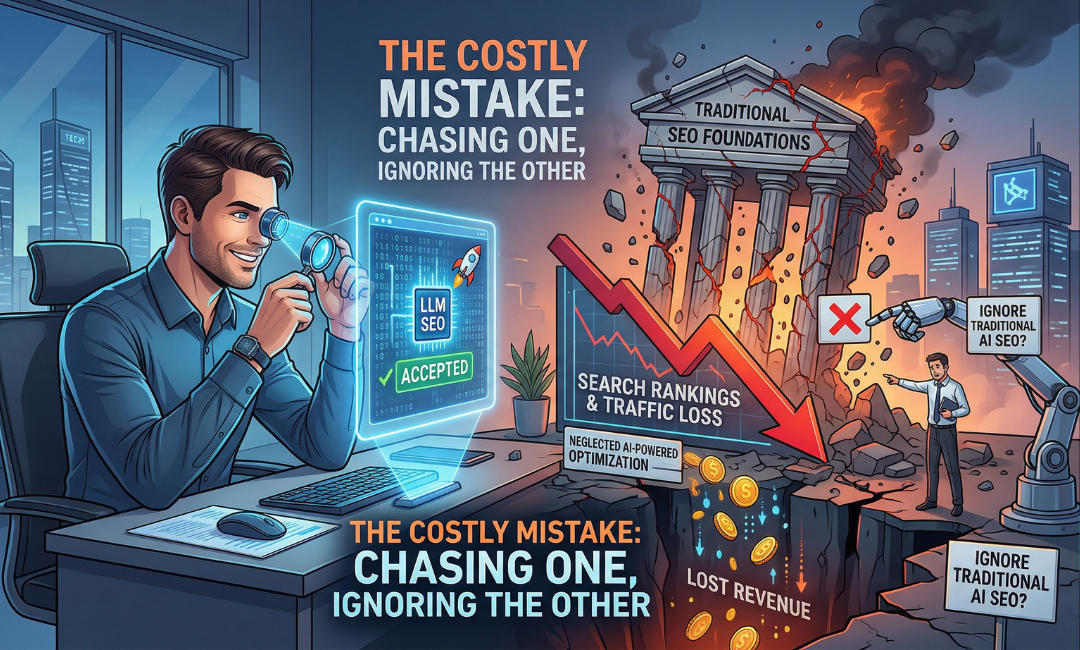
This is where most businesses fall off the cliff, often without realizing it until the traffic data makes it undeniable.
The Two Failure Modes
Failure Mode 1: All traditional search engine optimization, no AI SEO
A business invests heavily in ranking pages through traditional keywords, backlinks, and technical SEO. Rankings hold. But AI Overviews now appear above organic results for nearly every informational query, pushing those blue links further down the page. If you rank number one for your core category but ChatGPT tells the user that your competitor is cheaper and easier to use, you have lost the customer before they ever visited your website.
Traditional SEO efforts keep the lights on, but the pipeline quietly shrinks as user behavior shifts toward AI-generated answers for the queries that used to drive high-intent traffic.
Failure Mode 2: All LLM SEO, no traditional foundation
A business pivots aggressively to LLM SEO without a solid search engine optimization base. Content gets restructured for AI extraction. Entity signals get built. But because the technical foundation is weak, AI crawlers can’t access key pages reliably. Because domain authority is low, large language models don’t trust the content enough to cite it. Because there’s no semantic keyword depth, the content doesn’t cover the topic thoroughly enough to earn a citation when a relevant query comes in.
Some well-ranking sites are invisible in AI summaries, while others with modest traffic appear repeatedly in generated responses. The reverse is also true. Strong LLM SEO tactics applied to a technically weak site produce minimal results.
The Hidden Cost of the Split
The businesses that treat AI SEO and LLM SEO as separate, competing priorities end up with fragmented data analysis, duplicated work, and a strategy that serves neither system well. They’re tracking rankings in one place and citation frequency in another, with no unified view of how their brand performs across the full search landscape.
The compounding advantage goes to businesses that treat them as one integrated strategy with two measurement layers. Here’s what that looks like in practice:
- Build once, optimize for both – Content that is well-structured, semantically rich, and authoritative performs well in both traditional search results and LLM citations
- One technical foundation – Fixing crawlability, page speed, structured data, and schema markup serves both AI SEO and LLM SEO simultaneously
- Unified data analysis – Track organic traffic, AI Overview appearances, AI referral sessions, and citation frequency in a single reporting framework
- Same content creation process – Write content that answers user queries clearly and comprehensively. That’s the new standard for both retrieval-based systems and generative AI platforms
The agencies winning in 2026 aren’t those that picked a lane. They’re the ones that built strategies spanning the full search landscape, from traditional blue links to AI-generated answers, without treating them as separate disciplines.
Doc Digital SEM is built on exactly that principle. Whether you need LLM SEO specifically or a full AI SEO strategy that covers every surface area, the approach is always integrated. Because artificial intelligence doesn’t care which acronym you optimized for. It cares whether your content is worth citing. That’s the new rule, and sustainable visibility belongs to the businesses that build for it.
Win at Both With Doc Digital SEM in Your Corner.
AI SEO and LLM SEO aren’t a choice between two strategies. They’re two lenses on the same goal: making sure your brand shows up, gets cited, and builds authority wherever your customers are searching in 2026.
Key takeaways:
- AI SEO is a broad discipline; LLM SEO is the model-specific layer within it
- Traditional search engine optimization remains the foundation both depend on
- GEO and AEO are complementary tactics, not separate strategies
- Citation frequency and share of AI voice are the new metrics that matter
- Ignoring one while chasing the other creates expensive blind spots
- The businesses winning right now are optimizing for both, with one integrated strategy
Doc Digital SEM specializes in both AI SEO and LLM SEO, helping brands earn citations in AI-generated answers while staying visible in traditional search. No fragmented tactics, no guesswork. Get your free AI visibility audit and find out exactly where your brand stands across both channels.
Frequently Asked Questions
What is an LLM in AI SEO?
LLM stands for Large Language Model, the AI technology powering tools like ChatGPT, Gemini, Perplexity, and Claude. In the context of AI SEO, an LLM is the system that reads, interprets, and synthesizes your content into AI-generated answers. Optimizing for LLMs means structuring your content so these models can find it, trust it, and cite it when users ask relevant questions.
What are the 4 types of SEO?
The four core types of search engine optimization are on-page SEO (content, keywords, meta tags), off-page SEO (link building, brand mentions), technical SEO (crawlability, site speed, structured data), and local SEO (Google Business Profile, location-based visibility). In 2026, many practitioners add a fifth: AI SEO, which covers generative engine optimization, answer engine optimization, and LLM SEO across AI-powered platforms.
What is the difference between LLM optimization and SEO?
Traditional SEO gets your pages ranked in search results. LLM optimization gets your brand cited inside AI-generated answers. SEO targets retrieval-based systems that return blue links. LLM optimization targets generative systems that synthesize information and respond directly to user queries.
Ranking well in Google does not guarantee LLM visibility, and strong LLM citations don’t always correlate with traditional search rankings. Both disciplines operate on different signals and measure success differently.
Is SEO being replaced by AI?
No, but it is being fundamentally expanded. Shifting search behavior means traditional SEO alone is no longer enough to maintain visibility, but it remains the foundation that AI SEO and LLM SEO are built on. AI isn’t replacing Google; it’s expanding search. Ranking anymore requires optimizing for both traditional search engines and AI-powered platforms simultaneously. The businesses that treat AI as a replacement rather than an additional layer are the ones losing ground fastest.
Which LLM is best for SEO?
No single LLM is “best” for SEO because they serve different purposes. ChatGPT has the largest user base and drives the most AI referral traffic. Perplexity prioritizes citations from authoritative sources and is strong for research-driven queries.
Gemini integrates directly with Google Search and reaches billions through AI Overviews. A complete LLM SEO strategy targets all major platforms simultaneously rather than optimizing for one at the expense of others.
Is AI called LLM?
Not exactly. Artificial intelligence is a broad field. A large language model is a specific type of AI trained on massive text datasets to understand and generate human language. Not all AI is an LLM, but all LLMs are a form of AI.
For search and content visibility purposes, LLMs are the most relevant category of artificial intelligence because they power the answer engines and AI search platforms that increasingly shape user engagement and brand discovery in 2026.


