


While most marketers are still arguing about Google rankings, the real conversation has moved. Customers aren’t searching anymore. They’re asking. ChatGPT, Siri, Alexa, and Gemini are quietly answering for them, and if your brand isn’t in those answers, you’re invisible to a market that’s growing faster than any other.
ChatGPT reached 900 million weekly active users in February 2026, more than doubling from 400 million the previous February, and 93% of AI-driven searches now end without a click. Each AI assistant has its own logic, its own data sources, and its own way of choosing brands.
Here’s what we’ll talk about:
- How ChatGPT, Siri, Alexa, and Gemini differ (and why a one-size strategy fails)
- The new rules for content that AI assistants actually pick
- Technical foundations every brand needs for AI assistant visibility
- Why local SEO is the assistant advantage most brands miss
- How to track and measure AI assistant visibility
This is exactly the work Doc Digital SEM handles every day. Our team builds the structured, machine-readable foundations that get your brand named when customers ask any AI assistant for a recommendation, through our LLM SEO services and end-to-end AI search optimization.
How the Four AI Assistants Actually Differ
Treating ChatGPT, Siri, Alexa, and Gemini like one big category is the fastest way to waste your optimization budget. Each AI assistant has its own architecture, its own data sources, and its own logic for choosing which brands get named.
The mistake most marketers make is applying traditional keyword research and hoping it works across the board. It doesn’t. Here’s how each assistant actually behaves.
Side-by-Side Comparison
| AI Assistant | Owner | Primary Data Source | Best At | Optimize For |
|---|---|---|---|---|
| ChatGPT | OpenAI | Bing index + retrieval layer + training data | Deep work, nuanced analysis, complex tasks, writing tasks | Citations, structured data, topical authority |
| Siri | Apple | Google + Apple Intelligence + on-device data | Short commands, device control, smart home, Apple ecosystem | Apple-friendly schema, App Intents, Wikipedia presence |
| Alexa | Amazon | Bing + Amazon’s knowledge graph | Smart home control, voice commerce, e-commerce brands | Alexa Skills, product feeds, Echo devices integration |
| Gemini | Google Search index + Knowledge Graph | Conversational search, Google Workspace integration | Traditional SEO, GBP, structured data |
What Each One Cares About
The differences run deeper than data sources. Each AI tool is optimized for a different type of voice interaction:
- ChatGPT is the heavyweight for deep research and writing tasks. It’s the chat interface knowledge workers reach for when they want nuanced analysis. Optimization here is about being cited inside the conversation, not about ranking on a SERP.
- Siri is built for short commands on Apple devices. Apple selected Google’s Gemini as the core engine for the next-generation Siri, set to launch with iOS 27 in late 2026. So Siri’s behavior is becoming a hybrid of Apple Intelligence + Gemini’s reasoning.
- Alexa is the voice assistant that owns the smart home and the kitchen. It dominates voice commerce. The March 2026 Alexa+ generative AI update brought Amazon’s voice assistant to a new level.
- Gemini sits at the intersection of Google’s people search dominance and Google Workspace integration. It’s still the best general-purpose voice AI for Android and Google ecosystem users.
💡 Pro tip: If you sell physical products, prioritize Alexa optimization first. If you sell services, lead with ChatGPT and Gemini. If you sell to Apple loyalists, Siri matters more than the average brand thinks.
This is exactly why a one-size-fits-all SEO playbook fails. Each AI assistant requires its own structural and content treatment, which is why we build platform-specific strategies through our ChatGPT SEO, Gemini SEO, and Claude SEO services.
The New Rules for AI-Pickable Content
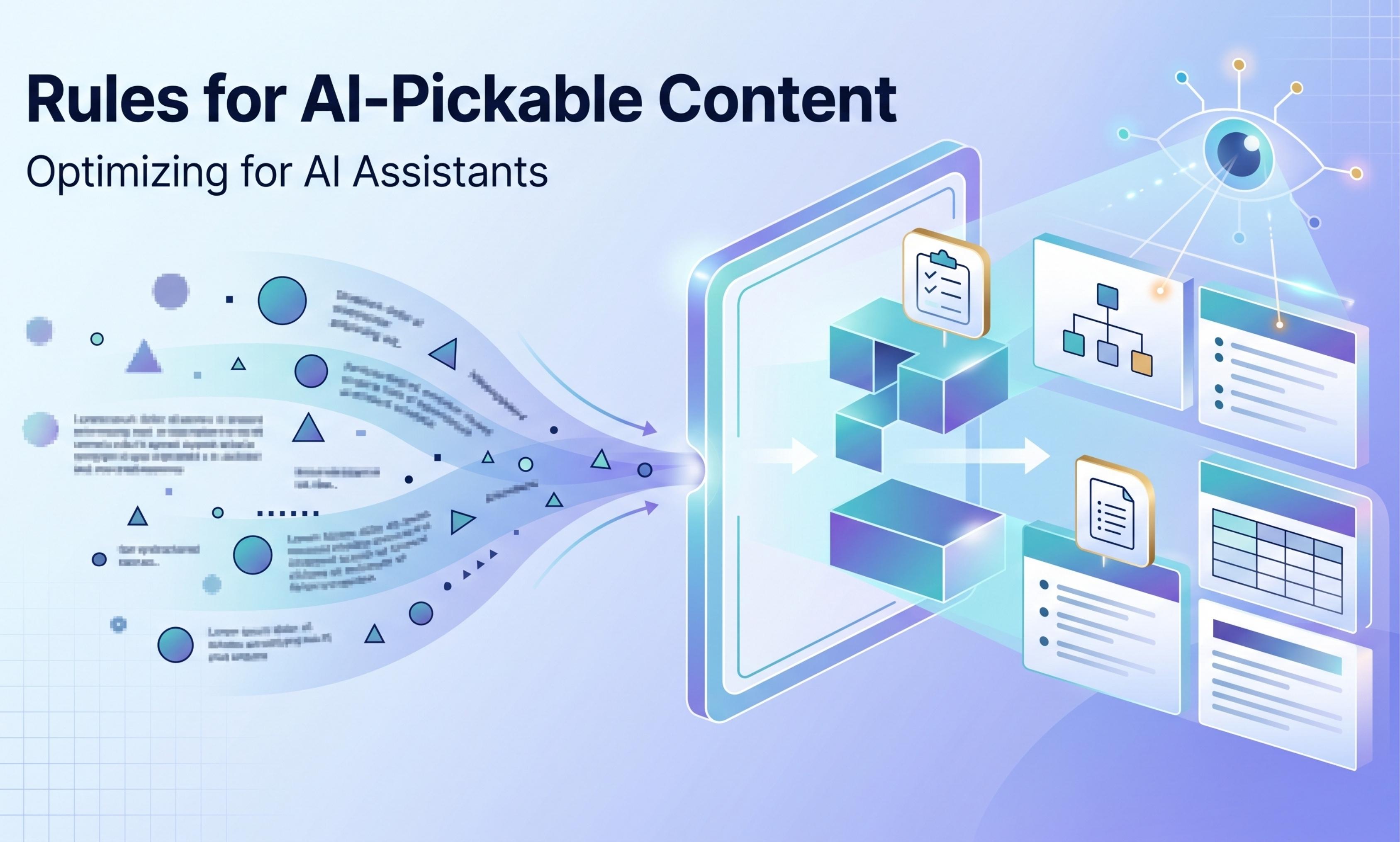
The content that wins on AI assistants looks nothing like the content that won on Google in 2018. Forget keyword density. Forget walls of SEO copy. Welcome to the era of AI-pickable content.
Five Rules That Decide Whether Your Brand Gets Named in AI Search
These are the exact patterns we apply across every client account, producing AI assistant visibility:
- Write in conversational language. People don’t ask AI tools “best dentist Miami.” They ask “Hey Siri, who’s the best dentist near me with weekend hours?” Your content should match how humans actually speak.
- Front-load every page with clear answers. AI assistants extract the first 50 to 100 words of a relevant page. If your direct answer is buried in paragraph nine, you’ll never get picked.
- Use FAQ schema religiously. FAQ-formatted content gets pulled into featured snippets, AI generated responses, and voice replies more than any other format.
- Skip the fluff. Use bullet points and tables. AI assistants love structured information they can parse instantly. Comparison tables and bulleted lists get extracted nearly verbatim.
- Anchor every claim to a fact, source, or number. Vague brand statements get ignored. Specific, verifiable facts get cited.
The Question-and-Answer Format That Wins
The format that consistently performs best across all four AI assistants follows a simple pattern:
- H3 question that mirrors how a real person would ask
- Direct answer in the first sentence (under 40 words)
- Supporting context in the next 1 to 2 short paragraphs
- Optional list, table, or stat to reinforce credibility
That’s it. No fluff, no preamble, no SEO chest-puffing. Just the answer, cleanly delivered.
What Doesn’t Work Anymore
Stop doing these things if you want AI assistance to surface your brand:
- Writing 3,000-word “ultimate guides” stuffed with keyword variations
- Using clever or abstract H2 headings that don’t match conversational queries
- Burying pricing, hours, or service details inside design elements
- Optimizing only for desktop SERPs while ignoring mobile devices and voice first interactions
- Treating every voice assistant the same when each speech recognition layer interprets queries differently
Need a deeper read on building AI-pickable content? Our breakdown on semantic SEO for LLMs and our guide on how to show up in AI Overviews on Google cover the structural rules that decide whether your content gets picked.
Technical Foundations You Can’t Skip
Great content gets you nowhere if AI assistants can’t access or interpret it. Technical foundations are the unglamorous, non-negotiable layer that decides whether your brand even shows up in the consideration set.
The Eight Technical Must-Haves
These are the items every brand needs in place before any AI assistant can reliably reference them:
- Open robots.txt access for GPTBot, ClaudeBot, PerplexityBot, GoogleOther, OAI-SearchBot, and Amazonbot. Block any of these, and you’re invisible to that AI assistant.
- Server-rendered HTML for all critical content. Most AI tools don’t execute JavaScript, so anything client-rendered effectively doesn’t exist.
- Comprehensive structured data. Organization, LocalBusiness, FAQPage, HowTo, Service, Product, and Person schemas. Connect them with sameAs links to Wikipedia, LinkedIn, and Crunchbase entries.
- An llms.txt file. A simple text file that helps language models interpret your site structure, similar to a sitemap built for AI consumption.
- Fast load times under 2 seconds. AI assistants give up on slow pages. Speed is a ranking factor for both Google search and AI search.
- Clear semantic HTML. Use <h1> through <h6> properly. Use <nav>, <section>, <article> correctly. AI tools rely on this hierarchy to understand context.
- Consistent NAP across the web. Name, address, phone, hours, services. If your site says one thing and your Google Business Profile says another, AI assistance will skip you.
- Alt text on every image with descriptive language. Voice AI uses alt text to interpret visual context, especially when AI tools analyze images.
Why This Layer Matters More Than Ever
In the era of AI powered search, your website is no longer just a destination. It’s an API. Every page is a potential data source for AI generated responses. If your structure is broken, the AI either skips you entirely or, worse, mispresents your brand.
📊 Worth knowing: AI assistants cross-reference your website against your Google Business Profile, directories, reviews, and social profiles. Inconsistencies break the trust signal and get your brand quietly excluded.
This is the technical groundwork our AI SEO agency team handles for every client. From structured data implementation to llms.txt file setup, we build the machine-readable foundation that AI assistants need to pick your brand with confidence.
Why Local SEO Is the Assistant Advantage
Voice search is overwhelmingly local. When someone asks Alexa, Siri, or Google Assistant a question, the most common ones start with “near me,” “open now,” or “best in [city].”
If you run a local business and you’ve ignored local SEO, you’ve handed your competitors a massive head start.
Why AI Tools or Assistants Love Local Queries
Voice interactions are intent-rich. People don’t ask Alexa to “research the best dental practices in South Florida.” They ask, “Hey Alexa, what’s the closest emergency dentist open right now?” That’s a buying signal, not a research signal.
Three reasons local AI search is the highest-leverage opportunity right now:
- Voice commands are predominantly local. Over 50% of voice searches have local intent.
- AI assistants pull from local trust signals. Reviews, GBP completeness, NAP consistency, and “near me” optimization decide who gets named.
- Voice commerce is mostly local. Reordering, booking, and service queries happen through assistants tied to a specific location.
The Local AI Visibility Checklist
To dominate AI assistant recommendations in your market, you need:
| Foundation | What to Do |
|---|---|
| Google Business Profile | Fully claimed, completed, and optimized with categories, services, photos |
| NAP Consistency | Identical across site, GBP, Yelp, Bing Places, Apple Maps, industry directories |
| Reviews | Active solicitation, weekly responses, focus on platforms AI tools cite |
| Local Schema | LocalBusiness, GeoCoordinates, OpeningHoursSpecification on every location page |
| Location Pages | One unique page per service area with original content, not duplicated boilerplate |
| “Near Me” Content | FAQ blocks targeting natural language queries with location modifiers |
The Hidden Power of Apple Maps and Bing
Most local SEO advice focuses on Google. That’s a mistake in the AI assistant era. Siri pulls heavily from Apple Maps. Alexa runs on Bing. If you’re not optimized on those two platforms, you’re invisible to the two voice assistants with the deepest hardware penetration.
💡 Pro tip: Claim and optimize your Apple Business Connect profile and your Bing Places listing. These two profile optimization moves alone unlock Siri and Alexa visibility that most local brands haven’t even thought about.
For local businesses, this is where competitive positioning gets won or lost. Our local SEO services and LLM optimization for local SEO work covers all of this end to end, from GBP optimization to multi-platform NAP audits to AI-tailored location pages.
How to Track AI Assistant Visibility
Here’s the metric most brands aren’t measuring, and it’s the one that actually matters in 2026. How often does your brand appear when customers ask an AI assistant about your category?
If you can’t answer that, you’re flying blind. Worse, your competitors aren’t.
Why Traditional Analytics Falls Short
Google Analytics, Search Console, and your old SEO dashboard can’t tell you whether ChatGPT recommends your brand. They can’t tell you if Siri reads your hours aloud. They can’t tell you if Alexa surfaces your business when someone says “find me a contractor.”
Voice AI and AI assistants live in a measurement blind spot for most digital marketing teams. To close it, you need a new tracking stack.
The AI Assistant Visibility Tracking Stack
This is the layered approach that actually works:
- Manual prompt testing. Pick 20 to 30 prompts your customers would realistically ask. Run them through ChatGPT, Gemini, Claude, Perplexity, Siri, and Alexa weekly. Document where your brand appears, where competitors appear, and the context.
- AI citation monitoring tools. Platforms like Profound, Goose, Rankeo, and Yoast AI Brand Insights track citation frequency across AI tools automatically. Manual is fine for under 20 prompts. Beyond that, automate.
- Branded search lift. When AI exposure works, branded Google search volume climbs. Watch it monthly in Search Console.
- Direct traffic correlation. AI assistants often drive direct visits without referral attribution. A spike in “direct” traffic alongside citation gains is a strong signal.
- Voice referral patterns. Filter analytics for traffic from mobile devices with conversational query patterns. It’s an imperfect proxy, but it’s a start.
The Five Metrics That Matter Most
| Metric | What It Measures |
|---|---|
| AI Presence Rate | Percentage of test prompts where your brand appears |
| Share of Voice | Your citation frequency vs. competitors on the same prompts |
| Citation Position | Whether you’re listed first, last, or with qualifiers |
| Sentiment | Whether AI tools describe your brand positively or negatively |
| Conversion Lift | Branded searches and direct conversions tied to AI exposure |
What to Do With the Data
Tracking is only useful if you act on it. Every month, review:
- Which prompts you’ve gained ground on (and what you did right)
- Which prompts you’ve lost ground on (and what to fix)
- Where competitors are outperforming you (and why)
- Which AI tool is sending the highest-intent traffic
- What new content or schema updates need to ship next
💡 Pro tip: Don’t try to dominate every AI assistant equally. Focus on the two or three most relevant to your audience and own those completely. Spreading thin across all six gets you mediocre visibility everywhere.
This is the discipline that separates brands quietly winning AI assistant visibility from brands wondering why their rankings stayed flat. Our team builds custom tracking dashboards as part of every LLM SEO engagement, so you know exactly where you stand across every AI tool that matters in your market.
The brands treating AI assistant visibility as a vague “future trend” are the ones losing share right now. The brands treating it as a measurable, optimizable channel are the ones quietly running away with the digital landscape.
How AI Assistants Are Evolving Fast
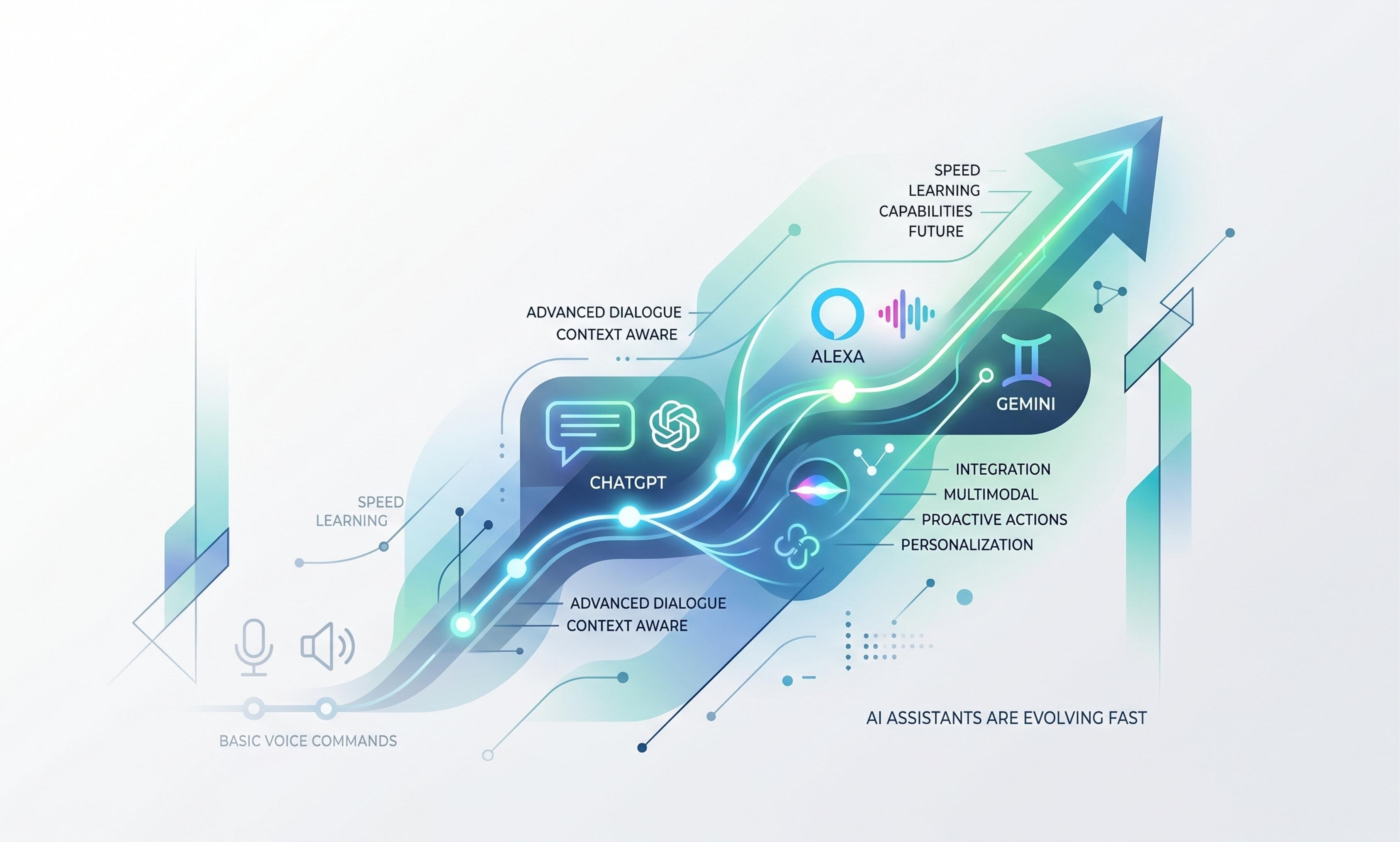
The AI assistant landscape isn’t standing still. The voice assistants you optimized for in 2023 aren’t the same ones running today, and the ones running today won’t look anything like the ones running in 2027. If your strategy is built for yesterday’s primary interface, your brand visibility is already slipping.
Here’s what’s changing, and what it means for how your brand appears across every AI tool customers use.
The Shift From Command to Conversation
Traditional voice assistants like the original Apple Siri, Google Assistant, and Alexa were built for short commands. “Set a timer.” “Play music.” “Turn off the lights.” That’s it.
The new wave of AI assistants does something fundamentally different. They handle complex tasks, hold persistent memory across conversations, and respond with the kind of nuanced reasoning that used to require a human assistant. Ask one to explain quantum physics, and it’ll give you a layered answer. Follow up with “now explain quantum physics like I’m five” and it remembers the context.
That’s not voice search anymore. That’s conversational AI, and it changes everything about how brands earn visibility.
Five Big Shifts Reshaping AI Assistance
These are the trends quietly redrawing the playing field:
- Voice and text are merging. People type in the chat window during the day, switch to voice while driving, then back to typing at home. Your content needs to perform across both.
- Multimodal AI is the new baseline. Modern assistants don’t just answer questions, they analyze images, read screenshots, and process video. Your alt text, image schema, and visual content quality all matter more than ever.
- Persistent memory is here. AI tools now remember past conversations, preferences, and brand interactions. A customer who hears your name once might be served your brand again weeks later without re-asking.
- Smart speakers are evolving into hubs. Echo devices, HomePods, Fire TV, and Nest Hubs are no longer single-purpose. They handle smart home control, voice commerce, entertainment, and AI assistance from one device.
- Context awareness is the differentiator. Context aware AI tools tailor answers based on time, location, device, recent activity, and even mood. A query at 8 a.m. on a phone returns different results than the same query at 9 p.m. on a smart speaker.
What Each Major Platform Is Building Toward
| Platform | What’s Coming Next |
|---|---|
| ChatGPT | Deeper agent capabilities, native voice for all users, expanded knowledge base via web retrieval |
| Apple Siri | Gemini-powered reasoning via iOS 20, deeper Apple Intelligence integration, third-party AI assistant support |
| Alexa | Alexa+ with generative AI, expanded smart home device control, growing role in voice commerce |
| Gemini | Tighter Google Workspace integration, real-time Gemini Live conversations, multimodal across every Google surface |
| Other assistants | Bixby, Copilot, and emerging device-native AIs are all pivoting to conversational AI architectures |
What This Means for Brand Visibility
The brands that win the next wave of AI assistant visibility share three traits:
- They show up across multiple surfaces. Smart speakers, mobile, desktop chat, in-car systems, smart TVs. One channel is no longer enough.
- They publish for natural language understanding. Their content is structured to answer the way people actually ask, not the way SEO tools used to recommend.
- They build a deep, machine-readable knowledge base. Every product, service, location, and policy is structured so AI tools can interpret and recommend with confidence.
💡 Pro tip: Audit your brand quarterly across at least four AI tools. Voice AI moves faster than any SEO trend in history, and a quarterly check keeps you from waking up to find that 30% of your discovery channel changed overnight.
Where the Real Opportunity Lives
Most knowledge workers, marketers, and business owners are still treating AI assistance as a side project. That’s the opportunity. The brands quietly investing in artificial intelligence visibility now are the ones that will own their categories in 18 months, when the rest of the market finally catches up.
Constant context switching between platforms, ecosystems, and AI tools is exhausting for customers. They reward the brands that show up consistently and confidently, no matter which AI assistant they happen to be using at the moment.
This is exactly the strategic layer our team builds for every client through LLM SEO services and AI search optimization. We treat AI assistants not as a trend to monitor but as the new primary interface for brand discovery, and we structure your content, schema, and authority signals accordingly.
Win Every AI Assistant With Doc Digital SEM
AI assistants aren’t replacing search engines, they are the new search engines. ChatGPT, Siri, Alexa, and Gemini each demand a different play, but the brands that adapt now will own their categories before the rest of the market wakes up.
Here’s what to remember:
- Each AI assistant pulls from different data sources and rewards different optimization
- Conversational, fact-rich, structured content wins citations
- Schema, llms.txt, and clean HTML are non-negotiable foundations
- Local SEO is where most brands quietly lose AI assistant visibility
- Tracking AI presence is the metric that matters most in 2026
Optimizing for ChatGPT, Siri, Alexa, and Gemini takes more than a checklist. It takes structured, citation-ready foundations built for the way customers actually ask questions today. Doc Digital SEM does exactly that. Get your free AI visibility audit (valued at $1,500) or explore our LLM SEO services and start showing up in every assistant your customers ask.
FAQs
Is Gemini better than ChatGPT for AI assistant?
Google Gemini wins for Workspace and Android users, while ChatGPT leads for deep research and writing. The best AI assistant depends on your ecosystem, and search results needs.
Which AI is better, Gemini or Siri?
Gemini outperforms Siri for natural language processing, conversational queries, and search engines integration. Siri leads only inside the Apple ecosystem and basic device control.
Is Siri using ChatGPT or Gemini?
Siri uses both. Apple Intelligence powers core features, ChatGPT handles complex queries via opt-in, and Google Gemini will power next-generation Siri starting with iOS 27 in late 2026.
What is Amazon’s AI assistant called?
Amazon’s AI assistant is Alexa, with the Alexa+ generative AI tier launched in 2026, making voice interactions, voice optimization, and search results sharper than ever.


