


You optimized your content. You built the backlinks. You ranked on page one. And yet, when someone asks ChatGPT about your industry, your brand is nowhere in the answer. That is the gap most SEO strategies are not built to close.
ChatGPT drives roughly 78% of all AI referral traffic, but Perplexity sends higher-quality clicks, and Claude barely sends direct referral traffic at all. Three platforms. Three completely different behaviors. Picking the wrong one to optimize for costs you visibility where your buyers are already looking.
Here is what this article covers:
- How each platform works differently for SEO and brand citation
- Where citations actually come from on ChatGPT, Perplexity, and Claude
- Which platform drives the most traffic and which drives the best traffic
- How to optimize content for each platform’s citation patterns
- Which platform deserves your focus first based on your goals and audience
At Doc Digital SEM, we work with this stuff every day. Our AI SEO agency has helped brands close exactly this gap, and the data behind each platform tells a very specific story.
How Each Platform Works Differently
Before comparing citation behavior, you need to understand the core architecture behind each platform. They are not versions of the same thing.
People lump these three together like they’re versions of the same thing. They’re not. They’re fundamentally different tools with different purposes, different data sources, and different citation behaviors.
ChatGPT: The Conversational AI Giant
ChatGPT is a large language model built primarily for conversation, content creation, and reasoning. Its relationship with the live web is conditional. Without web search enabled, it answers from training data with a knowledge cutoff. With it enabled, it pulls from Bing’s index to supplement its responses.
For SEO, that means two very different modes:
- Training data mode: ChatGPT pattern-matches against billions of text examples from its training. It does not choose sources in real time. Your brand visibility here depends on how much authoritative content about you exists across the web.
- Web search mode: It performs live web searches and surfaces citations, though less transparently than Perplexity. ChatGPT is usually the fastest option when a team needs output, strong at turning rough instructions into a usable draft, structured workflow, content brief, or schema concept.
ChatGPT generates large keyword lists quickly and handles brainstorming at volume, making it useful for SEO execution tasks where speed matters more than source visibility.
Perplexity AI: The Real-Time Answer Engine
Perplexity is built differently from the ground up. It is a real-time answer engine that pulls from the live web on every query, cites its sources inline, and is designed to replace the traditional search engines experience of scanning blue links.
Perplexity is a search engine powered by AI. Its purpose is to find information on the web in real time, synthesize it, and return an answer with citations to original sources.
This makes it uniquely valuable for SEO research. The defining characteristic that makes Perplexity uniquely valuable is current data with citations. When you ask what the top-ranking pages for a keyword say, it reads those pages now and reports back.
Its deep research mode goes further, analyzing multiple sources simultaneously and compiling structured output with full attribution, a significant upgrade for fact-checking, competitor pages analysis, and identifying citation gaps.
Claude: The Analytical Depth Specialist
Claude is built for careful reasoning across long documents and complex inputs. Its 200,000-token extended context window is the main difference that separates it from the other two for deep analysis work.
You can paste your entire article, the top competing articles, your GSC query data, and your existing schema markup into a single conversation and ask Claude to identify what is missing. That entire workflow fits in one analysis.
Claude does not browse the live web by default. It operates primarily from training data unless web search is specifically enabled. This means it is not your best tool for real-time research, but it is the best tool for deep analysis, content briefs, and building structured content that demonstrates obvious expertise.
Claude produces more comprehensive content briefs because it reasons carefully about Google search intent, topical completeness, and the E-E-A-T signals that content needs to demonstrate.
Quick Architecture Comparison
| Platform | Data Source | Best For | Citation Behavior |
|---|---|---|---|
| ChatGPT | Training data + Bing (optional) | Content creation, writing tasks, keyword research | Moderate, pull-based |
| Perplexity AI | Live web, real-time | SEO research, fact checking, competitor analysis | Consistent, always cited |
| Claude | Training data + optional web search | Deep analysis, long documents, content briefs | Minimal direct referral |
Understanding this at the architecture level is the best starting point for building a smarter AI SEO strategy that accounts for each platform’s behavior, not just its market share.
Where Citations Actually Come From
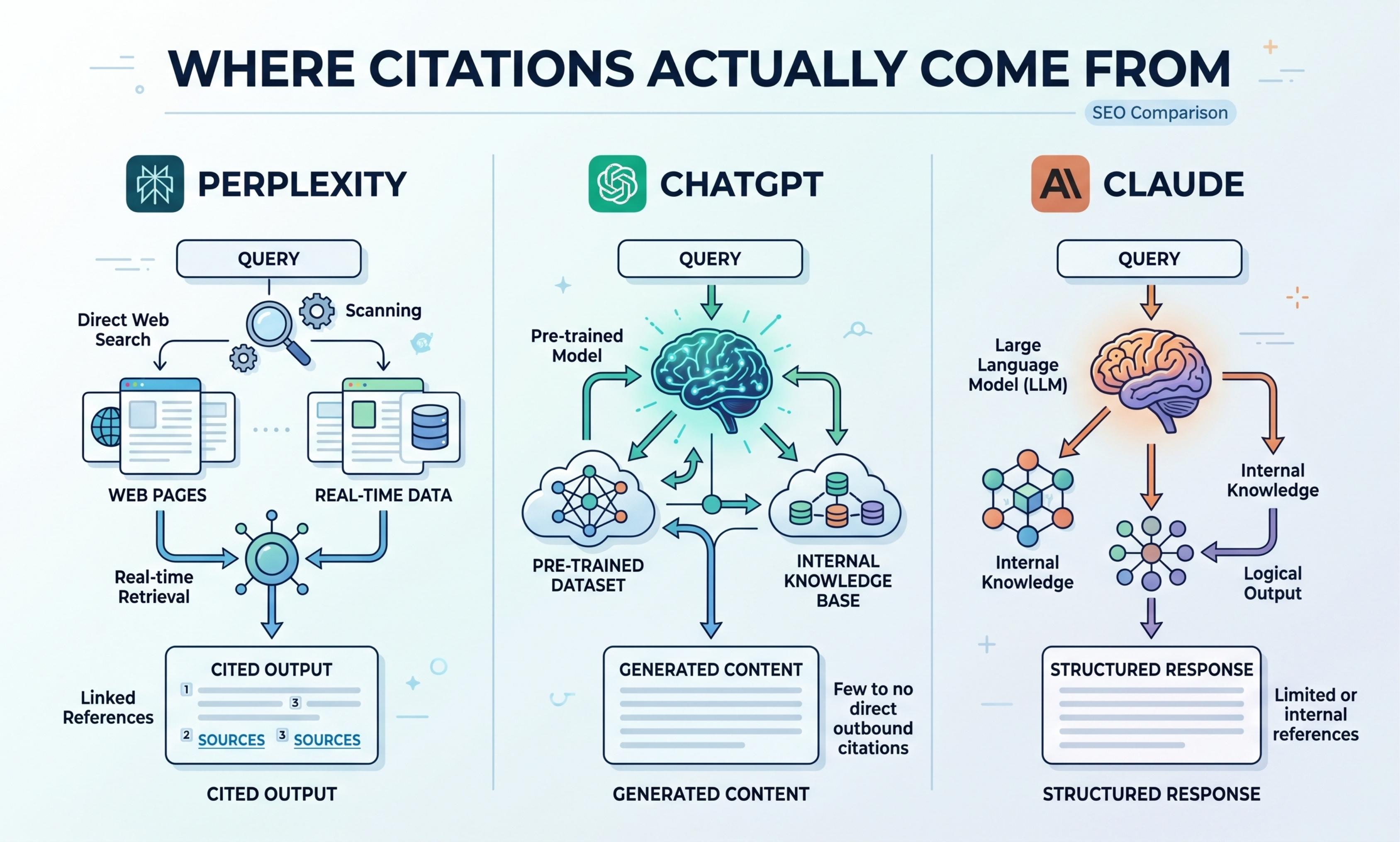
Knowing how each platform cites is one thing. Knowing what it responds to is what actually shapes your optimization strategy.
ChatGPT Citations: Brand Entity Over Page Optimization
When you ask ChatGPT a question without triggering web search, it is answering from training data and is not choosing sources in real time. It is pattern-matching against billions of text examples it saw during training.
This has a direct implication for brand visibility. Getting cited by ChatGPT is less about optimizing a single page and more about building brand entity strength across multiple domains over time.
What moves the needle for ChatGPT citations:
- Consistent mentions across review sites, industry publications, and forum discussions
- Being referenced in authoritative content that made it into the training data
- Strong traditional SEO signals that pushed your content into the sources ChatGPT trained on
- ChatGPT Search pulls from Bing’s index, so Bing SEO basics apply: structured data, clear page titles, and fast load times.
Only 12% of URLs cited by ChatGPT rank in Google’s top 10 search results. 28.3% of ChatGPT’s most cited pages have zero organic visibility. Traditional SEO rank tracking alone will not tell you whether you are getting cited here.
Perplexity Citations: Structure and Freshness Win
Perplexity uses a source-first architecture. Every answer is grounded in live web search, and citations are displayed as numbered cards next to each claim. Perplexity prioritizes recent, well-sourced content. It favors pages that cite their own sources, have clear authorship, and answer specific questions directly.
For brands, this means Perplexity is the most immediately actionable platform to optimize for. Improve your content structure today, and you can influence Perplexity citations within days, not months.
Key citation signals for Perplexity:
- Concise answers in the opening paragraph of each section
- Clear authorship and publication dates
- Outbound citations to primary sources within the content
- Direct answers to specific queries without burying the point
- Content freshness, pages updated within 30 to 60 days, consistently cited over older material
Claude Citations: Authority Built Over Time
Claude sends minimal direct referral traffic. It is not a search engine in the traditional sense, and it rarely displays clickable citations in the way Perplexity does. However, if you need authority positioning, the focus should be on Claude’s training standards rather than real-time retrieval.
What this means practically: Claude surfaces brands and content that have achieved a certain depth of presence across the web, especially those with content that demonstrates analytical depth and obvious expertise. It is less about individual pages and more about the cumulative weight of your brand’s knowledge footprint.
AI outcomes are not random. They are shaped by retrieval logic and source evaluation. The marketers who understand how each system looks for information and align their content strategy accordingly will have clarity and control as AI search continues to evolve.
We cover the deeper mechanics of this in our guide on how LLMs index the web.
Traffic Volume vs. Traffic Quality
This is where the perplexity vs ChatGPT debate gets interesting. Volume and quality are telling very different stories.
ChatGPT drives roughly 78% of all AI referral traffic, but Perplexity sends higher-quality clicks because its citation-first design puts source links front and center. Claude sends minimal direct referral traffic as it is not built as a search engine and rarely displays clickable citations.
The Volume Story: ChatGPT Dominates
ChatGPT is the most visited AI platform on Earth. The sheer number of queries it processes means even a small citation rate translates into meaningful traffic volume for most brands. If you are an established brand in a competitive category, the referral traffic from a single ChatGPT citation appearing in a high-volume query can be substantial.
But here is the catch. Most users search ChatGPT in a conversational, exploratory way. Many users never click through at all because they are satisfied with the summarized answer. The volume of sessions from ChatGPT does not always translate into the intent you want.
The Quality Story: Perplexity Converts Better
Users visit 13 pages on average from Perplexity referrals, versus 11.8 from Google. Perplexity users are researchers, professionals, and decision-makers who clicked on a citation specifically because they wanted more detail. That is a fundamentally different visitor than someone who stumbled across your site from a casual ChatGPT session.
Perplexity’s citation transparency fundamentally changes content credibility, including numbered citations linking to original sources. When your brand appears as a numbered citation in a Perplexity answer, the user sees your source before they click. They arrive already knowing what to expect.
AI Referral Traffic Breakdown
| Platform | Share of AI Referral Traffic | Traffic Quality | Best Audience |
|---|---|---|---|
| ChatGPT | ~78% | Moderate | Broad, general consumers |
| Perplexity | ~15-18% | High | Researchers, professionals |
| Claude | Minimal | Very high intent (rare) | Enterprise, analytical users |
A single platform strategy built around only one of these will leave significant traffic and brand visibility on the table. The best AI SEO agencies in 2026 are building for all three, not just the one with the biggest market share number.
How to Optimize for Each Platform
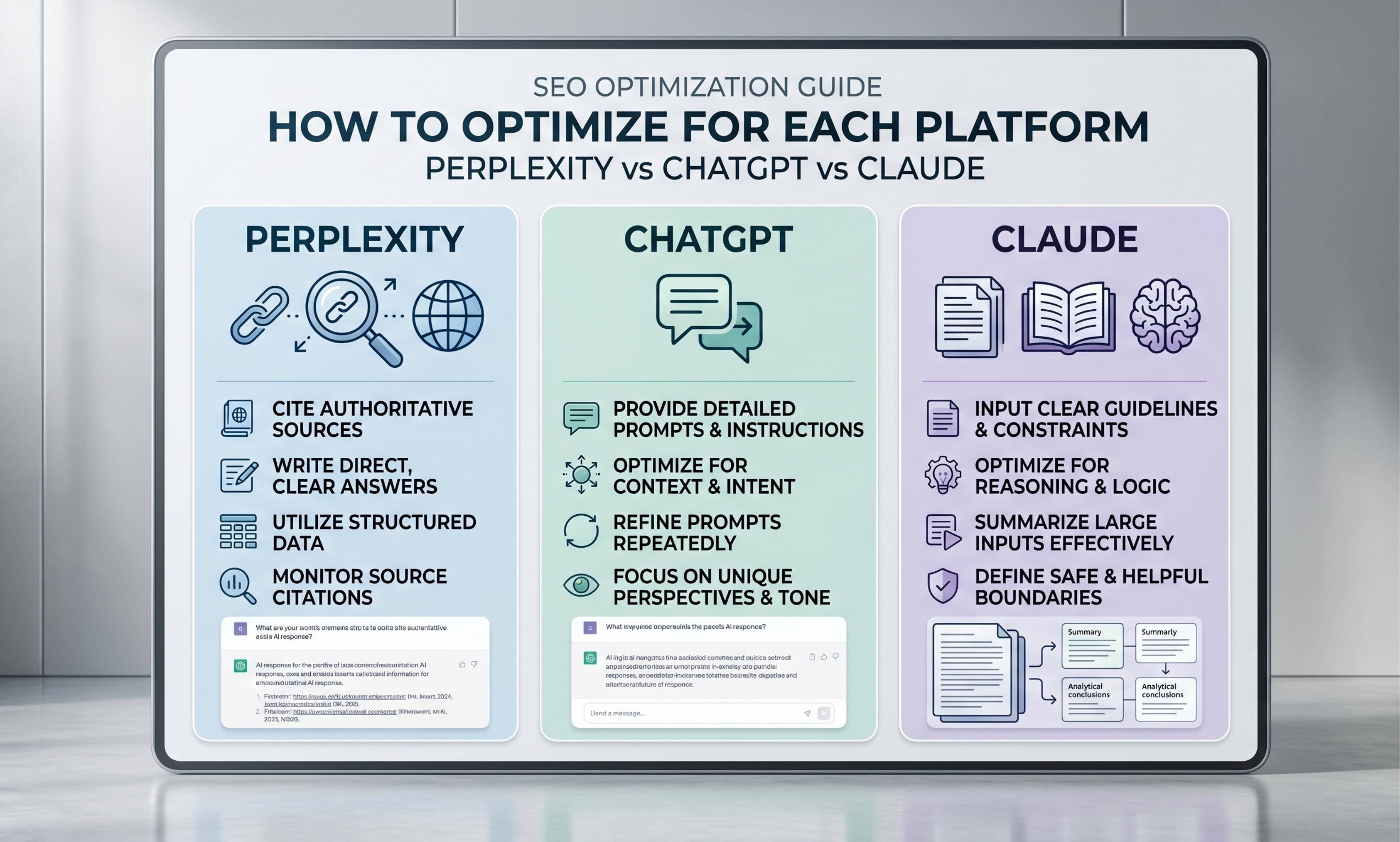
The good news: the fundamentals of structured content, E-E-A-T, and technical SEO apply across all three. The nuance is in how you layer on top of them.
Optimizing for ChatGPT
ChatGPT citation is a long game. The goal is to become so consistently cited across the web that your brand becomes part of its training signal and retrieval behavior for your target queries.
- Build brand mentions across review sites, Reddit, LinkedIn, and industry publications
- Publish authoritative content that other authoritative sites reference and link to
- Use schema markup so ChatGPT’s Bing-based retrieval can parse your content structure accurately
- Optimize for Bing as well as Google, since ChatGPT Search pulls from Bing’s index
- Create detailed comparison and listicle content, the content formats most consistently cited in ChatGPT responses
For broad reach, focus on ChatGPT training data and search by building consistent, high-quality content that gets incorporated across multiple sources over time.
Optimizing for Perplexity AI
Perplexity is the most responsive platform to direct optimization. Changes you make today can influence citations within days.
- Open each section with a direct answer in 40 to 60 words before expanding
- Add visible publication dates and author credentials to every piece
- Cite your own sources with outbound links to primary research
- Use clear H2 and H3 heading structures that match the natural language of deep research queries
- Update key pages at least every 60 days; freshness is a core citation signal here
- Use Perplexity’s own deep research mode as a competitor research tool, checking which pages are cited for your target queries and analyzing what makes them citation-worthy
For immediate citation visibility, focus on Perplexity with fresh, well-structured content and clear answers to specific questions.
Optimizing for Claude
Claude optimization is less about page-level tactics and more about the depth and breadth of your brand’s authoritative content across the web.
- Publish long-form, genuinely comprehensive content that covers topics with analytical depth
- Build a content library around your core subject matter, not isolated articles
- Earn mentions in established, credible publications that would appear in high-quality training data
- Create content that demonstrates careful reasoning and obvious expertise, not just keyword coverage
- Use Claude itself as a content analysis tool, paste your drafts alongside competitor pages, and ask it to identify gaps in depth and authority
Use Claude when you need judgment across long, complex inputs, and use ChatGPT when you need production speed and workflow support. The same principle applies to optimizing for each platform.
Content Formats That Work Across All Three
| Format | ChatGPT | Perplexity | Claude |
|---|---|---|---|
| Listicles | Strong | Strong | Moderate |
| Detailed comparisons | Strong | Strong | Strong |
| Data-driven articles | Moderate | Very strong | Strong |
| Long-form guides | Moderate | Moderate | Very strong |
| FAQ content | Strong | Very strong | Moderate |
Understanding AI citations at this level of granularity is what separates a reactive content approach from a proactive one.
Which Platform Should You Focus on First?
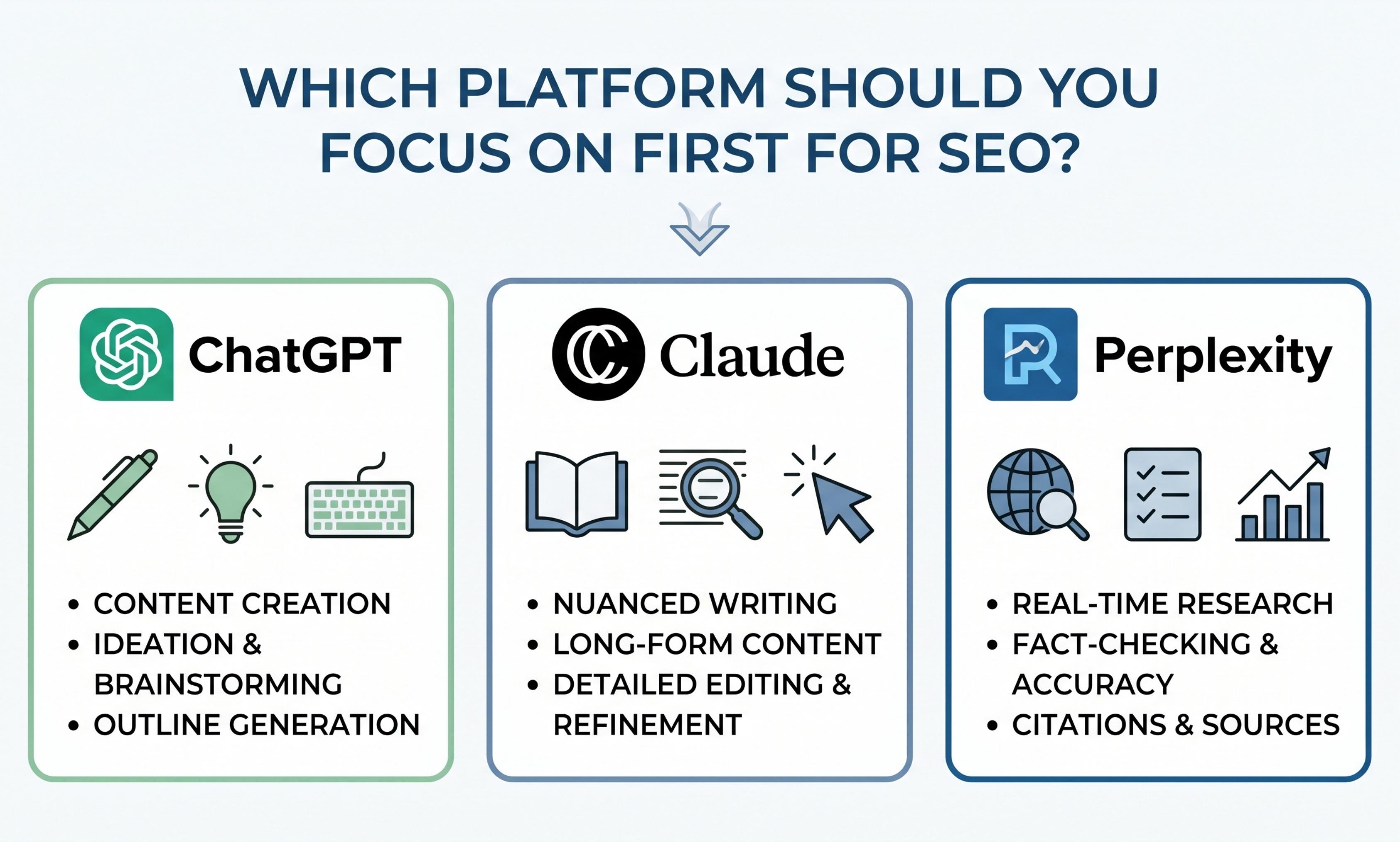
There is no single right answer. The honest one is: it depends on your goals, your audience, and where you are starting from.
Here is a practical framework:
Focus on Perplexity first if:
- You want the fastest feedback loop between content changes and citation results
- Your audience includes researchers, analysts, or professionals who do deep research queries
- You have fresh, well-structured content that just needs better answer formatting
- You are a newer brand that has not yet built the domain authority, and ChatGPT’s training data rewards
Focus on ChatGPT first if:
- You are an established brand with existing authority signals across multiple domains
- Your primary goal is volume of AI referral traffic rather than conversion quality
- You are already investing in Bing SEO as part of your traditional search strategy
- You publish high-volume content in formats like listicles and comparisons that ChatGPT favors
Focus on Claude first if:
- Your buyers are enterprise-level and tend to use Claude for analytical tasks
- You are building thought leadership in a niche where depth and expertise matter more than volume
- You have the content library to support a long-term authority play
The best starting point for most brands is Perplexity, simply because the optimization signals are the most transparent and the feedback loop is the shortest. But a single platform strategy will not hold as AI search continues to fragment. The real opportunity in 2026 is building content that is genuinely citation-worthy, specific, sourced, and structured to answer real questions. That content tends to perform across all the major AI engines, not just one.
Our Perplexity SEO agency and Claude SEO agency services are built around exactly this kind of platform-specific optimization, starting where your audience is, then expanding across every surface where they search.
Here is a look at what that kind of multi-platform approach delivered for one of our clients:
Freakin Fitness came to us as a multi-location gym needing a scalable content and SEO solution. We built a system that drove 560% SEO ranking growth and 350% growth in monthly leads. Read the full case study here.
Get Cited on Every Platform With Doc Digital SEM
Perplexity, ChatGPT, and Claude are not competing tools. They are three different discovery surfaces your buyers are already using. The brands winning AI visibility in 2026 are not picking one and hoping for the best.
Here is what to take away:
- ChatGPT drives the most AI referral traffic, but rewards long-term brand entity building
- Perplexity sends the highest quality clicks and responds fastest to direct content optimization
- Claude favors analytical depth and authoritative content built across a consistent content library
- Each platform has different citation behavior, different source preferences, and different user intent
- A single platform strategy leaves significant brand visibility on the table
At Doc Digital SEM, we build AI search visibility strategies that work across all three platforms, not just the one with the biggest market share number. If your brand is not showing up where your buyers are searching, we can help change that.
FAQs
Is ChatGPT or Claude better for SEO?
Both AI tools serve different purposes. ChatGPT delivers faster, usable output for SEO content. Claude excels at deep analysis. Use both for stronger AI answers.
Is Perplexity good for SEO?
Yes. Perplexity is one of the most valuable search tools for SEO work. Its real-time citations make it ideal for research, fact-checking, and generative engine optimization strategies.
Is Perplexity better than ChatGPT for business?
It depends on the task. Perplexity leads for research-driven AI discovery. ChatGPT wins for content creation. Most businesses benefit from using both AI systems together.
What is better, Perplexity, Claude, or ChatGPT?
No single AI assistant wins outright. Each of these AI models serves related concepts differently. Perplexity for research, ChatGPT for output format, and Claude for analytical SEO work.


