


There are more than 15,000 AI marketing tools on the market. Most marketing teams need three to five. The gap between those two numbers is where budgets go to die, buried under overlapping subscriptions nobody fully uses.
eMarketer research indicates over 90% of marketing organizations now use AI agents somewhere in their stack, and marketers report saving roughly 2.5 hours per day with the right tools. The catch: tool sprawl costs the average SME marketing team 8+ hours weekly in context-switching. Picking well matters more than picking many.
Here’s what we’ll cover:
- What changed in AI marketing tools between 2024 and 2026
- The top 10 tools, with features, pricing, and honest limitations
- How to build a stack instead of collecting subscriptions
- Where AI search visibility fits into your tooling
We evaluate and deploy these tools daily at Doc Digital SEM. Our AI SEO services and marketing automation work run on a deliberately small stack, because consolidation beats accumulation every time.
What Changed in AI Marketing Tools
Before the list, context on why the 2026 landscape looks different from the one you researched two years ago.
From Generative to Agentic
The biggest shift: tools moved from assisting marketers to acting on their behalf. A 2023-era tool suggested ad copy. A 2026-era tool launches campaigns, adjusts bids, and flags disapprovals without prompting.
That distinction matters when evaluating vendors. Ask whether a platform assists or executes, because the ROI profile is completely different.
From Standalone to Native
Point solutions are losing to platforms with built-in AI features. Marketers increasingly prefer an AI layer inside tools they already use over a separate subscription requiring another login and another data sync.
From Generic to Specialized
Early AI marketing tools tried to do everything adequately. The winners in 2026 do one thing exceptionally: SEO optimization, video editing, lifecycle email, competitive intelligence. Depth beats breadth.
A New Category: AI Search Visibility
This one didn’t exist in 2024. As buyers shifted toward asking ChatGPT, Gemini, and Perplexity for recommendations, a category emerged around tracking and improving brand visibility inside AI answers.
The Top 10 AI Marketing Tools in 2026
Ranked by real-world utility across content, SEO, automation, lifecycle, and analytics. Each entry covers what it does, what you get, and where it falls short.
1. Jasper AI
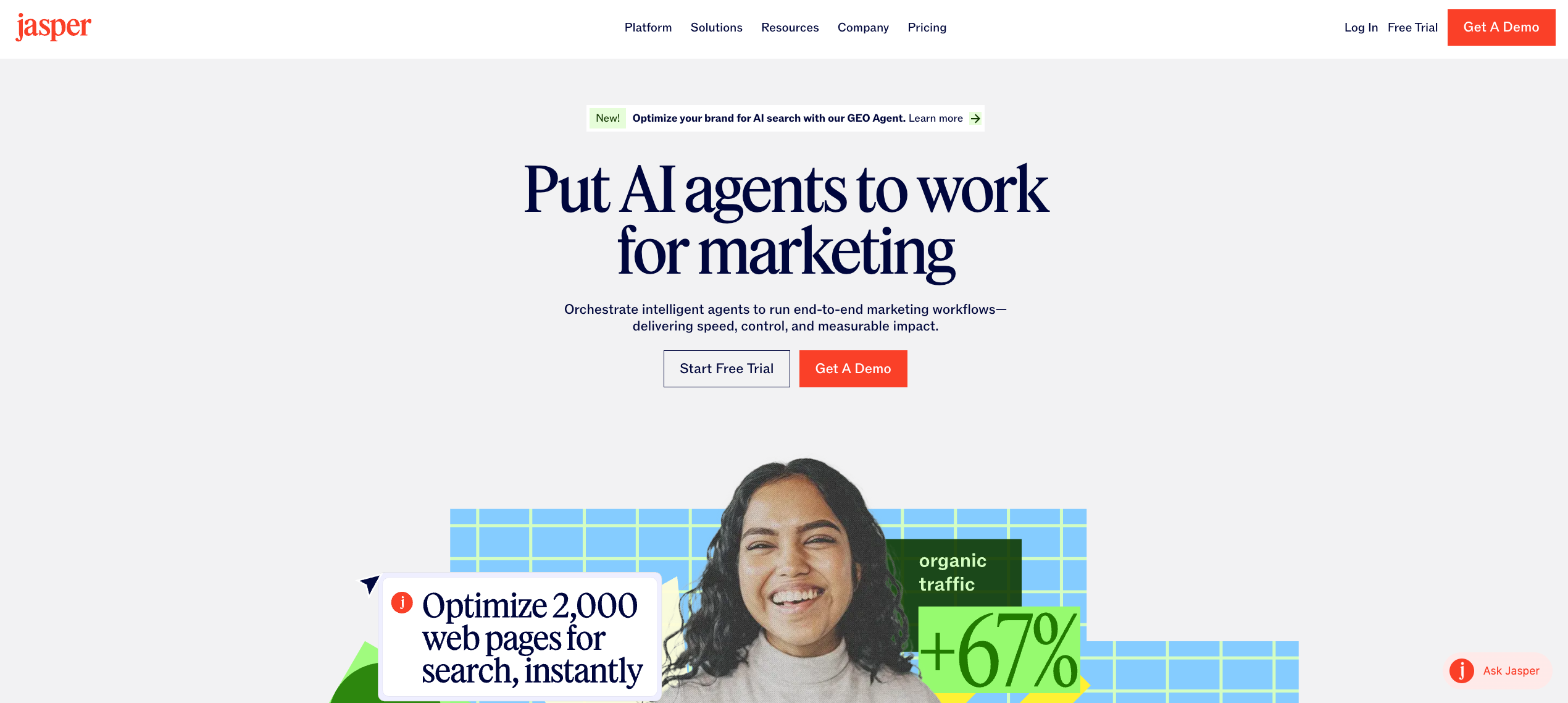
Best for: Marketing teams producing high volumes of on-brand content across multiple channels.
Jasper remains the strongest AI writing platform for teams that need brand consistency at scale. Its brand voice engine learns your tone from uploaded examples and style guides, then applies it across every piece of content the platform generates. That’s the differentiator over general-purpose chatbots, which restart from zero on every prompt.
What they offer:
- Brand voice training from your existing content and brand guidelines
- Templates for blog content, ad copy, product descriptions, and social media posts
- Campaign workflows that generate coordinated assets from a single brief
- Team collaboration with shared brand assets and approval flows
- Browser extension and Google Docs integration
- Multi-language content generation
Key features: Brand voice consistency, campaign-level generation, team workspaces, integration capabilities with existing marketing workflows.
Considerations: Pricier than general AI tools, and output still requires editing to carry genuine expertise. Teams producing under 10 pieces monthly won’t recoup the cost versus using ChatGPT or Claude directly.
Pricing: Roughly $49/month per seat for creator plans, with business tiers priced on request.
2. Surfer SEO
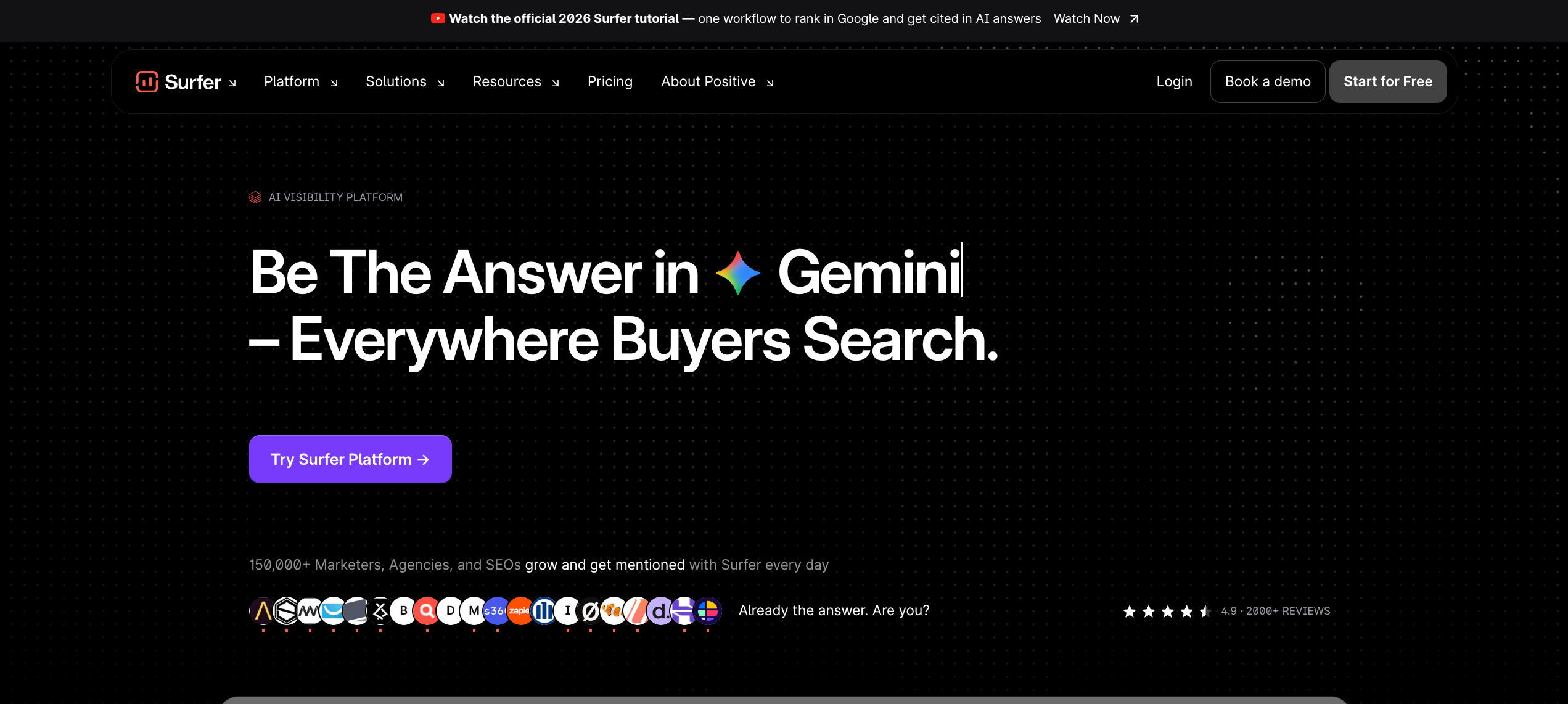
Best for: Content marketers who need SEO optimization baked into the writing process.
Surfer SEO analyzes top-ranking pages for your target keyword and scores your draft against them in real time as you write. Instead of writing blind and optimizing afterward, you see content scoring update live, showing which terms, headings, and structural elements you’re missing.
What they offer:
- Real-time content scoring against SERP competitors
- Content editor with term suggestions, word count targets, and heading recommendations
- Keyword research and clustering
- SERP analyzer showing what’s ranking and why
- AI writing built directly into the editor
- Content audit tools for refreshing existing pages
Key features: Live content optimization, competitor SERP analysis, keyword clustering, integration with Google Docs and WordPress.
Considerations: Optimizing purely to a Surfer score produces mechanical, over-optimized content. Treat the score as a signal, not a target. It also won’t tell you whether the topic is worth writing about in the first place.
Pricing: Around $99/month for essential plans, scaling with article volume.
3. HubSpot AI (Breeze)
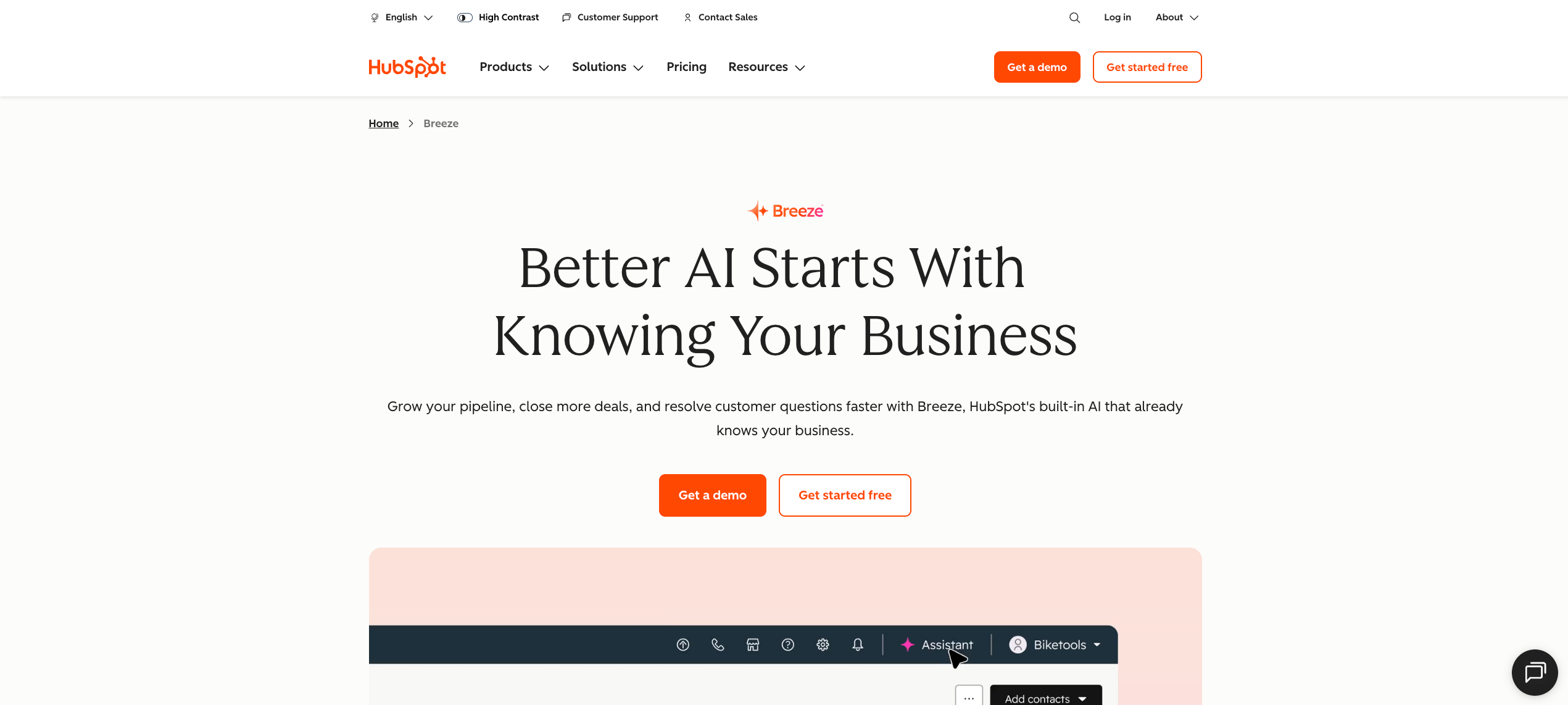
Best for: Teams already running HubSpot who want AI embedded across CRM, content, and automation.
HubSpot’s AI layer is compelling precisely because it isn’t a separate tool. It sits inside the CRM, marketing hub, and sales tools you already use, drawing on your existing customer data rather than requiring another integration. For teams on HubSpot, the marginal cost of adding AI capabilities is minimal.
What they offer:
- AI content assistant for emails, landing pages, and blog content
- Predictive lead scoring based on customer behavior patterns
- Conversation intelligence for sales teams
- Automated workflow suggestions based on usage patterns
- AI-powered reporting and actionable insights
- Chatbot and conversational AI for lead qualification
Key features: Native CRM integration, predictive analytics, unified customer data, AI across marketing and sales.
Considerations: Only makes sense if you’re on HubSpot. Standalone value is limited, and HubSpot’s pricing escalates sharply as contact volume grows.
Pricing: AI features are included across Professional and Enterprise tiers; Marketing Hub Professional starts around $800/month.
4. Klaviyo AI
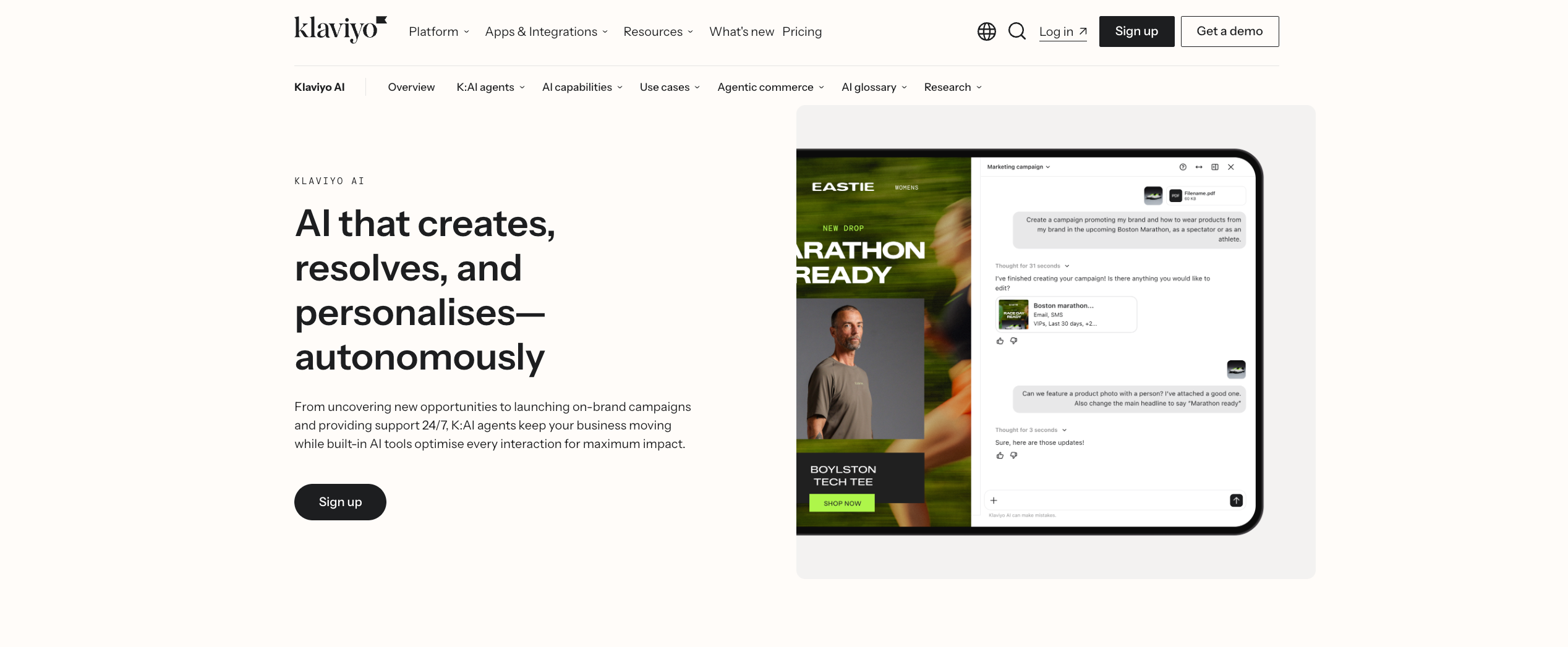
Best for: Ecommerce brands where email and SMS are the primary revenue channels.
Klaviyo’s AI capabilities focus narrowly on lifecycle marketing, and that specialization shows. Predictive analytics forecast customer lifetime value, churn risk, and next purchase date, then trigger campaigns automatically based on those predictions rather than static rules.
What they offer:
- Predictive analytics for CLV, churn probability, and purchase timing
- AI-generated subject lines and email content
- Smart send-time optimization per individual recipient
- Automated segmentation based on behavioral patterns
- SMS and email orchestration from one platform
- Revenue attribution by campaign and flow
Key features: Predictive customer modeling, behavioral audience segmentation, send-time optimization, deep ecommerce platform integrations.
Considerations: Built for ecommerce. B2B and service businesses will find much of the predictive modeling irrelevant. Pricing scales aggressively with list size.
Pricing: Free plan up to 250 contacts; paid plans scale by contact count, typically $45+/month at small volumes.
5. Gumloop
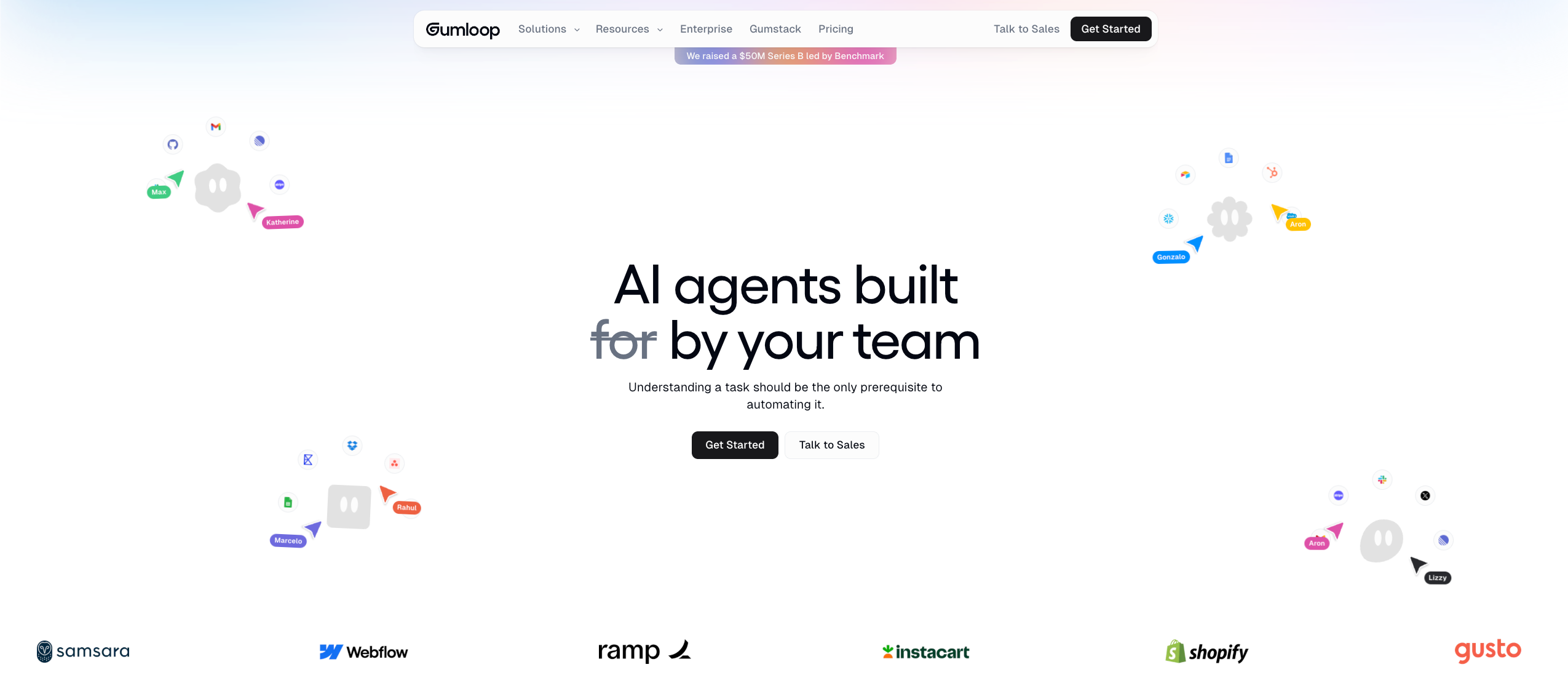
Best for: Teams that want to build custom AI workflows connecting internal tools without writing code.
Gumloop is the most underrated tool in this list. It works like Zapier with an AI layer, letting you connect any LLM (ChatGPT, Claude, Gemini) to your internal tools and build multi-step automated workflows. Used by teams at Webflow, Instacart, and Shopify, it handles the “we need something custom” problems that off-the-shelf tools can’t.
What they offer:
- No-code workflow builder connecting AI models to your tools
- Support for multiple LLM providers in one workflow
- Web scraping and data extraction nodes
- Sentiment analysis on reviews, social media posts, and support tickets
- Bulk content generation and processing
- Scheduled and triggered automation runs
Key features: Multi-LLM support, no-code interface, custom workflow logic, integrations across marketing and internal tools.
Considerations: Requires more setup thinking than plug-and-play tools. You need a clear idea of the workflow you want before it delivers value. Steeper initial learning curve than templated platforms.
Pricing: Free tier available; paid plans start around $97/month.
6. Canva Magic Studio
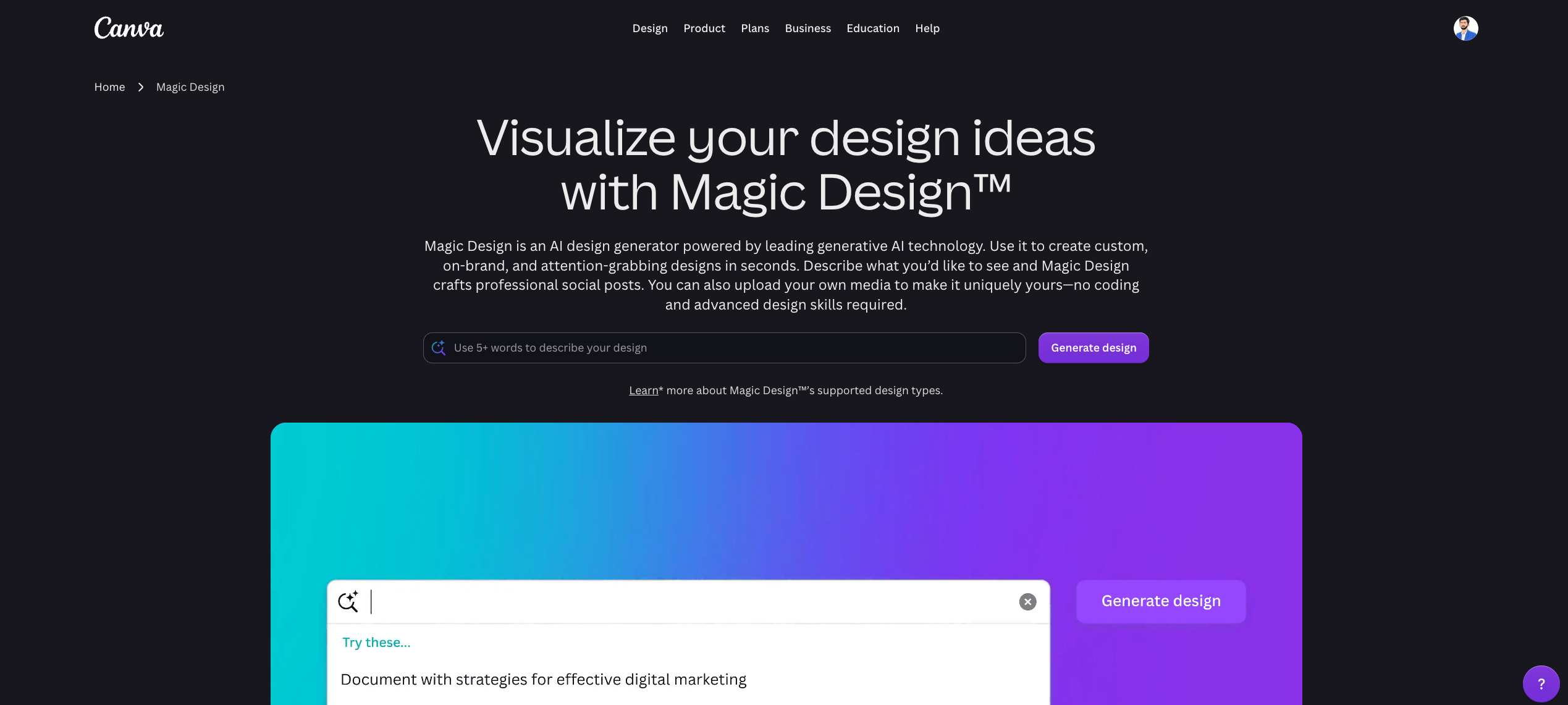
Best for: Marketing teams without dedicated designers who need on-brand visuals fast.
Canva’s AI suite turned it from a design tool into a production engine. Magic Studio generates images, resizes assets across formats, removes backgrounds, writes copy, and edits video, all while enforcing brand kit consistency automatically.
What they offer:
- AI image generation from text prompts
- Magic Switch for auto-resizing across social platforms
- Background removal and object editing
- Brand kit enforcement across all generated assets
- AI video editing and text-to-video
- Template library with brand-locked variations
Key features: Brand consistency enforcement, multi-format resizing, AI image and video generation, genuinely simple and intuitive dashboard.
Considerations: Output can look recognizably “Canva” if you rely on templates without customization. Not a replacement for a designer on brand-defining work.
Pricing: Free tier available; Canva Pro around $15/month, teams pricing above that.
7. HeyGen
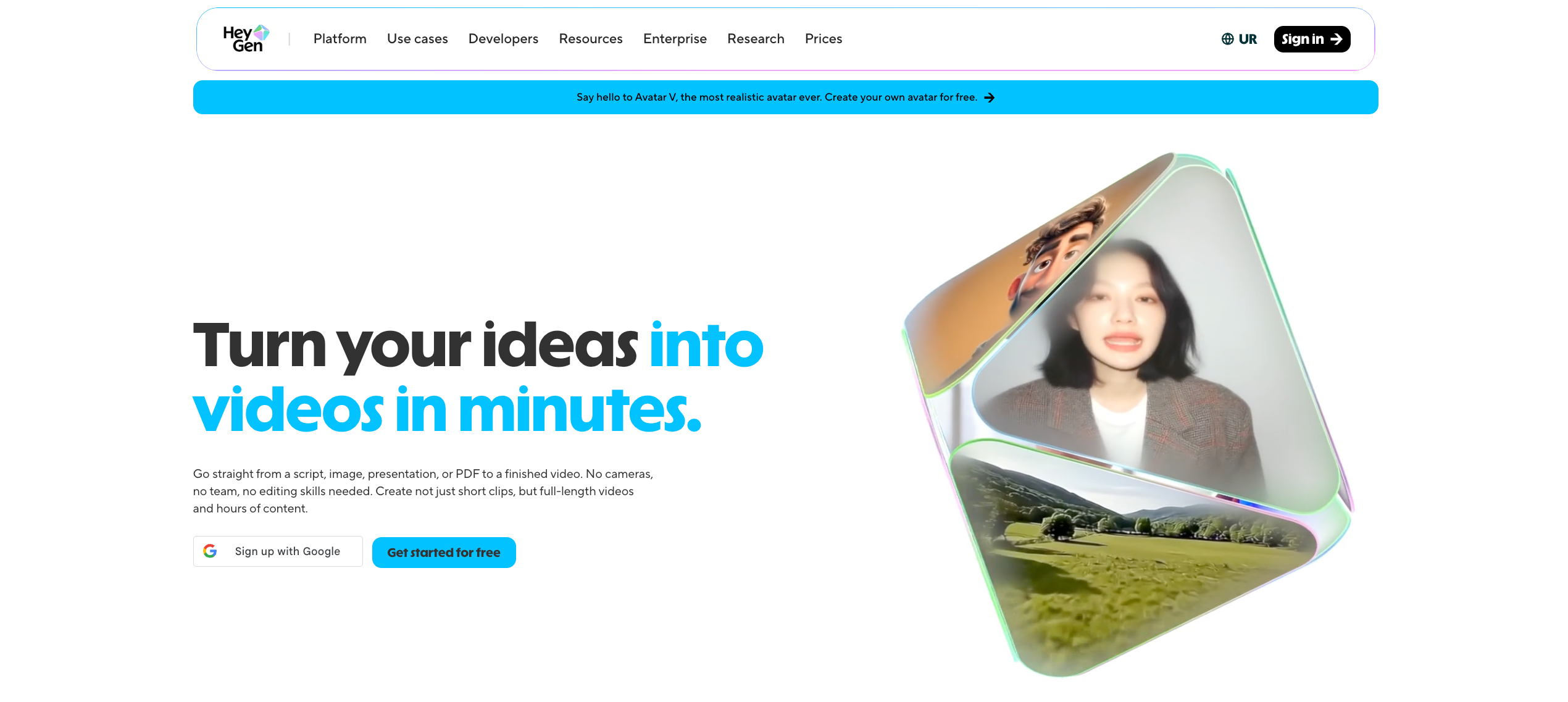
Best for: Brands scaling video marketing without production crews.
Video content dominates every channel, and production cost has been the bottleneck. HeyGen generates presenter-led video from a script using AI avatars, including custom avatars trained on your own team members, in dozens of languages with accurate lip sync.
What they offer:
- AI avatar video generation from text scripts
- Custom avatar creation from your own footage
- Video translation with lip sync across 40+ languages
- Screen recording with AI presenter overlay
- Template library for ads, explainers, and social clips
- API access for programmatic video generation
Key features: Custom avatars, multilingual translation, script-to-video generation, brand-consistent video at scale.
Considerations: AI avatars still read as synthetic to attentive viewers. Best for informational and internal content rather than brand storytelling where authenticity matters most.
Pricing: Free trial available; paid plans from roughly $29/month, scaling by video minutes.
8. Clay
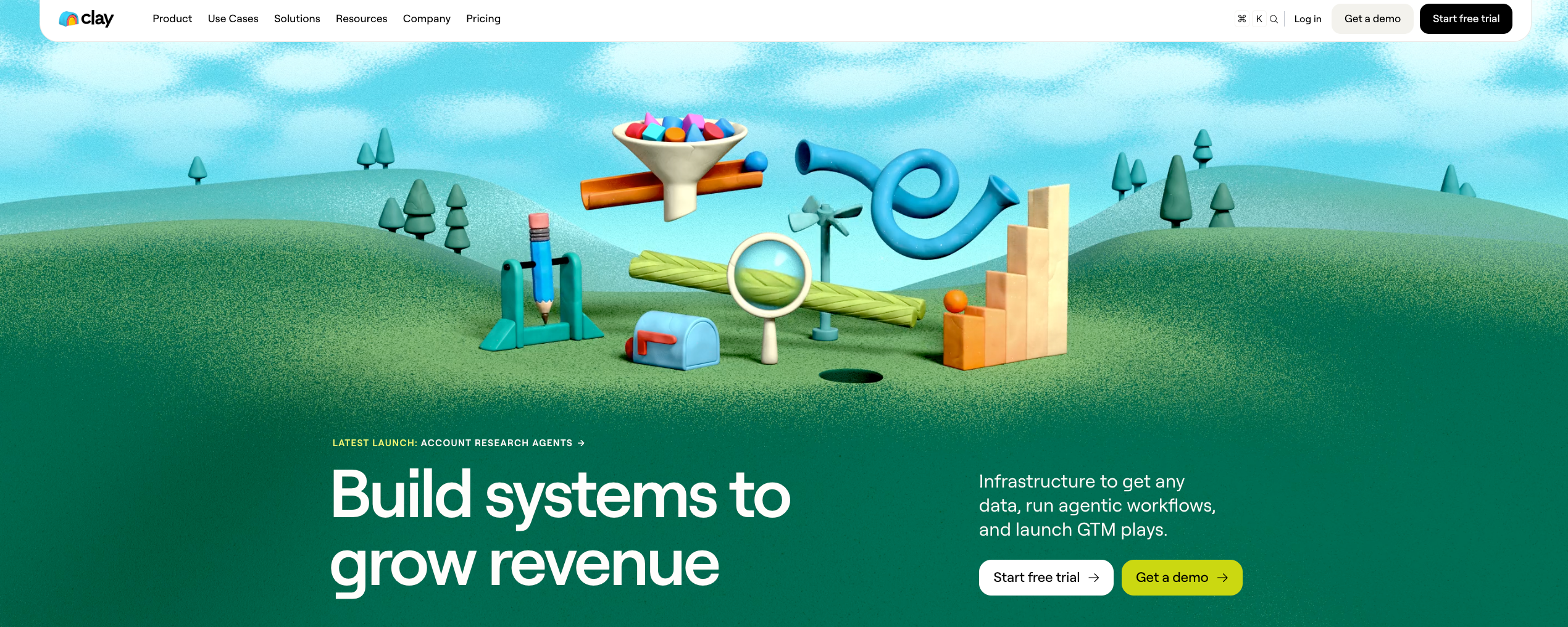
Best for: B2B teams needing enriched prospect data and competitive intelligence at scale.
Clay pulls data from 100+ sources, enriches it with AI, and lets you run research at volume that would otherwise require an analyst team. Marketing teams use it for account research, competitor analysis, and building highly targeted campaign lists.
What they offer:
- Data enrichment across 100+ providers from one interface
- AI research agents that scan websites, news sites, and social profiles
- Custom scoring and qualification logic
- Automated list building for ABM campaigns
- Integration with CRMs and outbound tools
- Waterfall enrichment that tries multiple sources per field
Key features: Multi-source enrichment, AI research agents, custom qualification logic, competitive intelligence gathering.
Considerations: Credit-based pricing gets expensive fast at scale. Primarily B2B; limited value for B2C or local businesses.
Pricing: Free tier with limited credits; paid plans from around $149/month.
9. Profound
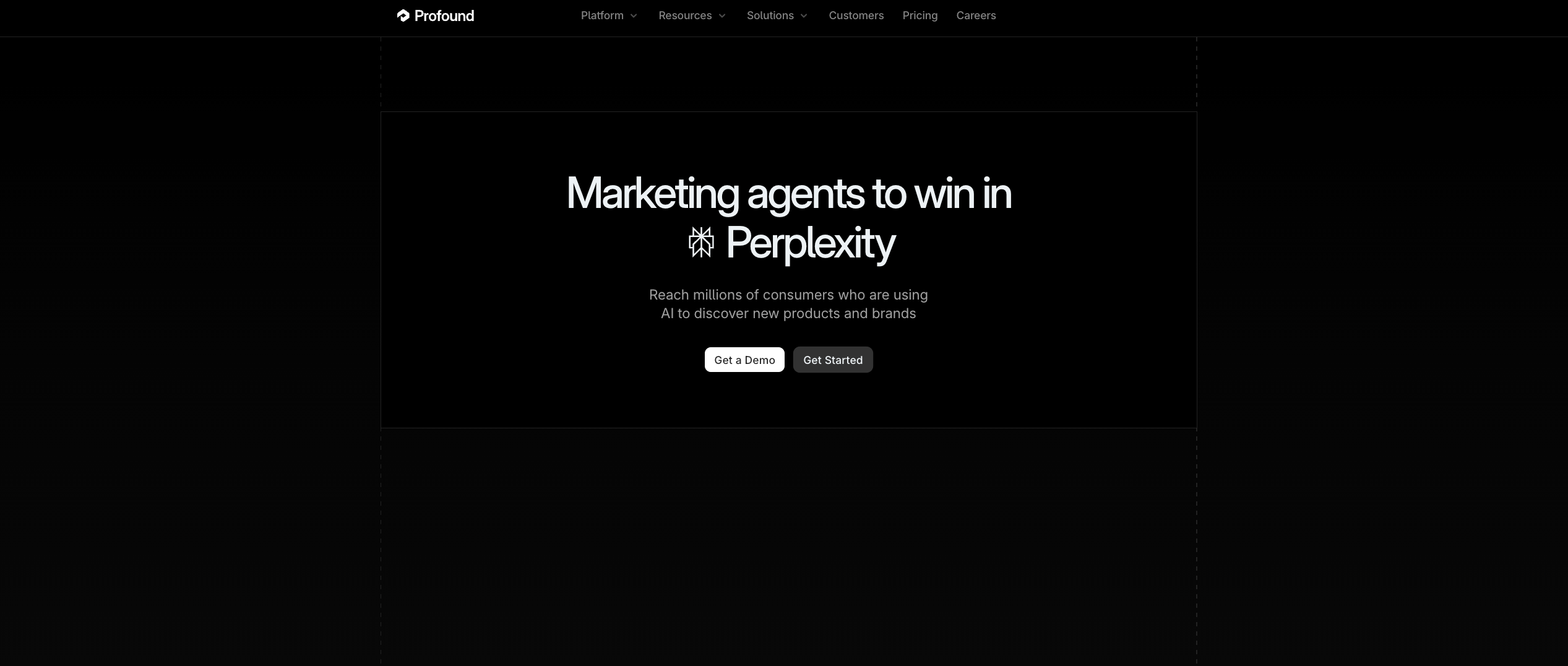
Best for: Brands that need to track and improve visibility inside AI assistants and answer engines.
This is the category that didn’t exist two years ago. As buyers shift toward asking ChatGPT, Gemini, Claude, and Perplexity for recommendations, traditional rank tracking stops telling you what you need to know. Profound monitors how often AI platforms mention your brand, what they say, and which competitors get cited instead.
What they offer:
- Citation tracking across ChatGPT, Perplexity, Gemini, Claude, and Google AI Overviews
- Share of voice measurement against competitors
- Sentiment analysis on how AI describes your brand
- Prompt-level visibility reporting
- Source attribution showing which pages AI cites
- Brand monitoring across AI-generated answers
Key features: Multi-platform AI citation tracking, competitive share of voice, sentiment measurement, actionable insights on visibility gaps.
Considerations: Tracking tells you what’s happening, not how to fix it. You still need the underlying content, schema, and authority work to move the numbers. Enterprise-oriented pricing.
Pricing: Custom pricing, typically enterprise-tier.
For the strategy side of this equation, our LLM SEO services handle the work that actually moves AI visibility metrics.
10. ChatGPT and Claude
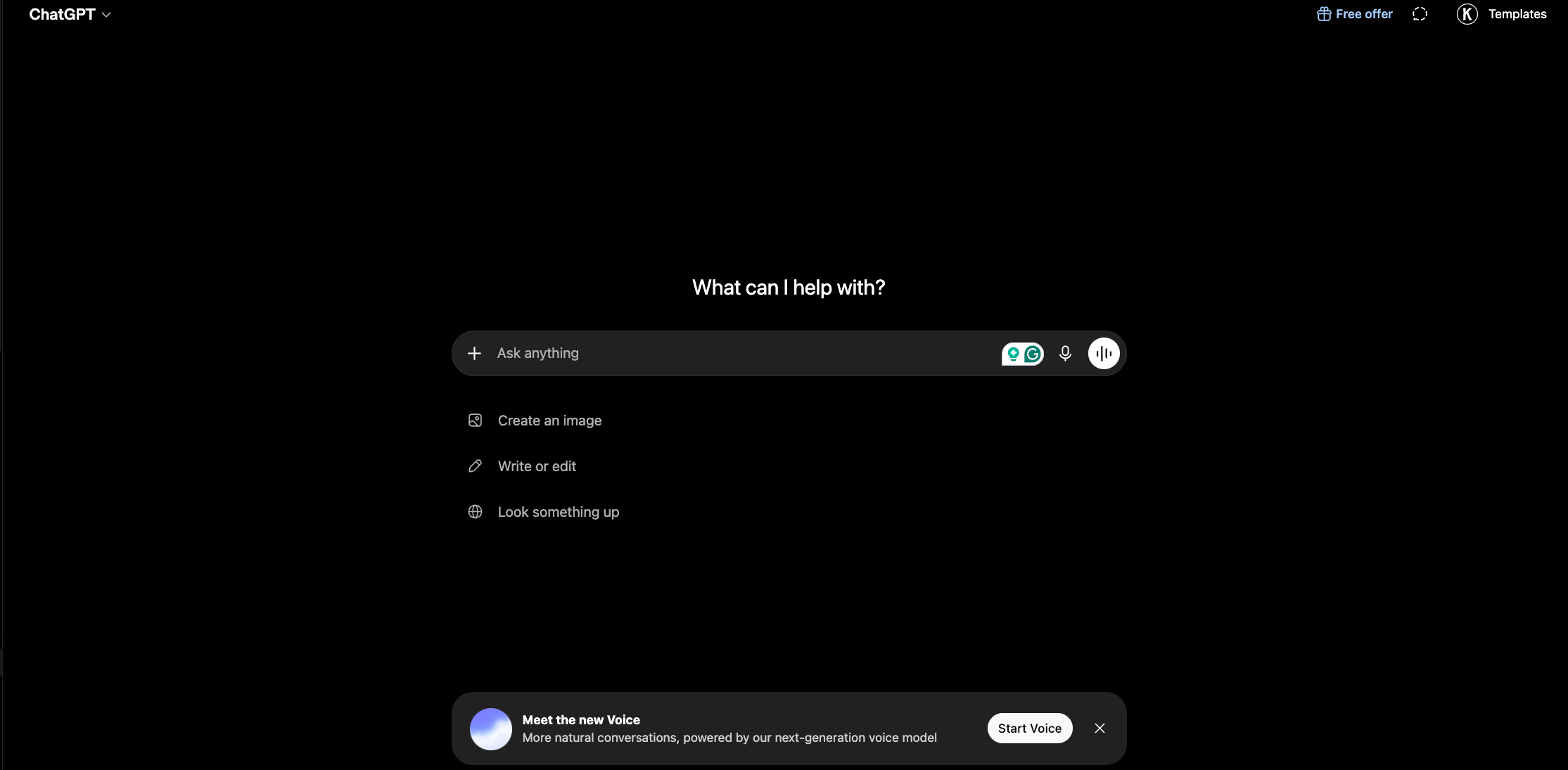
Best for: Every marketing team, as the general-purpose reasoning layer underneath everything else.
The most valuable AI marketing tool most teams have isn’t a marketing tool at all. General-purpose assistants like ChatGPT handle strategy work, analysis, research, and drafting that specialized tools can’t. They’re also dramatically cheaper than most dedicated platforms.
What they offer:
- Content strategy development and content briefs
- Data analysis from pasted spreadsheets and reports
- Competitor and market research
- Ad copy variations and messaging testing
- Custom instructions and projects that hold brand context
- Document analysis for long reports and research
Key features: Broad reasoning capability, custom instructions for brand voice, file analysis, extended context windows for large documents.
Considerations: No native marketing integrations, no automatic brand voice enforcement, and no workflow automation. You’re doing the connective work manually. Output quality tracks directly with prompt quality.
Pricing: Roughly $20/month per seat for both; team and enterprise tiers available.
How to Build a Stack, Not a Collection
Ten tools is a menu, not a shopping list. Here’s how to actually assemble something coherent.
Match Tools to Your Bottleneck
Start with where your marketing efforts genuinely stall:
| Your Bottleneck | Start Here |
|---|---|
| Content volume | Jasper + Surfer SEO |
| Design capacity | Canva Magic Studio |
| Email revenue | Klaviyo AI |
| Manual repetitive work | Gumloop |
| B2B prospect research | Clay |
| Video production | HeyGen |
| AI search visibility | Profound + LLM SEO strategy |
| Everything, generally | ChatGPT or Claude |
The Realistic Budget
For a 1-5 person marketing team, a sensible AI tooling budget lands around $200 to $800 monthly. That covers one content tool, one channel-specific platform, and a general assistant.
Above that range, you should be evaluating whether tools are replacing headcount rather than adding to overhead. Tool sprawl is a real cost, not a hypothetical one.
Prioritize Native Integration
A tool that lives inside your existing workflow beats a marginally better tool requiring a separate login and manual data transfer. Every integration gap costs time and creates a place for data to go stale.
Test Before You Commit
Most platforms offer free plans or trials. Run one real project through a tool before signing an annual contract. Vendor demos show the happy path; your actual workflow reveals the friction.
💡 Pro tip: Audit your AI tool subscriptions quarterly. Cancel anything nobody logged into in 30 days. Most teams discover they’re paying for three tools doing overlapping jobs and using one of them.
AI Marketing Tools by Channel
The top AI marketing tools don’t compete with each other so much as occupy different territory. Here’s how artificial intelligence applies across each marketing channel, and which capabilities actually matter in each one.
Content Marketing
This is where most teams start, and where the ROI case is clearest. AI content creation compresses the slowest part of content marketing: getting from blank page to workable draft.
What modern AI marketing tools handle here:
- Ideation and briefs built from competitor analysis and search intent
- First drafts of blog posts, guides, and marketing content
- Repurposing one asset into newsletters, social posts, and video scripts
- Consistent brand voice enforcement across every writer and every piece
- Editing and optimization for readability, tone, and structure
The tools worth your budget are the ones that hold brand context between sessions. A content creation tool that forgets your voice on every new document isn’t saving you much time once editing is factored in.
Search Engine Optimization
AI changed SEO in two directions at once. It made the work faster, and it changed what the work is.
| SEO Task | What AI Handles |
|---|---|
| Keyword research | Clustering by intent, surfacing gaps competitors missed |
| Content optimization | Real-time scoring against ranking pages |
| Technical audits | Crawl issue detection and prioritization |
| Internal linking | Relationship mapping across topic clusters |
| Content refreshes | Identifying decaying pages worth updating |
The newer half of the equation is AI search visibility. Ranking on Google no longer guarantees you appear when someone asks ChatGPT for a recommendation, which is why our LLM SEO services treat both surfaces as one strategy.
Paid Advertising
Google Ads has embedded machine learning so deeply that manual bidding is now the exception. Smart Bidding, responsive search ads, and Performance Max all run continuous optimization no human could match at scale.
Where AI-powered marketing tools add value on top:
- Generating and testing ad copy variations at volume
- Creative generation for display and video placements
- Cross-platform budget allocation based on actual conversion data
- Anomaly detection when campaign performance shifts unexpectedly
- Automated disapproval handling and account hygiene
The human job shifts from managing bids to managing strategy, offers, and creative direction. That’s a better use of your time anyway.
Social Media Marketing
Volume is the constraint in social, and AI addresses it directly:
- Caption and post generation matched to each platform’s format
- Optimal posting time prediction based on audience activity
- Visual asset creation and multi-format resizing
- Sentiment analysis across comments and mentions
- Trend detection before topics peak
- Response drafting for community management
The trap here is publishing AI-generated content without a human filter. Social audiences detect generic output faster than any other channel, and the reputational cost outweighs the efficiency gain.
Email Marketing
Email remains the highest-ROI channel, and marketing automation platforms have layered AI throughout:
- Subject line generation and predictive open-rate scoring
- Send-time optimization calculated per individual recipient
- Dynamic content blocks that swap based on subscriber behavior
- Predictive segmentation built on engagement patterns rather than static lists
- Churn prediction triggering retention flows before someone unsubscribes
Small optimizations compound here. A few percentage points on open rate across a large list translates to meaningful revenue over a year.
Ecommerce
Ecommerce gets the deepest AI application because the data is richest:
- Product description generation at catalog scale
- Personalized product recommendations per visitor
- Dynamic pricing informed by demand signals
- Abandoned cart sequences timed to individual behavior
- Predictive customer lifetime value modeling
- Inventory forecasting tied to campaign planning
Where Continuous AI Agents Fit
The newest development across every channel: agents that run persistently rather than executing on command. Instead of you asking a tool to check campaign performance, an agent monitors continuously and surfaces issues when they appear.
Early implementations handle:
- Ongoing paid campaign monitoring and bid adjustment
- Competitor content and pricing tracking
- Automated reporting when metrics cross thresholds
- Lead routing and qualification without manual review
This is genuinely where marketing efficiency compounds, because the work happens whether or not anyone remembers to check.
Don’t Buy Multiple Tools for One Job
The most common budget mistake we see: three tools with overlapping capability because each was bought to solve a slightly different problem.
Before adding anything to your AI marketing stack, ask:
- Does a tool we already pay for do this adequately?
- Will this integrate with our existing workflow, or create another silo?
- Who specifically will own this, and do they have time to learn it?
- What metric should move if this works?
A focused stack of four well-integrated tools beats twelve partially-adopted ones. The competitive advantage comes from execution depth, not subscription count.
Build a Smarter AI Stack With Doc Digital SEM
AI marketing tools have moved from advantage to baseline. The teams pulling ahead aren’t the ones with the most subscriptions. They’re the ones who picked a small, well-integrated stack and got genuinely good at using it.
Here’s what to remember:
- The shift from generative to agentic AI defines the 2026 landscape
- Specialization beats breadth; pick tools that do one thing exceptionally
- Native integration matters more than marginal feature advantages
- AI search visibility is a new category worth tracking
- A 1-5 person team needs $200-800 monthly, not twelve subscriptions
Tools are only half the equation. Strategy, clean data, and consistent execution are what turn subscriptions into results. Doc Digital SEM brings all three. Get your free digital marketing analysis (valued at $1,500) or explore our AI SEO services and build a stack that actually compounds.
FAQs
What is the AI marketing strategy in 2026?
The dominant strategy pairs agentic AI for execution with human direction for strategy. Teams automate repetitive workflows, personalize at scale, and optimize for visibility inside AI assistants alongside traditional search.
Which is the best AI tool for marketing?
There’s no single best tool. Jasper leads content creation, Surfer SEO leads content optimization, Klaviyo leads ecommerce lifecycle, and Gumloop leads workflow automation. Pick based on your bottleneck.
What are the top 5 AI tools right now?
ChatGPT or Claude for general reasoning, Jasper for branded content, Surfer SEO for search optimization, Canva Magic Studio for design, and Gumloop for workflow automation.
How much should I budget for AI marketing tools?
A 1-5 person marketing team should budget $200 to $800 monthly. Beyond that, tools should be replacing headcount rather than adding overhead.
Can AI marketing tools replace a marketing team?
No. AI tools compress execution time but can’t set strategy, understand market positioning, or make judgment calls. Teams using AI outperform teams without it, not teams replaced by it.
Do AI marketing tools hurt SEO?
Not inherently. Search engines evaluate content quality, not authorship. Thin, unedited AI content performs poorly, while well-edited AI-assisted content with genuine expertise ranks normally.


