


For two decades, SEO meant keywords. You picked a phrase, you targeted it, and you ranked. Then entities came along, and SEO meant relationships, brands, places, products, mapped inside a knowledge graph. Now AI search has rewritten the rules again, and a third concept is quietly reshaping how brands earn visibility in 2026: conversational entity modeling.
Google’s Knowledge Graph now handles more than 800 billion facts about 8 billion entities, and SEO experts agree that “entity-based optimization isn’t optional anymore, it’s the foundation of effective SEO in 2026.” But entities alone aren’t enough. AI systems demand both entity clarity and conversational structure to cite your brand.
Here’s what we’ll go through in detail:
- What conversational entity modeling actually means (the unified definition)
- How AI systems use entity models in conversational search
- The shift from keywords to entities to conversational entity modeling
- How to build a conversational entity model for your brand
- How to measure whether your model is actually working
If this concept feels new, that’s because it is. Doc Digital SEM has been quietly building conversational entity models for SaaS, healthcare, and B2B brands through our LLM SEO services and generative engine optimization work, and we’re going to break down the playbook the way we’d brief a new client.
What Conversational Entity Modeling Actually Means
Conversational entity modeling is the practice of structuring your brand, your content, and your data in a way that AI systems can understand as a meaningful entity in a conversation, not just as a string of keywords on a page.
It’s the intersection of three previously separate disciplines:
- Entity-based SEO (mapping your brand to recognizable real-world things)
- Conversational AI (understanding how people ask questions in natural language)
- Knowledge graph optimization (showing AI systems how your entity relates to others)
Put together, conversational entity modeling defines your brand, its attributes, and its relationships in a way that lets large language models understand and reference you when generating answers to a user’s input.
The Plain-English Definition
Imagine someone types into ChatGPT: “What’s the best workforce management software for restaurants?”
The AI doesn’t pull a list of pages. It pulls a list of entities it has learned to associate with the topic. Each entity has a defined identity, a set of attributes, and a set of relationships to other entities (competitors, integrations, use cases, industries, customer types).
If your brand is well-modeled as an entity, you appear in the response. If your brand is just a website with a bunch of keywords on it, you don’t.
The Three Components of a Conversational Entity Model
Every effective conversational entity model includes three core components:
| Component | What It Defines | Example |
|---|---|---|
| Entity identity | Who or what your brand is | “Doc Digital SEM is an AI SEO and LLM SEO agency based in Fort Lauderdale, Florida” |
| Entity attributes | The facts and values that describe the entity | Services offered, locations served, founding year, leadership, certifications |
| Entity relationships | How your entity connects to other entities | Industries served, partner platforms, competitors, use cases, integrations |
Together, these three components form the data set AI systems use to predict whether to mention you in a generated answer.
Why This Replaces Old SEO Thinking
Traditional SEO targets a fixed set of keywords. Conversational entity modeling targets the meaning behind those keywords and the relationships that surround them. The system isn’t matching strings of text anymore. It’s understanding the entity, evaluating context, and choosing which entities to surface based on the user’s intent.
That’s a fundamental shift, and it’s why brands that nail conversational entity modeling end up cited far more frequently than brands chasing keyword rankings.
How AI Systems Use Entity Models
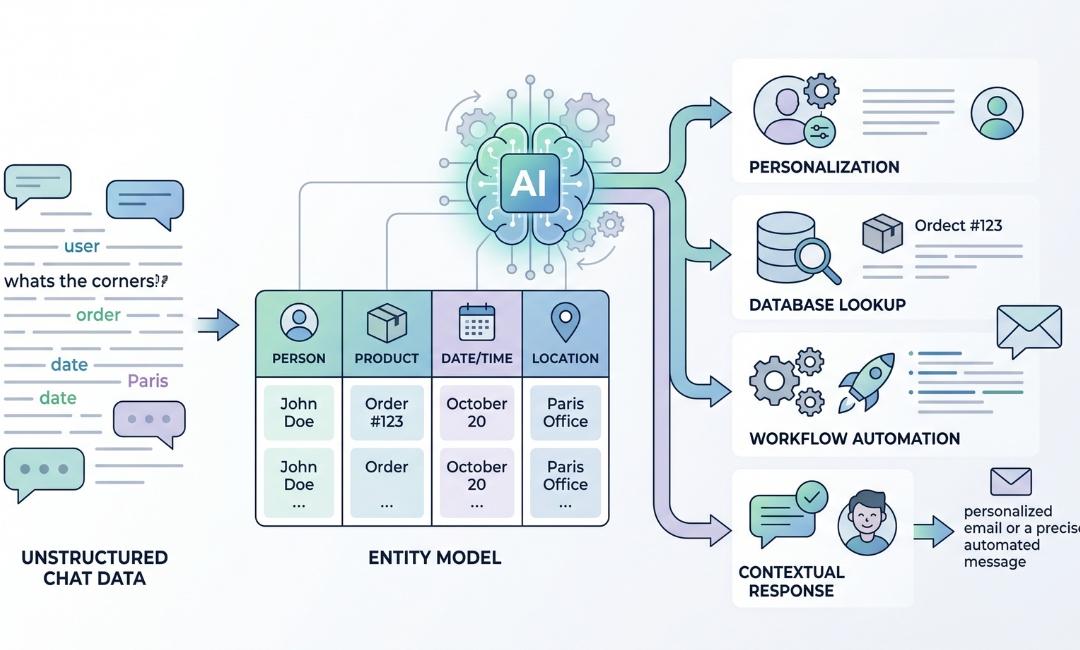
To understand why this matters, you need to know what’s actually happening inside an AI system when it answers a question. The mechanics aren’t magic. They’re a pipeline, and each step is an opportunity for your entity to be picked or skipped.
The AI Conversation Pipeline
Every time a user asks an AI tool a question, the system runs through a defined process:
- Parse the user’s input. The AI breaks the utterance down into intents and entities. “Best CRM for small business” becomes intent: find recommendation, entities: CRM, small business.
- Match intents to known entity sets. The system checks which entities in its training data match the user’s request. This is where entity modeling either works for you or against you.
- Retrieve candidate entities. The system pulls a closed set of relevant entities from its knowledge graph or live retrieval.
- Evaluate context and relationships. Each entity is scored against the conversational context: industry, use case, audience, and recency.
- Generate the answer. The AI produces a response that references the highest-scoring entities, often with citations.
If your brand isn’t well-modeled as an entity, you fail at step 2. The system can’t identify you as a meaningful entity in the conversation, so you never reach the generation stage.
What AI Systems Look For
When AI systems evaluate entities, they look for specific signals that tell them an entity is real, distinct, and trustworthy:
- Consistent mentions across multiple data sets. Your brand should appear with consistent attributes on Wikipedia, LinkedIn, Crunchbase, industry directories, and review platforms.
- Structured data on your website. Schema markup tells AI systems exactly what your entity is, what it does, and how it relates to other entities.
- Clear entity attributes in your content. Your services, locations, founding info, and team should be stated explicitly, not buried in design elements.
- Relationships to other known entities. Linking your entity to recognized industries, competitors, partners, and customer types helps AI systems generalize from your data.
- Topical authority. A brand that consistently produces content in a specific field signals to AI systems that the entity is a credible source on that topic.
The Role of Conversational Context
Here’s where the conversational part of conversational entity modeling kicks in. AI systems don’t just match entities. They match entities to the context of the conversation.
If a user asks ChatGPT, “What’s the best AI SEO agency for B2B SaaS?”, the AI looks for entities tagged with both:
- Service: AI SEO agency
- Industry: B2B SaaS
A brand that’s modeled as an “AI SEO agency” but isn’t connected to “B2B SaaS” as a relationship will get skipped in favor of one that is. That’s why building both the entity and the conversational context matters equally.
💡 Pro tip: Think of your entity as a node in a graph and every related word, industry, or use case as an edge. The more high-quality edges your node has, the more often you’ll show up in conversations across that topical neighborhood.
This is exactly the work our team handles through LLM SEO services and structured data implementation, modeling your brand as a fully-formed entity in the AI knowledge layer.
From Keywords to Conversational Entity Modeling
To understand where SEO is heading, you have to understand where it came from. The journey from keywords to entities to conversational entity modeling is a 25-year evolution, and each stage required SEO professionals to learn an entirely new way of thinking about content.
The Three Eras of Search Optimization
| Era | Optimization Target | Example Tactic | What Won |
|---|---|---|---|
| Keyword Era (2000-2012) | Exact-match keywords | Stuff “best running shoes” 18 times into a page | Whoever matched the most keywords |
| Entity Era (2012-2022) | Real-world entities + attributes | Build out brand schema, knowledge graph entries | Whoever was clearly identified as a real entity |
| Conversational Entity Era (2022-now) | Entities + conversational context + relationships | Model your brand for how users actually ask questions in AI tools | Whoever AI systems learn to associate with the conversation |
Each era didn’t kill the last. It layered on top. Keywords still matter as semantic signals. Entities still matter as the foundation of credibility. But conversational entity modeling is what decides who AI tools cite when the user types or speaks a question.
Why Pure Keyword Targeting Stopped Working
The old playbook fails for three reasons in 2026:
- AI systems don’t match keywords. They interpret meaning. A page stuffed with “best CRM” no longer beats a page that clearly establishes itself as a CRM entity with strong relationships to other relevant entities.
- Conversational queries are longer and more specific. People don’t type “best CRM” into ChatGPT. They type “What’s the best CRM for a 5-person sales team in commercial real estate?” That requires entity + context, not keyword matching.
- AI systems generalize. Even if a user uses a synonym you didn’t target, the AI will still find your entity if it’s well-modeled, because the system understands related words and concepts through its training data.
The Mental Model Shift
The old question was “what keywords should I rank for?” The new question is “what entity is my brand, and what conversations should it appear in?”
That single shift changes everything about how you create content, structure your site, and build authority. You stop targeting search terms. You start defining your entity and seeking out the conversational neighborhoods where your entity belongs.
For a deeper read on this transition, our breakdowns on semantic SEO for LLMs and LLM SEO vs AI SEO cover the strategic shifts happening across the discipline.
How to Build a Conversational Entity Model
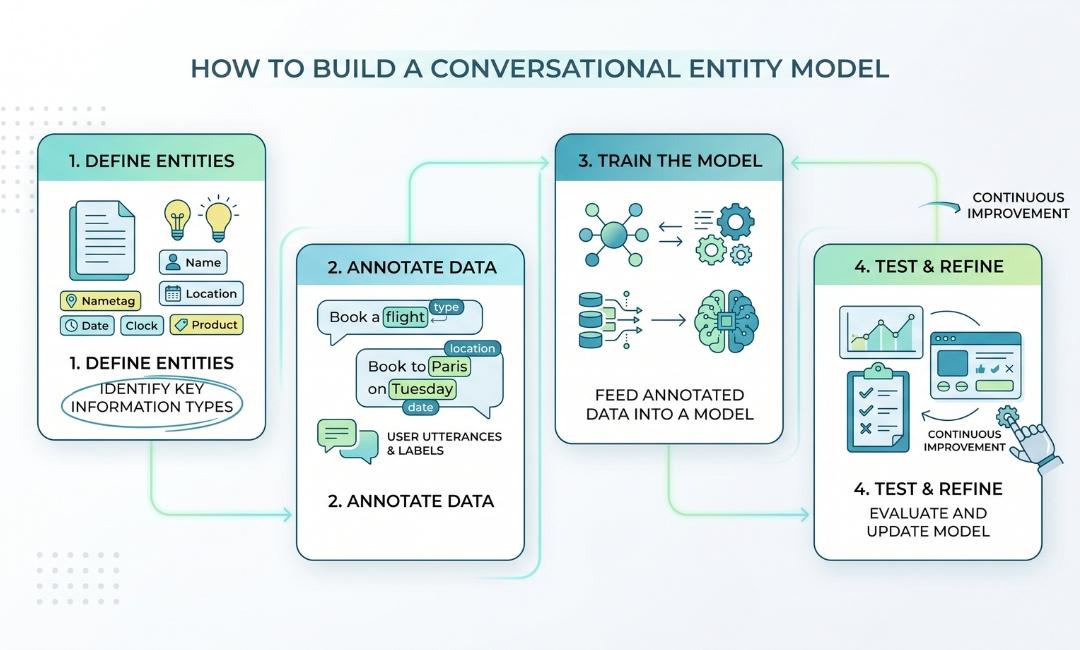
Building a conversational entity model for your brand isn’t a one-week project. It’s an ongoing discipline. But the foundation can be built in 60 to 90 days if you follow the right process.
Step 1: Define Your Entity Clearly
Start with a one-sentence definition of your entity that includes type, what you do, who you serve, and where you operate. Example:
“Doc Digital SEM is a full-service AI SEO and LLM SEO agency that helps SaaS, medical, and service businesses earn visibility across ChatGPT, Gemini, Claude, and Perplexity, based in Fort Lauderdale, Florida.”
That sentence becomes the anchor for every other piece of content, schema, and external mention. Consistency across all data sets is non-negotiable.
Step 2: Map Your Entity Attributes
List every attribute that defines your entity:
- Services offered
- Industries served
- Locations operated in
- Founding year
- Leadership and key team members
- Certifications and partnerships
- Notable clients (where contractually allowed)
- Awards and recognitions
- Pricing approach
- Engagement model
Each attribute becomes a fact that AI systems can extract and reference. The more attributes you publish clearly, the more often AI tools can confidently cite your entity.
Step 3: Build Out Your Entity Relationships
This is where most brands stop. Don’t.
Map your entity to:
- Industries you serve (each one is a related entity)
- Competitors in your category (helps AI understand your position)
- Integrations and partners (signals your entity’s connections)
- Use cases and customer types (defines who you’re relevant to)
- Topics and concepts you cover (builds topical authority)
- Geographic markets (essential for local relevance)
Each relationship becomes an edge in your entity graph. The more well-defined edges, the more conversations your entity participates in.
Step 4: Implement Schema Markup
A schema is how you tell AI systems explicitly what your entity is. The minimum viable schema set:
- Organization schema with sameAs links to LinkedIn, Wikipedia, Crunchbase, Twitter
- LocalBusiness schema if you have physical locations
- Service schema for each service offering
- Person schema for leadership and authors
- FAQPage schema for question-based content
- Product schema for SaaS products
Each schema type provides structured data that AI tools can parse with high confidence. Without a schema, you’re forcing AI systems to infer your entity from unstructured text, which they’ll often do incorrectly.
Step 5: Create Content Around Conversational Intents
Your content should answer the questions people actually ask in AI tools. For each topic in your field, build content that covers:
- “What is X” (definition pages)
- “How does X work” (educational content)
- “Best X for Y” (comparison and listicle content)
- “X vs Y” (head-to-head comparison pages)
- “X pricing” (transparent pricing breakdowns)
- “How to do X” (process and tutorial content)
Each piece of content reinforces your entity’s relevance in a specific conversational context.
Step 6: Build External Entity Signals
Your website is only one signal. AI systems triangulate across:
- Wikipedia (where genuinely warranted)
- Industry directories (Crunchbase, G2, Capterra, Clutch)
- Review platforms (Trustpilot, Google Reviews)
- Social profiles (LinkedIn, Twitter, YouTube)
- Reddit and Quora discussions
- Media mentions and PR placements
- Podcast appearances and guest articles
Consistent entity information across these channels builds the trust signals AI systems need to confidently cite your brand.
Step 7: Maintain Entity Consistency
Once your entity is established, the work shifts to maintenance. Every piece of content, every schema update, every new platform should reinforce the same entity definition. Inconsistencies (different addresses, mismatched service lists, conflicting founding dates) confuse AI systems and degrade your entity model over time.
💡 Pro tip: Build a brand entity prototype document that defines your entity, attributes, relationships, and approved descriptions. Every new asset gets checked against the prototype before publishing. That single discipline prevents the drift that destroys most entity models within a year.
This is the kind of structured, end-to-end entity modeling our team handles inside LLM SEO engagements and structured data optimization projects, so your brand becomes the entity AI systems learn to trust and cite.
How to Measure Your Conversational Entity Model
Here’s the part everyone skips entirely. How do you know if your conversational entity model is actually working? Without measurement, you’re optimizing in the dark.
The Five Metrics That Matter
These are the signals that tell you whether AI systems are recognizing and citing your entity:
| Metric | What It Reveals | Where to Find It |
|---|---|---|
| AI Citation Frequency | How often AI tools mention your brand in answers | Profound, Goose, Rankeo, Yoast Brand Insights |
| Share of Voice | Your citation rate vs. competitors on shared queries | AI citation tracking tools |
| Entity Recognition Rate | Whether AI tools correctly identify your brand when prompted | Manual prompt testing across ChatGPT, Gemini, Claude, Perplexity |
| Branded Search Volume | Whether AI exposure drives downstream search demand | Google Search Console |
| AI Referral Traffic | Visits arriving from AI platforms | GA4 with custom AI/LLM Traffic channel group |
The Manual Test Every Brand Should Run
Once a month, run these queries through ChatGPT, Gemini, Claude, and Perplexity:
- “What is [your brand name]?” (entity recognition test)
- “What does [your brand name] do?” (attribute accuracy test)
- “Who are competitors of [your brand name]?” (relationship test)
- “Best [your category] for [your target customer]” (conversational citation test)
- “How do I [task your brand solves]?” (topical authority test)
Document the responses. Look for:
- Whether your brand is mentioned at all
- Whether your description matches your defined entity
- Whether your attributes are correctly cited
- Whether competitors are listed accurately
- Whether you appear for queries, you should win
What Strong Entity Modeling Looks Like
A well-modeled entity will:
- Be correctly identified by AI tools when asked directly
- Be consistently described across multiple AI platforms
- Show up as a recommendation in relevant conversational queries
- Be cited by name with accurate attributes and relationships
- Generate growing branded search traffic over time
If any of those signals are weak, the gap reveals exactly where to focus next. Weak entity recognition means you need more external mentions and a consistent NAP. Inaccurate descriptions mean your schema and on-site content need tightening. Missing competitor relationships means you need comparison content and category-level positioning.
Iterate Based on the Data
Conversational entity modeling isn’t a one-time setup. It’s a continuous loop:
- Define and publish your entity
- Build attributes, relationships, and external signals
- Measure recognition and citation across AI tools
- Identify gaps in your entity model
- Add content, schema, or mentions to close the gaps
- Re-measure monthly
The brands that win aren’t the ones with the prettiest websites. They’re the ones who treat their entity as a living asset and refine it month after month based on real measurement data.
💡 Pro tip: Set a quarterly “entity health audit” on your calendar. Pull your AI citation data, compare it to last quarter, and identify two or three specific changes to make. Quarterly discipline beats annual overhauls every time.
This measurement-driven approach is exactly how Doc Digital SEM closes the loop on every LLM SEO engagement and AI search optimization project. Building the model is half the work. Measuring, refining, and compounding the results is the other half, and it’s the half most agencies never get to.
The brands that own their conversational entity model own their categories. The ones who don’t will spend the next five years wondering why ChatGPT keeps recommending their competitors.
How Conversational Entity Modeling Works Behind the Scenes
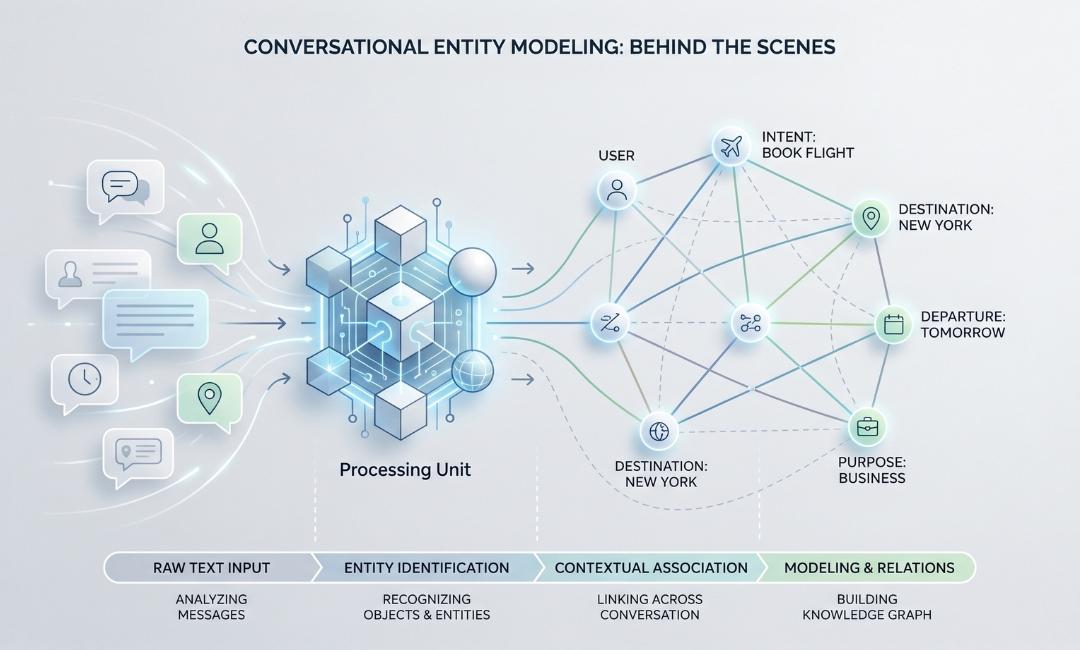
Most marketers treat AI systems as black boxes. You publish content, you cross your fingers, and you hope ChatGPT mentions your brand. That’s not a strategy. That’s a wish.
To actually win at conversational entity modeling, you need to understand the operations happening under the hood when an AI tool processes a user’s input and decides which entities to surface. Once you see the mechanics, the optimization choices become obvious.
How AI Systems Process a Conversation
Every conversation between a user and an AI tool follows the same fundamental pipeline:
- Input parsing. The system breaks down the user’s sentence into smaller units of text and identifies the words, intents, and entities present.
- Intent classification. The system tries to predict what the user actually wants. Is this a question? A request for a recommendation? A task to handle?
- Entity recognition. Named entities (brands, products, locations, concepts) get identified and tagged so the system knows what the conversation is about.
- Context evaluation. The system reviews the broader dialogue, including previous turns in the conversation, user history (where available), and any constraints baked into the prompt.
- Retrieval and matching. The system pulls candidate entities and information from its training data and live retrieval sources, matching them against the input.
- Response generation. The system composes a response that references the highest-scoring entities, often with citations.
Each of these steps creates an optimization opportunity. Brands that understand the pipeline can engineer their content to perform better at every stage.
Intents, Entities, and Utterances Explained
Three terms you’ll hear constantly when discussing conversational AI architecture:
| Term | Definition | Example |
|---|---|---|
| Intent | What the user is trying to accomplish | “Find a recommendation,” “Get pricing info,” “Compare options” |
| Entity | A specific thing referenced in the user’s input | “AI SEO agency,” “Fort Lauderdale,” “B2B SaaS” |
| Utterance | The actual sentence or question the user typed or spoke | “What’s the best AI SEO agency for B2B SaaS in Fort Lauderdale?” |
When AI systems are trained to handle a new field, engineers build out a fixed list of intents the system needs to recognize, plus a set of entities that commonly appear in those intents, plus a library of utterances that represent how real users phrase the same intent.
For your brand to be cited, your entity needs to appear in the system’s training data with strong, consistent signals across many utterances and intent contexts.
Why Synonyms and Related Words Matter
AI systems don’t just match exact words. They generalize. If your brand is well-modeled around the entity “LLM SEO agency,” the system can also surface you for utterances like:
- “AI SEO agency”
- “Generative engine optimization firm”
- “ChatGPT SEO experts”
- “Agency that helps me show up in AI answers”
This generalization happens through synonyms, related concepts, and the relationships your entity has to other known entities. The richer your entity’s web of relationships, the more conversational variations the system can match you against.
💡 Pro tip: When you publish content, list common synonyms for your entity and your services in a dedicated section. AI systems will learn the synonym mapping faster, which means broader citation coverage with less effort.
How Entity Tagging Works on Your Site
The signals AI systems use to tag and classify your entity come from a combination of sources on your website:
- Schema markup. Structured data tells AI tools exactly what your entity is in a machine-readable format.
- Heading structure. Clear H1, H2, H3 tags signal which sections cover which entities.
- Internal linking. Links between related pages reinforce entity relationships across your site.
- Page-level context. The combination of headings, body text, and metadata helps AI systems generalize your entity’s relevance.
- Anchor text. The words used to link to your entity from across the web (and within your site) shape how AI systems understand what your entity is.
For technical implementation, some platforms even let you write regular expression patterns or custom rules to define which terms should activate certain entity tags. That’s the kind of granular control most brands never reach but that compound over time.
Training Data, Prototypes, and Iteration
Here’s something most brands miss: AI systems don’t have a closed set of entities they recognize forever. The training data is updated, retrieval layers refresh, and entity recognition improves over time. Your entity isn’t fixed in stone.
That means you can:
- Add new entity attributes as your business evolves
- Build new entity relationships when you expand to new industries or product types
- Update prototype descriptions when your brand positioning shifts
- Refresh content to reinforce current entity signals
- Find and fix incorrect entity associations when AI tools get things wrong
This is an ongoing project, not a one-time setup. The brands with the strongest conversational entity models are the ones running quarterly entity health audits to seek out gaps, address inconsistencies, and provide cleaner signals to AI systems.
Security, Privacy, and the Data You Provide
One important note for organizations handling sensitive data. When you publish entity information, you’re providing it to AI systems that may include it in future training data. That’s mostly a feature, not a bug, since accessible information drives citations. But organizations in regulated fields (healthcare, finance, legal) should think carefully about which entity attributes they make publicly accessible versus which ones stay behind authentication.
A few practical guardrails:
- Publish only the entity attributes that support your visibility goals
- Keep client-specific information behind login walls
- Use schema to define your entity, not to expose private data
- Audit your published entity attributes annually for accuracy and security
What This Means in Practice
The brands winning conversational entity modeling treat their entity model like a product. They build it intentionally, document it carefully, measure it consistently, and iterate based on what AI systems actually surface. Every new piece of content, every schema update, every external mention is checked against a clear question:
“Does this strengthen our entity’s recognition, attributes, or relationships in the conversations we want to win?”
If the answer is yes, ship it. If the answer is no, rework it.
That’s the difference between a brand that gets cited consistently and a brand that wonders why AI systems keep listing their competitors instead.
Our team applies this product-thinking approach to every LLM SEO engagement, AI SEO project, and structured data implementation we build. Conversational entity modeling isn’t a feature we add. It’s the framework we operate inside, every single day.
Build a Stronger Entity With Doc Digital SEM
Conversational entity modeling is the new foundation of AI search visibility. Brands that define their entity clearly, build strong relationships, and measure citation performance consistently will dominate AI answers. Brands that don’t will quietly fade out of every relevant conversation.
Here’s what to remember:
- Conversational entity modeling unifies entity SEO + conversational AI + knowledge graph optimization
- AI systems cite entities, not keywords
- Define your entity, attributes, and relationships clearly
- Schema markup, external signals, and content all reinforce your entity
- Measurement and iteration turn the model into compounding citations
The brands quietly winning AI search are the ones treating their conversational entity model as a product. Doc Digital SEM builds that model end-to-end. Get your free AI visibility audit (valued at $1,500) or explore our LLM SEO services and start owning your entity in every AI conversation.
FAQs
What is an example of conversational AI?
ChatGPT, Gemini, Claude, and Perplexity are conversational AI examples. Users ask questions, and the system uses prediction models to determine and access the most relevant answer.
What is an entity in conversational language understanding?
An entity is any distinct thing the system can identify, like a brand, product, location, or number, used to access and predict the right response.
How does conversational AI work?
Conversational AI parses user input, identifies intents and entities, then uses prediction models trained on massive data sets to determine and generate the most contextually relevant answer.
How to build conversational AI?
Define intents, tag entities, build training utterances, add synonyms, and book ongoing iteration cycles. Each sign of misclassification helps the system learn and improve prediction accuracy.
What is a user’s input in conversational AI?
A user’s input is the question or sentence typed or spoken into a conversational AI system, used to determine intent and access the right prediction.
How do large language models handle conversations?
Large language models process a user’s input, predict intent based on training data, and generate responses by matching entities to relevant context across billions of data points.
How does a regular expression help in conversational AI?
A regular expression matches fixed patterns in a user’s input, helping the system determine intent, sign of specific entities, or access exact values like phone number formats.


