


Ranking in your home country is one game. Ranking across ten countries in six languages is an entirely different one, with rules that trip up even experienced marketers. Businesses expand internationally, translate a few pages, and then wonder why they’re invisible in every market except the one they started in. Global SEO is the discipline that fixes that.
Global SEO, more commonly called international SEO, optimizes your website so search engines deliver the right content to the right audience across multiple countries and languages. Get it right, and you unlock enormous demand. Consider that English speakers make up a minority of internet users worldwide, yet most websites target them exclusively.
Here’s what we’ll cover:
- What global SEO actually is and what it includes
- How global SEO differs from local SEO
- The core components of an international SEO strategy
- Keyword research and localization across markets
- A real case study: ACC Aviation’s 500% traffic growth through international consolidation
We run international SEO for global brands at Doc Digital SEM. Our SEO services helped ACC Aviation grow from 3,000 to nearly 18,000 monthly users, and we’ll show you the strategy behind results like that.
What Global SEO Actually Is
Global SEO is the practice of optimizing a website to rank in search engines across multiple countries and languages. It ensures that international visitors find content relevant to their country, language, and cultural context, rather than being served pages meant for a different market.
The Terms You’ll Hear
These get used interchangeably, but there are subtle distinctions:
| Term | What It Emphasizes |
|---|---|
| Global SEO | The overall practice of ranking internationally |
| International SEO | The same thing, most common term |
| Multiregional SEO | Targeting multiple countries (possibly same language) |
| Multilingual SEO | Targeting multiple languages (possibly same country) |
In practice, a strong international SEO strategy usually involves both multiregional and multilingual elements. A brand expanding into Canada might need English and French (multilingual) while targeting a specific country (multiregional).
What Global SEO Includes
An effective international SEO strategy combines several disciplines:
- Technical structure signaling which content targets which country and language
- Hreflang tags telling search engines which version to serve which user
- Localized content adapted to each market’s culture and search behavior
- Country-specific keyword research matching how locals actually search
- International link building from local sources in each target market
- Region-specific URL structure helping search engines identify content by country
Each piece reinforces the others. Miss one and international performance suffers.
How Global SEO Differs From Local SEO
People confuse these constantly, but they’re nearly opposite disciplines. Understanding the difference clarifies what global SEO actually requires.
Local SEO vs. Global SEO
| Local SEO | Global SEO | |
|---|---|---|
| Target | Nearby customers in a specific area | International audiences across countries |
| Keywords | Hyper-local (“dentist near me”) | Country and language-specific |
| Key tool | Google Business Profile | Hreflang tags and URL structure |
| Authority | Local citations and reviews | International and local-language backlinks |
| Content | Location-specific service pages | Localized content per market |
| Goal | Rank in one geographic area | Rank across multiple markets |
The Core Distinction
Local SEO focuses on being found by people near you, using location-specific keywords and Google Business Profile to dominate a city or region. Measuring local SEO success means tracking rankings and visibility in that specific area.
Global SEO focuses on being found by people in different countries, using hreflang, localized content, and international link building to rank across markets. Success means organic traffic and keyword rankings growing across multiple regions.
A business can need both. A multi-location international company might run local SEO for each physical location and global SEO across countries. They’re complementary, not competing.
The Core Components of International SEO
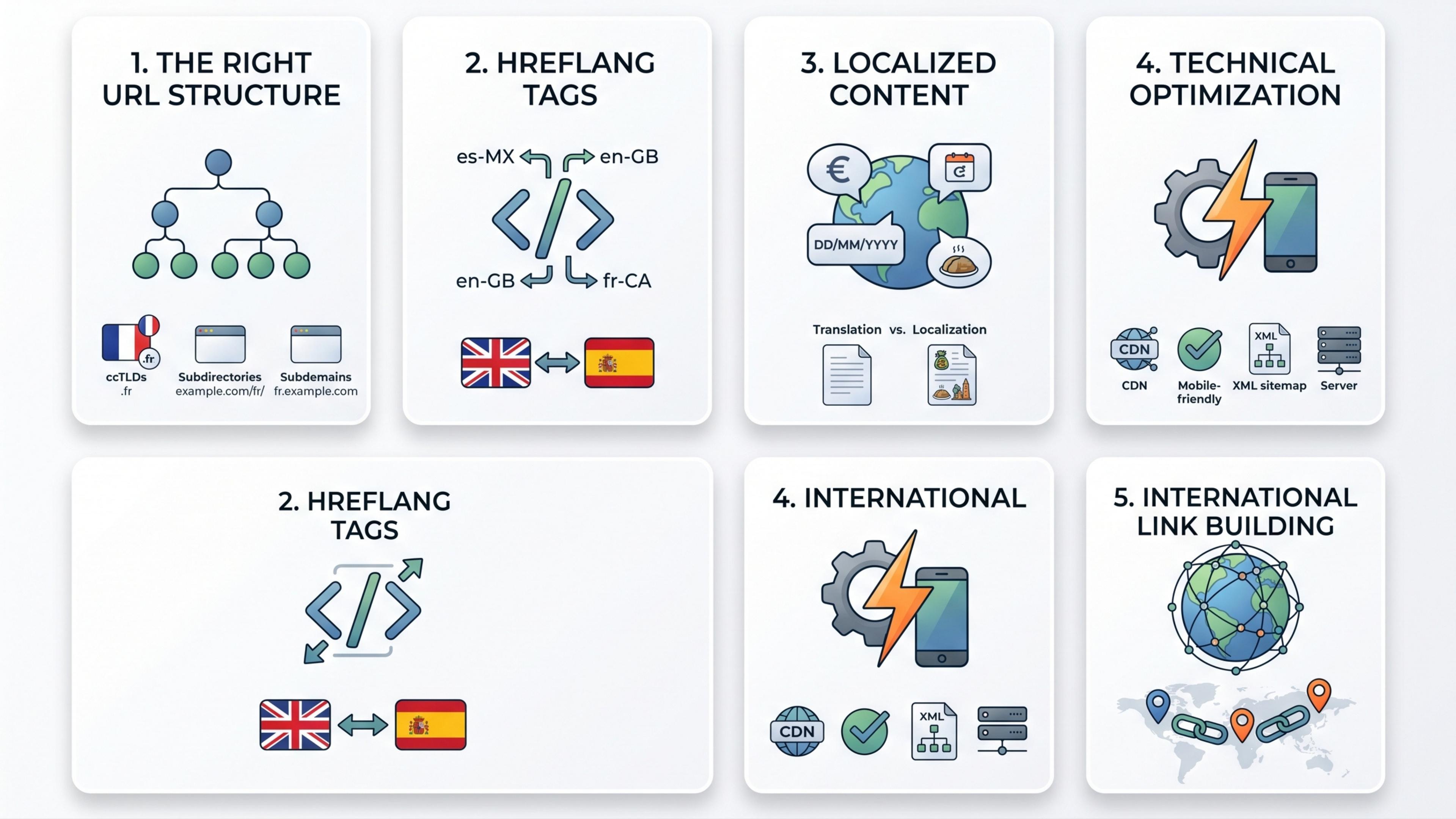
Building a successful international SEO strategy means getting several components right. Here’s what each one requires.
1. The Right URL Structure
Your URL structure tells search engines which content targets which country. Three options:
- ccTLDs (example.fr) send the strongest country signal but split authority
- Subdirectories (example.com/fr/) consolidate authority under one domain
- Subdomains (fr.example.com) separate regional content
For most businesses, subdirectories win because they keep domain authority unified. Country-specific domains suit large global brands with distinct operations per country.
2. Hreflang Tags
Hreflang tags help search engines serve the correct language version to each user. They prevent someone in France from landing on your English page, and they stop your different language versions from being flagged as duplicate content.
The rules that matter:
- Every language version must reference all others, including itself
- Use correct language and region codes (es-MX, en-GB, fr-CA)
- Only reference pages that genuinely exist
- Verify implementation in Google Search Console
Implementing hreflang correctly prevents users and search engines from seeing the wrong language version, which is one of the most common international SEO failures.
3. Localized Content
Localization adapts content to local markets rather than just translating words. It accounts for cultural nuances, local terminology, currency, date formats, and market-specific messaging.
Localized content increases relevance and trust with international audiences, which improves both engagement and search rankings. Machine translation alone produces content that reads as foreign and gets devalued by local search engines. Professional localization, ideally with native speakers, is what makes content genuinely resonate.
4. Technical Optimization
International sites still need strong technical foundations:
- Fast load times across regions (consider a CDN)
- Mobile-friendly design for markets where mobile dominates
- Clean, updated XML sitemaps including all localized URLs
- Proper indexing configuration
- Server-side rendering so search engines index translated content easily
5. International Link Building
Backlinks remain a top ranking factor, and for global SEO, local backlinks carry special weight. Acquiring links from relevant websites in each target market builds authority in that market, signaling genuine local relevance rather than a translated foreign site.
Keyword Research Across Markets
This is where global SEO strategies most often go wrong. Translating your home-market keywords and targeting the translations doesn’t work, because search behavior varies dramatically by country and language.
Why You Can’t Just Translate Keywords
Even within the same language, localized keywords differ significantly. What Americans call an “apartment,” the British call a “flat.” Search volume for the same concept varies enormously by region. A high-volume keyword in one market may be nearly unsearched in another.
How to Do International Keyword Research
For each target country and language:
- Conduct independent keyword research rather than translating your existing list
- Use tools like Ahrefs, Semrush, and Google Keyword Planner to find local search volume
- Understand local search behavior and the terms locals actually use
- Adapt keywords to cultural context, not just literal meaning
- Involve native speakers who understand market-specific phrasing
Choose Target Markets With Data
Before researching keywords, use market research to decide which countries are worth pursuing:
- Use Google Analytics to see where existing international traffic originates
- Evaluate search demand and competition per market
- Analyze competitors already succeeding in target markets
- Prioritize markets where the opportunity justifies the localization investment
💡 Pro tip: Don’t expand into a market just because you can translate into its language. Expand where thorough market research shows real search demand and manageable competition. Spreading thin across too many markets underperforms focusing on a few done well.
Case Study: ACC Aviation’s Global SEO Transformation
Here’s what global SEO looks like executed at scale. ACC Aviation is a UK-based private jet charter company operating internationally, and their project shows that international SEO success sometimes means fewer pages, not more. Read the full case study here.
The Situation
ACC Aviation had accumulated more than 3,000 pages across multiple domains, markets, aviation services, and destinations. That looks like enormous international reach. In reality, it was fragmenting their performance.
Multiple domains divided search authority. Overlapping pages across countries and languages competed for the same keywords. Regional content lacked clear ownership. The signals search engines needed to rank ACC Aviation were scattered across too many URLs, and in an international context, this cannibalization was severe. Global service pages overlapped with regional ones. Destinations had near-duplicate versions across markets.
The Strategy
Rather than migrating all 3,000 pages, the objective was determining which deserved to exist. Every group of competing pages was evaluated on search intent, regional relevance, traffic, backlinks, content quality, and strategic importance.
The result: over 3,000 legacy pages consolidated into a focused platform of nearly 1,300, with at least 1,700 pages merged, redirected, or retired, a reduction of roughly 57%. Multiple domains were unified under one primary site, concentrating backlinks, search equity, and authority that had been divided.
The International Architecture Decisions
Two decisions demonstrate genuine international SEO expertise:
A US version was deliberately not created. After evaluating duplication risk, global English and US English stayed together on the primary site, while the UK and Latin America were treated as secondary markets needing distinct regional experiences. Creating a US folder just because it was technically possible would have produced hundreds of near-duplicate competing English pages.
Localization over duplication. Regional versions used different headlines, calls to action, airport references, routes, and market-specific messaging, real localization, rather than cloning global pages into each region. Hreflang relationships were created only when equivalent pages genuinely existed.
The Results
| Stage | Monthly Users |
|---|---|
| Start of engagement | ~3,000 |
| After a year of foundational work | ~8,000 |
| Within one month of consolidation | ~18,000 |
That’s roughly 125% growth over the pre-consolidation baseline, and about 500% growth across the full engagement, from 3,000 to nearly six times that audience. And these results were early, with the UK consolidation still in progress and search engines still processing the new architecture.
The Takeaway
International SEO growth doesn’t always come from publishing more content across more countries. Sometimes it comes from consolidation, identifying where authority is divided, where pages compete across markets, and where content can combine into stronger resources. For international brands with sprawling multi-market footprints, that lesson is worth more than any tactic.
Measuring International SEO Performance
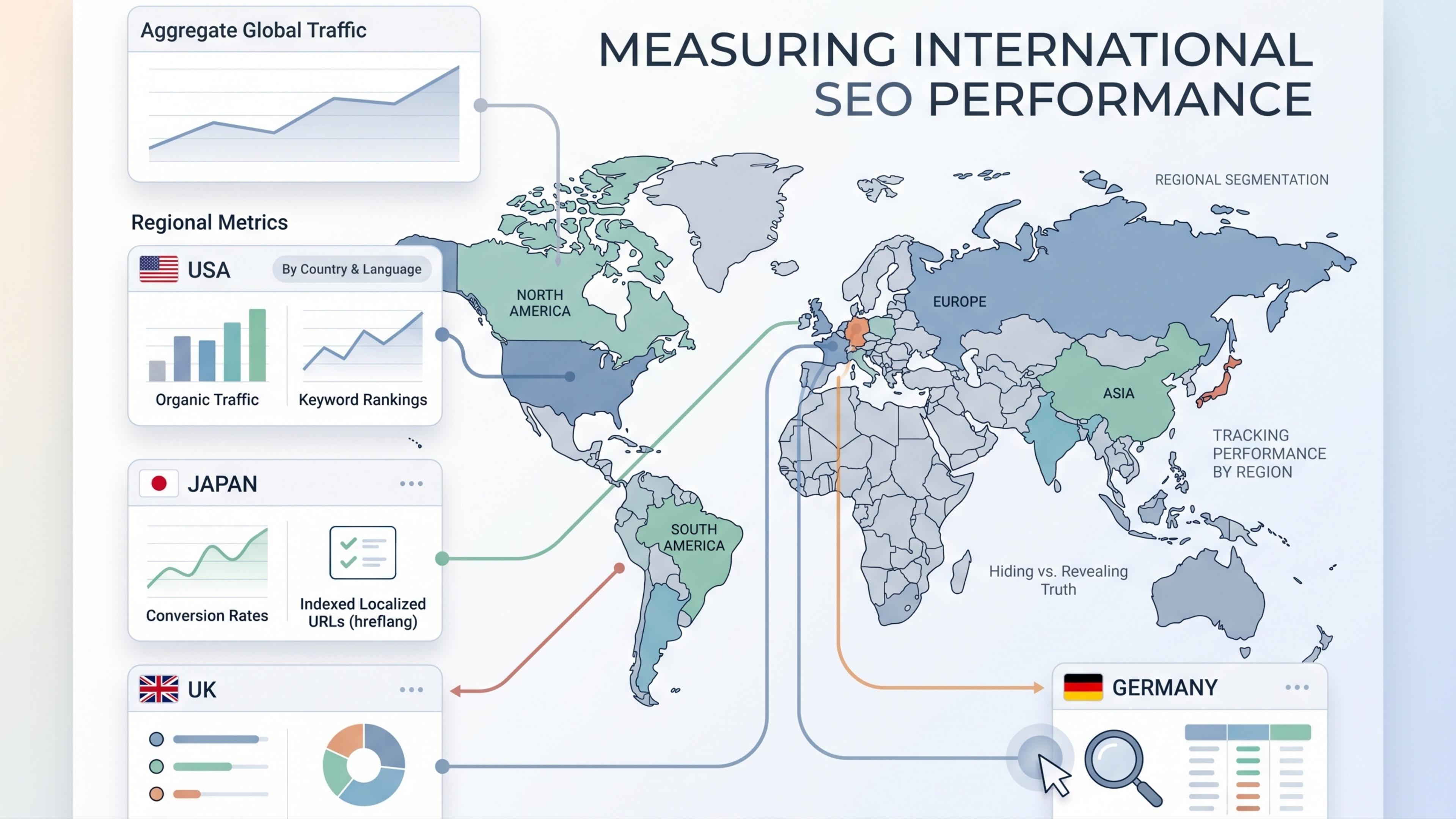
You can’t improve what you don’t measure, and global SEO requires tracking performance by region rather than in aggregate.
The Key Metrics to Track
- Organic traffic by country and language in Google Analytics
- Keyword rankings per market to see where you’re winning
- Search Console performance filtered by country
- Conversion rates per region (traffic without conversions signals a localization problem)
- Indexing status of localized URLs via locale-specific sitemaps
Why Regional Segmentation Matters
Aggregate numbers hide the truth. A site might show growing total traffic while quietly failing in three target markets. Monitoring performance by region reveals exactly where your international SEO strategy succeeds and where it needs adjustment.
This regional view is what lets you double down on markets showing traction and diagnose problems in markets that aren’t performing, whether the issue is technical setup, weak localization, or insufficient local authority.
The Key Benefits of Investing in Global SEO
Understanding what global SEO is matters less if you’re not convinced it’s worth the investment. So here’s the case: what international SEO efforts actually deliver, and why brands that commit to global search engine optimization consistently outperform those that stay in one market.
1. Access to Demand You’re Currently Ignoring
The most obvious benefit is reach. Most businesses optimize for a single country and language, leaving enormous demand across global markets untouched. When you implement international SEO properly, your web pages start appearing in search engine results pages across different countries and languages, putting your brand in front of international customers who would otherwise never find you.
This isn’t incremental. Entering even two or three well-chosen international markets can multiply your addressable audience.
2. Higher-Quality Traffic That Converts
International SEO focuses on serving culturally relevant content to the right audience, which means the website visitors you attract are genuinely relevant. When a user in Germany finds a page written in German, localized for German search behavior and cultural context, they’re far more likely to engage and convert than if they’d landed on a generic English page.
Localized content matched to local user intent produces traffic that converts, not just traffic that bounces.
3. Competitive Advantage in Underserved Markets
Many competitors neglect international SEO best practices, either targeting only their home market or translating pages badly. That creates opportunity. A brand that invests in proper language targeting, conducts genuine keyword research per market, and creates content adapted to local audiences can dominate search engine rankings in markets where competitors barely show up.
Being early and thorough in an international market is a durable advantage. Once you establish authority in a region, catching up becomes expensive for latecomers.
4. Diversified Traffic and Reduced Risk
Relying on a single market concentrates risk. An algorithm update, a competitor’s aggressive push, or an economic shift in one country can hurt a single-market business badly. An effective global SEO strategy spreads your organic visibility across different countries and languages, so a downturn in one market doesn’t sink the whole operation.
Diversification across international markets makes your traffic more resilient.
5. Stronger Brand Authority Worldwide
Ranking across multiple countries signals scale and credibility. When your brand appears in search results across global audiences, it reinforces the perception of an established, trustworthy international company. That authority compounds, making each subsequent market easier to enter.
6. Valuable Insights From Multiple Markets
Operating across international markets generates data you’d never get from one country. Comparing search behavior, keyword rankings, and conversion patterns across regions surfaces valuable insights, which markets respond to which messaging, which products travel well, where demand is growing. Those insights inform not just SEO but broader business strategy.
How the Benefits Compound
These benefits don’t stack in isolation. They reinforce each other:
| Benefit | Feeds Into |
|---|---|
| Broader reach | More traffic and more market data |
| Higher-quality traffic | Better conversions and stronger authority |
| Competitive advantage | Durable rankings and market leadership |
| Diversified traffic | Reduced risk and stable growth |
| Brand authority | Easier expansion into new markets |
| Market insights | Smarter strategy across the whole operation |
What It Takes to Realize These Benefits
None of this happens automatically. Capturing these key benefits requires doing global SEO properly:
- The right URL structure and clean language parameters so you don’t confuse search engines
- Correct hreflang implementation for accurate language targeting
- Independent keyword research to find relevant keywords per market
- Professionally localized, culturally relevant content
- Local authority building in each target market
- Regional performance measurement to guide ongoing investment
International SEO differs from single-market SEO precisely because these layers must work together across different countries and languages. Done right, the payoff is access to global markets most competitors never reach. Done carelessly, it produces a fragmented site that ranks nowhere, which is exactly the trap ACC Aviation escaped through consolidation.
This is where working with a team experienced in global search engine optimization pays off. Our SEO services are built to help brands enter international markets efficiently, capturing these benefits without the costly missteps that come from treating global SEO as translated domestic SEO.
Go Global the Right Way With Doc Digital SEM
Global SEO opens access to demand most businesses never touch, but only when done properly. The right URL structure, clean hreflang, genuine localization, country-specific keyword research, and local authority building are what separate international success from expensive invisibility.
Here’s what to remember:
- Global SEO optimizes your site for multiple countries and languages
- It differs fundamentally from local SEO in targets, tools, and tactics
- Hreflang, localized content, and URL structure are the technical core
- Keyword research must be independent per market, not translated
- Sometimes growth means consolidating, as ACC Aviation’s 500% growth proved
International SEO at scale takes technical depth, localization expertise, and strategic judgment. Doc Digital SEM delivered exactly that for ACC Aviation, and we can do it for you. Get your free digital marketing analysis (valued at $1,500) or explore our SEO services and take your brand into new markets the right way.
FAQs
What is global SEO?
Global SEO, or international SEO, optimizes your website to rank in search engines across multiple countries and languages, serving the right content to the right audience in each market.
How is global SEO different from local SEO?
Local SEO targets nearby customers using location-specific keywords and Google Business Profile. Global SEO targets international audiences across countries using hreflang tags, localized content, and international link building.
What are hreflang tags?
Hreflang tags tell search engines which language and regional version of a page to serve each user, preventing wrong-language results and duplicate content issues across markets.
Do I need different keywords for each country?
Yes. Search behavior and terminology vary by country, even in the same language. Conduct independent keyword research for each target market rather than translating your existing keywords.
How long does international SEO take to work?
International SEO typically takes 6 to 12 months to show meaningful results, depending on market competition, existing authority, and how much technical consolidation your site requires.
Should I use country-specific domains for global SEO?
Country-specific domains (ccTLDs) suit large global brands with distinct country operations. Most businesses benefit more from subdirectories, which consolidate domain authority under one site.


