


ChatGPT saw an eightfold increase in weekly active users from October 2023 to April 2025, reaching over 800 million users. That stat alone has business owners sweating. But here’s the thing: Google Search advertising generated $54 billion in Q4 2024, representing 56% of Google’s total revenue. They’re not abandoning ship anytime soon. The real question isn’t whether AI kills SEO. It’s whether your SEO strategy survives the shift.
This guide breaks down exactly what’s changing and how to stay visible:
- Why traditional SEO isn’t dead (but outdated tactics are)
- How AI Overviews and LLMs are reshaping search behavior
- What “LLM SEO” means and why it matters now
- The skills that separate future-proof marketers from the rest
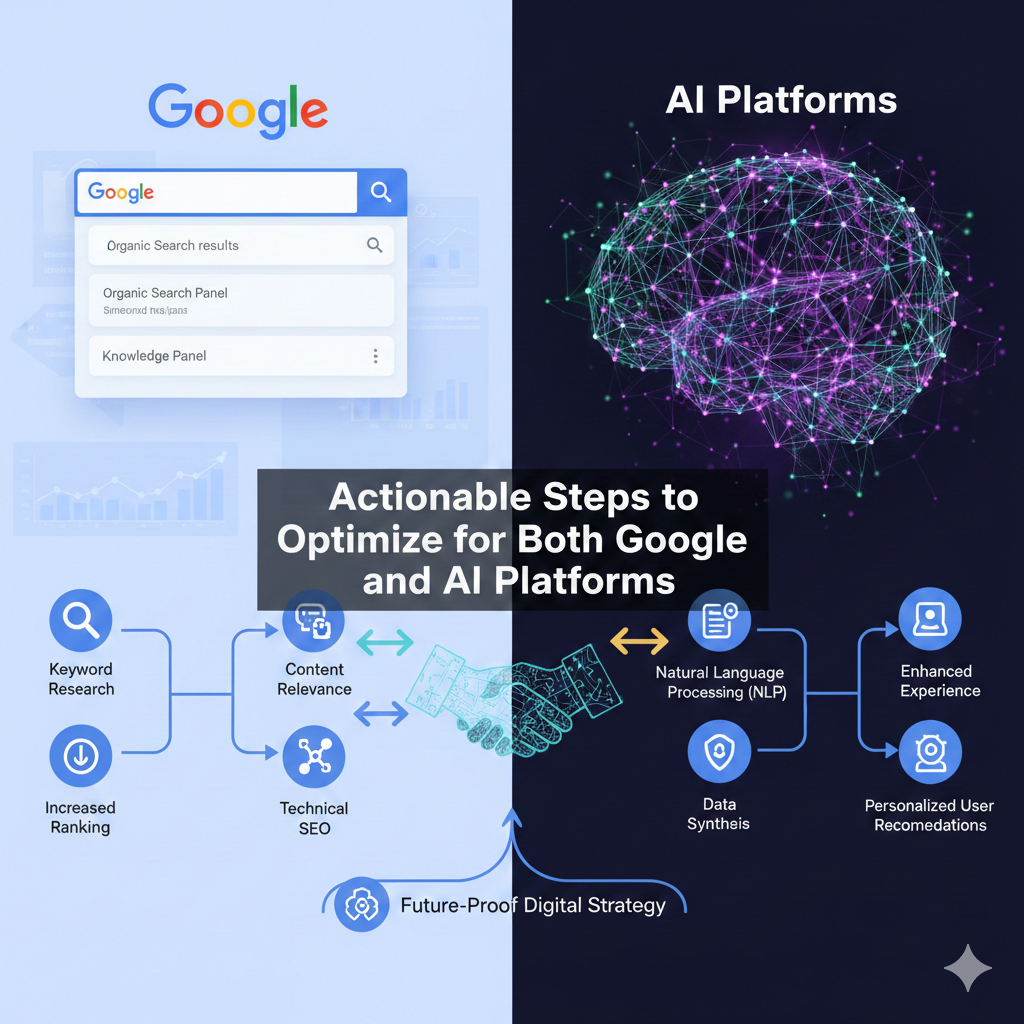
- Actionable steps to optimize for both Google and AI platforms
At Doc Digital SEM, we’ve been tracking this shift closely. As an agency specializing in LLM SEO, we help businesses rank not just on Google, but on ChatGPT, Perplexity, and Google SGE. No long-term contracts, no fluff.
Why Traditional SEO Isn’t Dead
The doom-and-gloom headlines love to declare SEO’s funeral. But here’s the reality: as of March 2025, Google continued to dominate the global search engine industry by far, with an 89.62 percent market share. That’s not a dying platform. That’s a behemoth.
Google’s Financial Stake in Search
Google isn’t walking away from organic search anytime soon. Why? Money.
Google Ads generated $264.5 billion in ad revenue in 2024. Their entire business model depends on people using the search engine. No searches, no ads. No ads, no revenue. It’s that simple.
| Year | Google Ad Revenue |
|---|---|
| 2023 | $237.86 billion |
| 2024 | $264.5 billion |
| 2025 | $340+ billion |
They’re not killing the golden goose. They’re evolving it.
What’s Actually Changing
Traditional SEO tactics are shifting, not disappearing. Here’s what still works:
- Quality content that answers real questions
- Technical foundations like site speed, mobile optimization, and crawlability
- Backlinks from authoritative sources
- User experience signals that keep visitors engaged
What’s dying? Keyword stuffing. Thin content. Link schemes. The lazy shortcuts that never should have worked in the first place.
The Real Threat Isn’t AI Replacing SEO
Google’s share has declined from above 92% in 2021 to approximately 89-90% in 2025, marking the first sustained drop below 90% since 2015. That small dip? It’s coming from AI-native platforms like ChatGPT and Perplexity.
The threat isn’t SEO becoming obsolete. It’s SEO expanding beyond Google.
This is where LLM SEO comes in.Agencies like Doc Digital SEM specialize in helping businesses rank on both traditional search engines and AI platforms. Because the brands winning today aren’t choosing between old and new. They’re optimizing for both.
How AI Overviews and LLMs Are Reshaping Search Behavior

The way people find information has fundamentally changed. And if your SEO strategies haven’t adapted, you’re already falling behind.
Google’s Search Generative Experience Is Here
Google’s AI Overviews (formerly Search Generative Experience) now appear at the top of search results, delivering AI-generated summaries before users ever see traditional search results.
Here’s the problem: when AI Overviews are present, click-through rates plummet to just 8%, compared to 15% for traditional search results without AI summaries.
That’s a 47% reduction in clicks. For businesses relying on organic traffic, this shift changes everything.
| Metric | Without AI Overview | With AI Overview |
|---|---|---|
| Organic CTR | 1.62% | 0.61% |
| Click reduction | – | -61% |
| Queries affected | ~84% | ~16% |
Semrush analyzed over 10 million keywords and found that terms triggering AI Overviews grew rapidly at the start of 2025 before settling at around 16% of all queries. That number keeps climbing.
The Rise of AI-First Search Engines
Google isn’t the only player anymore. ChatGPT currently has 800 million weekly active users, and Perplexity AI processed 780 million search queries in May 2025.
These platforms answer questions without sending users to websites. People are asking ChatGPT questions they used to type into Google. They’re using Perplexity for research they’d previously done across five different sites. The user intent remains the same. The destination has changed.
What this means for search engine optimization:
- Traditional search still matters, but it’s no longer the only game
- Content creation must serve both human readers and artificial intelligence
- Search engine rankings on Google don’t guarantee visibility in AI search
- Understanding search algorithms now includes understanding how LLMs source information
Zero-Click Searches Keep Growing
Zero-click searches now make up 69% of all queries, according to Similarweb. Users get answers directly on the search results page and never visit a website.
This isn’t necessarily bad news. But it requires a shift in strategic thinking about what “success” looks like. The future of SEO isn’t just about driving traffic. It’s about being the source AI platforms trust enough to cite.
What “LLM SEO” Means and Why It Matters Now
If you’re still optimizing only for Google, you’re optimizing for yesterday’s search trends.
Defining LLM SEO
LLM SEO is the practice of optimizing content specifically for large language models, AI systems like ChatGPT, Claude, Google’s Gemini, and Perplexity, so they can accurately find, understand, extract, and cite your information when responding to user queries.
Think of it as search engine optimization for AI platforms. Your content needs to rank in traditional search and get cited by AI tools when users ask questions.
This isn’t about replacing traditional SEO. It’s about expanding your digital marketing strategy to cover where people actually search in 2025.
How LLM SEO Differs from Traditional SEO
| Traditional SEO | LLM SEO |
|---|---|
| Optimizes for search engine algorithms | Optimizes for AI citation and trust |
| Focuses on keyword research and backlinks | Focuses on entity clarity and structured data |
| Measures rankings and traffic | Measures share of voice and brand mentions |
| Targets Google’s search results | Targets ChatGPT, Perplexity, Gemini responses |
ICODA has identified three key shifts in how companies approach search: the move from traffic metrics to visibility metrics, the emphasis on entity clarity over keyword targeting, and the requirement for content that serves as training material rather than simply ranking fodder.
Why AI Replace SEO Fears Are Overblown
Will AI replace SEO professionals entirely? No. Will AI replace SEO experts who refuse to adapt? Absolutely.
The real question isn’t whether AI replace SEO jobs exist. It’s whether SEO professionals learn to work with AI tools rather than against them. The SEO practices that worked in 2020 won’t cut it anymore. But the core principles of content optimization, user intent understanding, and technical excellence remain the same.
What’s actually happening:
- AI tools are automating keyword research and content optimization tasks
- SEO professionals are shifting toward strategic thinking and oversight
- Search algorithms now include AI-powered components that reward clarity and authority
- Businesses need dual optimization for both Google and LLM platforms
The Stakes Are High
Brands cited in AI Overviews earned 35% more organic clicks and 91% more paid clicks compared to non-cited competitors on the same queries.
Being mentioned by ChatGPT or appearing in Google’s AI Overview isn’t just nice to have. It’s becoming essential for maintaining visibility. The SEO jobs of the future will require understanding both traditional search and generative engine optimization.
This is exactly why agencies like Doc Digital SEM focus on LLM SEO. Ranking on Google alone won’t cut it anymore. Businesses need visibility across ChatGPT, Perplexity, and Google’s AI-powered features. That requires a different approach to SEO processes, one that combines traditional expertise with AI-first optimization.
The Skills That Separate Future-Proof Marketers from the Rest
Will SEO exist in five years? Yes. But the SEO professionals who thrive will look very different from those who struggle.
The question isn’t whether AI will replace seo jobs entirely. It’s whether you’re developing the skills that make you irreplaceable.
Human Expertise Still Wins
One team drives 70% human strategy, creativity, and relationship building and 30% AI execution, research, and optimization. They expect this ratio to shift to 60/40 by 2027, but the human elements will become more valuable, not less.
Machine learning can process search data faster than any human. AI algorithms can analyze patterns across millions of search queries. But machines can’t replicate human creativity, strategic thinking, or the ability to understand nuanced audience needs.
Skills that matter more than ever:
- Content strategy development that aligns with both search intent and business goals
- Critical thinking to evaluate AI generated content for accuracy and brand voice
- Storytelling that connects with audiences emotionally
- Technical SEO expertise to ensure AI platforms can crawl and understand your content
- Advanced data analysis to interpret AI-driven search performance metrics
Mastering AI Powered Tools
According to AI SEO statistics, 47% of marketers are already implementing AI SEO tools to improve search efficiency, and another 84% are using them to identify and leverage emerging search trends.
The marketers pulling ahead aren’t avoiding artificial intelligence. They’re using AI powered tools to automate repetitive tasks while focusing their human expertise on strategy and creativity.
| Task | AI Handles | Human Handles |
|---|---|---|
| Keyword research | Data collection, clustering | Strategic prioritization |
| Content creation | First drafts, outlines | Voice, accuracy, storytelling |
| Technical SEO | Audits, error detection | Strategic fixes, prioritization |
| Predictive analytics | Pattern recognition | Business interpretation |
This isn’t about ChatGPT replacing Google scenarios or AI taking over entirely. It’s about working with machine learning algorithms to multiply your output.
Understanding Search Intent at a Deeper Level
AI-driven search algorithms are getting better at understanding what users really want. Google’s Helpful Content Update rewards user-centric content that genuinely answers questions rather than keyword-stuffed pages that game the system.
Future-proof marketers understand:
- Why does someone search, not just what they type
- How voice search changes query patterns (conversational, question-based)
- The difference between informational and transactional search intent
- How natural language processing interprets meaning, not just keywords
Building for Omnichannel Search Visibility
We’re watching the convergence of channels, search, social, AI, all optimized by the same core signals: Authority (citations and mentions), Originality (first-party research and insights), Trust (consistency across platforms and personas).
Transforming SEO from a single-channel discipline to an omnichannel strategy separates leaders from laggards. The same content principles that help you gain search engine rankings on Google also help you get cited by ChatGPT, appear in Perplexity answers, and show up in Google’s AI Overviews.
What this means practically:
The best SEO AI strategies don’t treat each platform separately. They build authority, trust, and topical expertise that translates across all ai driven search platforms.
Actionable Steps to Optimize for Both Google and AI Platforms
Theory is nice. Execution pays the bills. Here’s how to actually create content and marketing strategies that work across traditional and AI-driven search.
Step 1: Audit Your Current Search Visibility
Before changing anything, understand where you stand.
For traditional search:
- Check search engine results rankings for target keywords
- Review Google Search Console for impressions and click-through rates
- Identify pages losing traffic to AI Overviews
For AI platforms:
- Search your brand and target keywords in ChatGPT, Perplexity, and Claude
- Note whether you appear as a cited source
- Compare which competitors show up when you don’t
Run your target queries across different AI platforms. Scan the answers. And see if your brand shows up. If you’re not appearing, study what the cited sources are doing differently.
Step 2: Structure Content for AI Extraction
To be cited in Google AI Overviews, ChatGPT, or Perplexity, your content must be clear, structured, trustworthy, and topically relevant.
AI systems don’t read content like humans. They extract information. Make extraction easy.
Formatting best practices:
- Lead each section with 1-2 sentences that directly answer the heading
- Use short paragraphs (2-3 lines maximum)
- Break information into bullet points and numbered lists
- Include summary tables for complex comparisons
- Add FAQ sections with clear question-and-answer formatting
This on-page optimization approach works for both search engine algorithms and LLMs. Structured content helps Google understand your page and helps AI systems cite you in ai generated answers.
Step 3: Build Topical Authority, Not Just Keywords
Citations don’t always come from the top Google results. One study found only 12% of ChatGPT citations matched URLs on Google’s first page.
AI platforms value topical expertise over traditional ranking signals. A site that covers one topic comprehensively gets cited more often than a high-authority site with thin coverage.
How to build topical authority:
- Create content clusters around core topics
- Cover subjects from multiple angles (beginner, advanced, comparison, how-to)
- Update content regularly to maintain freshness
- Link related content internally to show depth
This content strategy approach aligns perfectly with Google’s Helpful Content Update, which rewards sites that demonstrate genuine expertise rather than surface-level coverage.
Step 4: Optimize Technical SEO for AI Crawlers
AI agents are now browsing on behalf of users, not just indexing for later but fetching information in real time. BrightEdge internal tracking shows these agents now account for roughly 33% of organic search activity.
Your technical SEO foundation determines whether AI platforms can even access your content.
Technical checklist:
- Verify GPTBot, ClaudeBot, and PerplexityBot aren’t blocked in robots.txt
- Implement schema markup (Organization, Product, FAQ, Article)
- Ensure fast page load times
- Use semantic HTML for clear content hierarchy
- Add author bylines with credentials for E-E-A-T signals
Step 5: Create AI-Citable Content Assets
Certain content types get cited more frequently by AI systems. Prioritize these in your content strategy:
| Content Type | Why AI Cites It |
|---|---|
| Statistics and data | Adds credibility to ai generated answers |
| Definitions and explanations | Answers “what is” search queries |
| Step-by-step guides | Provides clear, actionable information |
| Comparison content | Helps users make decisions |
| Expert quotes and insights | Signals authority and E-E-A-T |
Step 6: Track AI Visibility Alongside Traditional Metrics
We’ve seen that when people click to a website from search results pages with AI Overviews, these clicks are higher quality, where users are more likely to spend more time on the site.
Traditional SEO performance metrics like rankings and traffic still matter. But add AI visibility tracking to your reporting:
- Share of voice in AI-generated responses
- Citation frequency across ChatGPT, Perplexity, and AI Overviews
- Brand mentions in ai generated content
- Personalized search results patterns for your target audience
Tools like Semrush’s AI Visibility Toolkit, Peec.ai, and manual prompt testing help track these newer metrics alongside traditional search data.
Step 7: Invest in Voice Search Optimization
With AI Overviews becoming more sophisticated, voice search optimization becomes increasingly important: Conversational Query Optimization means targeting natural speech patterns.
Voice search queries are longer, more conversational, and often phrased as questions. Optimize accordingly:
- Target long-tail, question-based keywords
- Write content in a conversational tone
- Include FAQ sections that mirror how people actually speak
- Focus on local intent for “near me” queries
Bringing It All Together
The brands winning in 2026 aren’t choosing between traditional SEO and AI optimization. They’re doing both, using ai driven seo strategies that build authority across every platform where their audience searches.
At Doc Digital SEM, this dual-optimization approach is exactly what we do. We help businesses rank on Google, appear in AI Overviews, and get cited by ChatGPT and Perplexity. No long-term contracts, just results-driven strategies that adapt as search continues to evolve.
Ready to Win on AI and Google? Doc Digital SEM Can Help
The future of SEO isn’t about choosing between traditional search and AI platforms. It’s about mastering both. Search engine optimization will continue to exist, but the strategies that worked five years ago won’t cut it anymore. The brands pulling ahead are optimizing for Google, ChatGPT, Perplexity, and AI Overviews simultaneously.
Key takeaways:
- Google still dominates with ~90% market share, but AI platforms are growing fast
- AI Overviews reduce click-through rates by up to 61% for affected queries
- LLM SEO focuses on getting cited by AI systems, not just ranking on Google
- Human expertise in strategy and creativity remains irreplaceable
- Content structure, topical authority, and technical SEO matter for both traditional and AI search
- Brands cited in AI Overviews earn 35% more organic clicks than non-cited competitors
- Future-proof marketers optimize for search visibility across all platforms
Doc Digital SEM specializes in exactly this dual approach. We help businesses rank on traditional search engines and get discovered on AI platforms like ChatGPT, Perplexity, and Google’s AI Overviews. No long-term contracts, no hidden fees, just AI driven seo strategies built for how people actually search today.
FAQs
Will SEO exist in 5 years?
Yes, SEO will absolutely exist in five years. SEO will still exist in five years, but it will look different from what it does today. AI will become a bigger part of how search engines rank and display content. The core principles of helping users find relevant information won’t disappear. What’s changing is where people search. Future SEO means optimizing for Google, AI platforms, and voice assistants simultaneously.
Can SEO be done with AI?
Absolutely. AI tools now handle keyword research, content optimization, technical audits, and predictive analytics faster than any human could manually. The key is finding the sweet spot between AI automation and human expertise.
When SEO pros get this balance right, they can be more productive than ever, focusing on high-value, strategic work that really moves the needle. The most effective approach uses AI for data-heavy tasks while humans handle strategy and creativity.
Can ChatGPT replace SEO?
No. ChatGPT won’t replace SEO, but it’s changing how SEO works. ChatGPT replace Google fears are overblown since Google still holds nearly 90% market share. What’s actually happening is that SEO is expanding to include optimization for ChatGPT and Google. Smart marketers now optimize for both traditional search and AI platforms to maximize visibility.
Is AI going to take over SEO?
AI is transforming SEO, not taking it over. AI can support SEO, but it cannot fully replace the role of a skilled SEO professional. While AI handles automation and data analysis, human expertise remains critical for strategy, understanding audience needs, and creating content that delivers genuine value. The user experience AI creates still requires human oversight to ensure quality and accuracy.


