


Most brands publish content, ship a fresh website, and assume AI search will reward them. Then they wait, watch competitors get cited inside ChatGPT and Perplexity, and quietly fall behind without ever knowing why. The kicker: it’s almost never a content problem. It’s a stack of small, fixable mistakes that add up to invisibility.
Industry research shows that AI-search interactions now represent 30% of total search volume, and the brands losing share aren’t the ones without budget. They’re the ones unknowingly making the same dozen mistakes that block AI systems from understanding, trusting, or citing them.
Here’s what we’ll talk about:
- The technical issues (JavaScript blocks, missing schema, slow sites) that hide your content from AI
- The structural mistakes (weak entities, poor internal linking, and no topical authority) that confuse AI systems
- The content traps (thin content, no LLM optimization, design over substance) that get your pages skipped
- The off-site gaps (no brand mentions, stale content) that prevent AI trust
- The fix for each mistake, with practical actions you can ship this week
If any of this hits home, Doc Digital SEM is the team that quietly fixes every one of these gaps for clients across SaaS, healthcare, and B2B services. Through our LLM SEO services and AI search optimization work, we engineer the foundations that make AI tools recognize, trust, and cite your brand instead of skipping past it.
Technical Issues That Hide Your Content From AI
Before any content, brand, or authority signals matter, AI search platforms have to actually access your pages. If they can’t, nothing else you do counts. This is where most brands quietly lose AI visibility and never realize it.
Mistake 1: JavaScript-Rendered Content AI Can’t See
Modern platforms like Webflow, Framer, Wix, and React-based frameworks ship beautiful sites that AI crawlers can’t read. If your core content (product specs, pricing, services, hours) loads only after JavaScript executes, most AI tools see a blank page. Tools like ChatGPT, Perplexity, and other AI platforms generally don’t render JavaScript at all, or they render it poorly.
The fix: Implement server-side rendering (SSR) or pre-rendering for any page you want AI to read. Make sure all critical text, including pricing, services, FAQs, and contact info, exists in raw HTML before JavaScript fires. Validate by viewing your page source (right-click → “View page source”). If you can’t find your key content there, AI can’t either.
Mistake 2: Missing Schema Markup
Structured data is how you tell search engines and AI systems what your content actually means. Without schema markup, AI is forced to guess. AI doesn’t guess well.
The minimum schema set every site needs:
- Organization schema with sameAs links to LinkedIn, Wikipedia, and Crunchbase
- LocalBusiness schema if you have physical locations (essential for local SEO)
- Service schema for every service you offer
- FAQPage schema on every FAQ block
- Article schema for blog posts with author and dates
- Product schema for ecommerce or SaaS products
The fix: Audit your top 20 pages with Google’s Rich Results Test. Implement the missing schema systematically. Treat structured data as infrastructure, not decoration. For a deeper read on getting this right, our breakdown on structured data for LLM optimization covers the implementation details most teams skip.
Mistake 3: Slow or Poorly Optimized Websites
Performance still matters in 2026. Slow sites reduce crawl efficiency, hurt user experience, and damage your website’s ranking in both traditional search and AI driven search. AI crawlers also abandon pages that take more than 3 to 4 seconds to load.
The fix: Run PageSpeed Insights and Core Web Vitals reports on your top 50 pages. Compress images, enable caching, eliminate render-blocking JavaScript, and consider faster hosting. Aim for Largest Contentful Paint under 2.5 seconds and Cumulative Layout Shift under 0.1. Performance is foundational technical seo that pays off in every search environment.
Mistake 4: Ignoring Mobile Optimization
Most AI crawlers evaluate the mobile version of your site by default, just like Google. A site that works perfectly on desktop but breaks on mobile loses visibility across both traditional search and AI overviews. Ignoring mobile optimization is one of those mistakes that costs more than people realize.
The fix: Test your site with Google’s Mobile-Friendly Test. Audit for tap target spacing, font legibility, and load times on 4G connections. Make sure schema markup loads identically on mobile and desktop. Mobile parity isn’t optional anymore.
Structural Mistakes That Confuse AI Systems
Once AI crawlers can access your site, the next layer is whether they can understand it. Three structural mistakes account for most brands’ invisibility in AI overviews and AI generated answers.
Mistake 5: No Clear Entity Signals
AI models recognize entities, not keywords. Your brand is an entity. Your products, services, and locations are entities. If your site doesn’t clearly establish those entities (with consistent names, schema markup, and authoritative citations), AI systems can’t confidently identify or recommend you.
The fix:
- Use exact brand and product names consistently across every page
- Add Organization schema with sameAs links to Wikipedia, Wikidata, LinkedIn, and Crunchbase
- Reference related entities (industries, locations, integrations) explicitly in your content
- Build entity-rich author bios with verified credentials
Without these signals, your brand is a string of keywords to AI systems. With them, you become a recognized entity AI can confidently cite.
Mistake 6: Weak Internal Linking Structure
Internal links are how you signal your site hierarchy and the relationships between pages. Sites without intentional internal linking force AI crawlers to evaluate every page in isolation, which destroys topical authority and search relevance. This is a common mistake we see on otherwise well-built sites.
The fix:
- Build hub-and-spoke structures around core topics (one pillar page, 5 to 15 supporting articles)
- Link from pillar pages down to clusters and back up
- Use anchor text that includes entity names, not generic phrases like “click here”
- Audit and fix broken links monthly
- Eliminate orphan pages (pages with zero internal links pointing to them)
A solid internal linking structure can lift rankings and AI citations within 30 to 60 days, often without publishing a single new page.
Mistake 7: No Topical Authority
Publishing scattered content across unrelated topics weakens your authority everywhere. AI tools reward brands that demonstrate deep expertise on a focused set of topics, not surface-level coverage of dozens of unrelated subjects.
The fix:
- Identify 3 to 5 core topics your brand wants to own
- Build a comprehensive guide for each (the pillar page)
- Surround each pillar with 5 to 15 supporting articles answering specific sub-questions
- Connect every piece in the cluster through internal links and consistent entity references
- Resist the urge to expand into adjacent topics until your core clusters are solid
The brands AI systems consistently cite don’t publish more content. They publish deeper content on fewer topics. For a deeper read, our breakdown on semantic SEO for LLMs covers how topical authority gets evaluated by AI.
Mistake 8: Poor Page Structure
Walls of text with no headings, lists, or hierarchy are functionally invisible to AI overviews. AI tools extract content in chunks, paragraphs, lists, FAQ blocks, and comparison tables. Pages that don’t structure information cleanly get skipped, no matter how good the underlying content is.
The fix:
- Use H1, H2, H3 tags consistently and hierarchically
- Phrase H2s and H3s as questions where possible (mirrors how users ask AI tools)
- Break long paragraphs into 3-4 line chunks
- Use bulleted lists for unordered information
- Use numbered lists for sequences and processes
- Include comparison tables for any “X vs Y” content
- Add FAQ blocks with H3 questions and short, direct answers
Good content structure is what separates pages that get cited from pages that get ignored.
Content Traps That Get Your Pages Skipped
Even with clean technical and structural foundations, content quality decides whether AI tools actually pick your pages over competitors. Three content traps consistently sink AI visibility.
Mistake 9: Thin or Generic Content
AI prioritizes depth, originality, and usefulness. Generic blog posts that rehash what every other site says get filtered out fast. Pages stuffed with keywords but missing real insight, original data, or a unique perspective contribute nothing to AI generated answers.
The fix:
- Lead with a direct answer to the core question in the first 50 to 100 words
- Include original data, statistics, or proprietary research where possible
- Add specific examples (industry references, case dynamics, real numbers)
- Bring a clear point of view, not safe corporate-speak
- Cut filler paragraphs that add word count without adding value
- Avoid keyword stuffing, which actively hurts your rankings in AI driven search
Information density beats word count every single time. Keyword research still matters for understanding user intent, but it can’t replace genuine expertise on the page.
Mistake 10: Ignoring LLM Retrieval Optimization
Ranking on Google is no longer enough. AI tools pull from different signals than traditional search engines. Brands optimizing only for Google rankings while ignoring how ChatGPT, Perplexity, Claude, and Gemini retrieve content end up invisible across the platforms, generating answers for buyers.
The fix:
- Front-load every page with a TL;DR answer in the first 50 words
- Use question-based content with H3 questions and concise responses
- Add FAQ blocks designed to be extracted into AI overviews
- Include verifiable facts, statistics, and named sources throughout
- Allow GPTBot, ClaudeBot, PerplexityBot, and GoogleOther in your robots.txt
- Build an llms.txt file as a roadmap for AI tools
Optimizing for AI retrieval doesn’t replace traditional SEO. It layers on top.
Mistake 11: Over-Reliance on Design Over Content
Beautiful websites with poor content do not perform in AI search. Design wins clicks from human visitors. Content wins citations from AI systems. Brands that prioritize visuals while neglecting content depth end up with sites that look stunning and rank nowhere.
The fix:
- Treat content as the primary asset, design as the wrapper
- Make sure every important fact (pricing, services, hours) lives in HTML, not images or animations
- Write for clarity first, polish second
- Avoid hiding key information behind interactive elements that AI crawlers can’t trigger
- Audit your site through the lens of an AI crawler. If the bot can’t extract your value proposition in seconds, neither can your future customers
The brands winning AI recommendations aren’t the prettiest. They’re the most extractable.
For a deeper view of why this matters, our breakdown on how to rank in ChatGPT covers the exact retrieval mechanics that decide what gets cited.
Off-Site Gaps That Prevent AI Trust
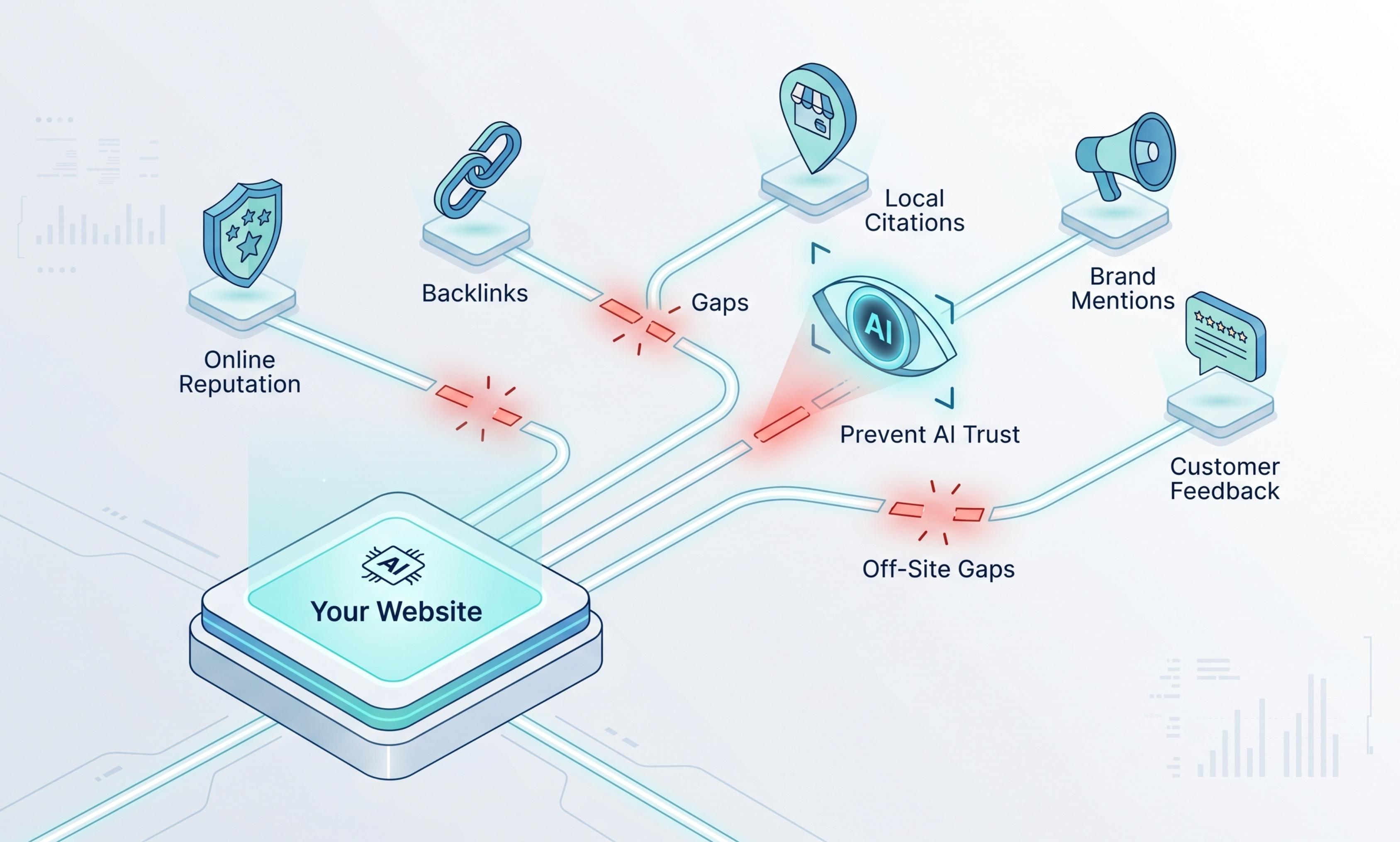
The final category is what happens outside your site. AI systems triangulate trust signals across multiple sources. Brands without a strong off-site presence get treated as ambiguous, and ambiguous brands get skipped in AI generated answers.
Mistake 12: No Brand Mentions Across the Web
AI tools weight third-party validation heavily. If your brand only exists on your own website, AI systems have nothing to cross-reference. Without mentions on industry directories, review platforms, Reddit, Quora, or trusted publications, your brand looks isolated, even if your site is technically perfect.
The fix:
- Get listed on Crunchbase, LinkedIn, G2, Capterra, Clutch, and category-specific directories
- Pursue digital PR placements on industry publications and high-authority sites
- Earn reviews on platforms AI tools cite (G2, Trustpilot, Google Reviews)
- Show up on Reddit, Quora, and forums where buyers actually discuss your category
- Pursue podcast appearances and guest articles in your niche
- Build Wikipedia presence where genuinely warranted
The trust signals AI tools rely on are built off-site, not on-site. Most brands waste resources optimizing on-page elements that already work, while their off-site footprint stays empty.
Mistake 13: Not Updating Content Regularly
Stale content is invisible content. AI tools actively prefer fresh, recently updated pages over identical content that hasn’t been touched in over a year. Outdated articles lose relevance fast, especially in fast-moving categories like AI, SaaS, and tech.
The fix:
- Set a quarterly content refresh cadence
- Update statistics, dates, and examples on your top 20 pages every 90 days
- Add new sections covering recent developments in your category
- Update the modification date in your schema markup
- Add explicit version notes (“Updated November 2026”)
- Track engagement in Google Search Console. Pages with declining clicks usually need a refresh
Freshness is one of the strongest signals AI systems use to decide what to cite. Brands that maintain their content compound the advantage. Brands that publish and forget watch their rankings and citations slowly evaporate.
Bonus Mistake: Duplicate Content and Cannibalization
Some brands publish multiple pages targeting the same user intent, then watch all of them underperform. Duplicate content fragments your authority across pages that should be consolidated. AI systems can’t tell which page is the “real” answer, so they often cite none of them.
The fix:
- Audit your site for pages targeting overlapping intents
- Merge cannibalizing pages into one stronger version
- 301 redirect the consolidated URLs
- Update internal links to point to the merged page
- Watch your rankings consolidate within 30 to 60 days
Your Fix-It-This-Week Action Plan
Identifying mistakes is half the work. Actually fixing them is where most teams stall. Here’s the realistic priority order to ship the highest-impact fixes within seven days.
The 7-Day Fix Schedule
| Day | Focus | Action |
|---|---|---|
| Day 1 | Crawl access | Audit robots.txt for GPTBot, ClaudeBot, PerplexityBot, GoogleOther, OAI-SearchBot. Allow all of them |
| Day 2 | Schema basics | Add Organization schema with sameAs links to LinkedIn, Wikipedia, Crunchbase. Validate with Rich Results Test |
| Day 3 | JavaScript audit | Check that pricing, services, and contact info live in raw HTML. Implement SSR or pre-rendering where missing |
| Day 4 | Top 5 pages | Restructure with TL;DR intros, H3 questions, FAQ blocks, comparison tables |
| Day 5 | Internal linking | Audit your top 20 pages. Add hub-to-spoke and lateral links using entity-rich anchor text |
| Day 6 | Off-site signals | Update or create profiles on G2, Capterra, Crunchbase, LinkedIn. Verify NAP consistency |
| Day 7 | Measurement | Set up custom AI/LLM Traffic channel group in GA4. Run baseline AI prompt tests across ChatGPT, Gemini, Claude, Perplexity |
This isn’t theoretical. Every one of these fixes has been shipped successfully by clients in our LLM SEO engagements, and the impact shows up in citation tracking and AI visibility within 30 to 60 days.
What to Prioritize If You Only Have Time for Three
If you can only fix three things this month, pick:
- Schema markup on your top 20 pages with proper Organization, LocalBusiness, and FAQPage schemas
- Restructured content on your highest-traffic pages with TL;DR intros, FAQ blocks, and comparison tables
- Internal linking architecture that connects related pages through entity-rich anchor text
These three alone will move the needle on both Google rankings and AI search visibility within 90 days, often dramatically.
What Compounds Over Time
The fixes above are the immediate wins. The compounding plays are the ones you start now and let mature over months:
- Topical authority clusters that establish your brand as the definitive source on core topics
- Content freshness cadence that keeps your top pages updated quarterly
- Off-site mentions earned through digital PR, podcast appearances, and category-specific directories
- Entity recognition built through consistent brand signals across every channel
- Multi-platform AI tracking so you measure visibility across ChatGPT, Perplexity, Gemini, Claude, and Google AI Overviews
The brands quietly winning AI search aren’t shipping miracle tactics. They’re avoiding these mistakes systematically and shipping fixes every single week. That discipline compounds. Most competitors don’t have it. That’s the opportunity.
If you want help fixing every one of these issues without losing momentum or burning your team’s time, our AI SEO agency and LLM SEO services ship the entire 12-mistake audit and fix-list as part of every client onboarding, so you stop bleeding visibility and start owning the AI conversations your buyers are already having.
How to Tell If These Mistakes Are Hurting You
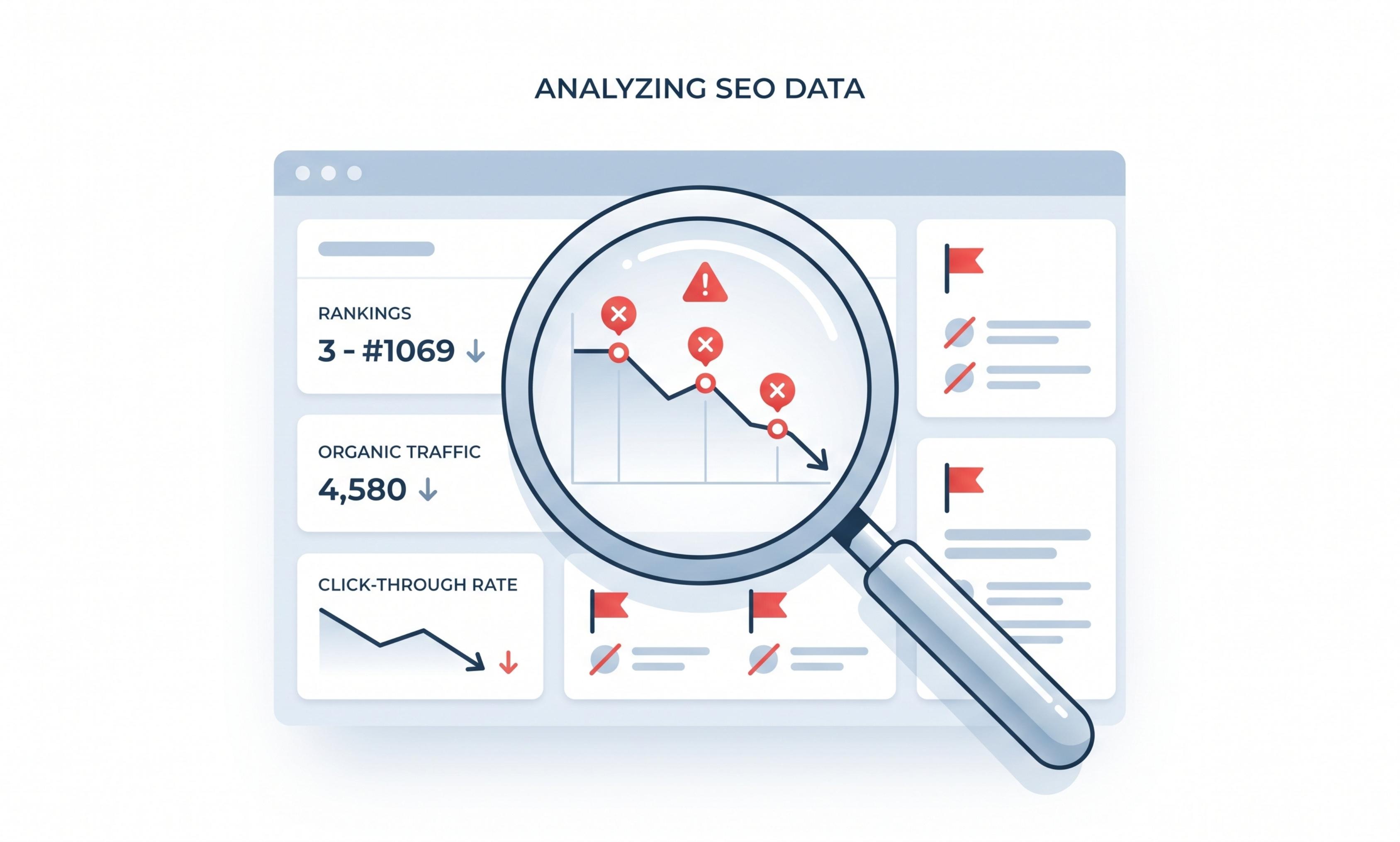
Reading a list of AI SEO mistakes is one thing. Knowing which ones are actively damaging your visibility is another. Here’s the diagnostic framework we run on every new client engagement, the same one you can use to check your own site this week.
The Five-Test AI Visibility Diagnostic
These five tests reveal exactly which mistakes are quietly costing your brand AI visibility right now.
Test 1: The Robots.txt Crawl Test
Open your site’s robots.txt file (yourdomain.com/robots.txt). Look for these AI crawlers:
- GPTBot
- ClaudeBot
- PerplexityBot
- GoogleOther (powers Google AI Overviews and Google’s AI features)
- OAI-SearchBot
- Bingbot
Any of these blocked? You’re invisible to that AI platform. This is the single fastest fix in AI SEO and the most common mistake we audit.
Test 2: The Manual Prompt Test
Open ChatGPT, Gemini, Claude, and Perplexity. Run these prompts:
- “What is [your brand name]?”
- “What does [your brand name] do?”
- “Best [your category] for [your target customer]”
- “How do I [task your brand solves]?”
Document the results. Five red flags to watch for:
- Your brand isn’t mentioned at all
- The description is wrong or incomplete
- Competitors get cited, and you don’t
- Your brand appears, but the AI links to a competitor’s page describing you
- You appear inconsistently across platforms
If any of those happen on a real question your customers would actually ask, the mistakes covered in this article are costing you.
Test 3: The Google Search Console Audit
Open Google Search Console and check three signals:
- CTR drops on informational queries. When AI overviews intercept clicks, CTR can fall by 30 to 60% on the same impressions. If your impressions are flat but clicks are dropping, AI Mode is intercepting your traffic.
- Long-tail queries appearing in impressions but not clicks. This often signals that AI summaries are using your content without sending visitors.
- Pages losing rankings without losing backlinks. If your site ranks consistently dropped while your link profile stayed strong, structural issues (entity clarity, schema, internal links) are likely the cause.
Test 4: The AI Referral Traffic Test
Set up a custom channel group in GA4 to track AI traffic. If you’re seeing:
- Less than 1% of total sessions from AI referrals on a content-heavy site → you’re underperforming
- AI sessions concentrated on one platform, but not others → your strategy is too narrow
- Direct traffic spiking without explanation → likely dark AI traffic that lost referrer data
Each of these patterns points to specific mistakes in this article. Real benchmarks beat guesswork every time.
Test 5: The Entity Validation Check
Run your homepage through Google’s Natural Language API. Look at the entities it extracts. Three signs of entity problems:
- Your brand isn’t recognized as an entity
- It’s recognized but linked to the wrong Knowledge Graph entry (e.g., a different company with the same name)
- Important services or products aren’t recognized at all
Weak entity recognition means AI models can’t confidently cite you, no matter how much more content you publish. Fix the entities first, then scale content.
Common Patterns We See in Audits
After running this diagnostic across hundreds of sites, these patterns repeat:
| Pattern | What’s Causing It | Priority Fix |
|---|---|---|
| High traditional search rankings, low AI citations | Content not structured for AI extraction | Restructure top 20 pages with TL;DR + FAQ blocks |
| Strong content, weak AI overviews presence | Missing schema or weak entity signals | Implement Organization + Article schema sitewide |
| Site ranks well on Google, but invisible in ChatGPT/Perplexity | Robots.txt blocks AI crawlers, or no off-site mentions | Open robots.txt + build digital PR + directory presence |
| Brand appears in AI, but description is wrong | Inconsistent entity signals across the web | Audit and consolidate brand mentions, NAP, and schema |
| Direct traffic climbing without explanation | Dark AI traffic from AI recommendations | Set up AI traffic tracking + improve cited landing pages |
The One-Hour Self-Audit
If you’ve got 60 minutes this week, run all five tests in this exact order:
- Check robots.txt (5 minutes)
- Run manual prompts across four AI tools (20 minutes)
- Audit Google Search Console for CTR drops on informational queries (15 minutes)
- Set up the custom AI/LLM Traffic channel group in GA4 (15 minutes)
- Run your homepage through an entity recognition API (5 minutes)
The output is a prioritized list of which mistakes are actively hurting your AI visibility. No guessing. No theorizing. Just data.
💡 Pro tip: If you find five or more mistakes from this article on your site, don’t try to fix them all at once. Your team will burn out, code reviews will pile up, and nothing will ship. Pick three high-impact fixes per month and ship them properly. Compounding works the same way for AI SEO as it does for everything else.
When to Bring in Help
Some mistakes are easy to diagnose and fix in-house. Schema gaps, broken internal links, and FAQ block additions. Most teams can ship those.
Other mistakes require deeper expertise: entity model design, multi-platform citation tracking, server-side rendering rollout, and comprehensive guide restructuring across hundreds of pages. That’s where having a partner like our LLM SEO agency earns its keep. We run this exact diagnostic for new clients in week one, then ship the prioritized fix list across the next 90 days, while measuring impact in real Google Search Console data, GA4 reports, and AI citation tracking dashboards.
The goal isn’t a beautiful audit document. It’s a measurable shift in how AI generated answers describe your brand to your audience over the next quarter.
Stop Killing Your AI Visibility With Doc Digital SEM
Most brands aren’t losing AI visibility because of bad luck. They’re losing it because of the same dozen fixable mistakes that quietly compound until the whole channel goes dark. The good news? Every one of these mistakes has a clear fix.
Here’s what to remember:
- Technical issues (JavaScript, schema, speed, mobile) hide your content from AI crawlers
- Structural mistakes (weak entities, internal links, topical authority) confuse AI systems
- Content traps (thin content, design over substance) get your pages skipped
- Off-site gaps (no brand mentions, stale content) prevent AI trust
- Run the five-test diagnostic to find which mistakes are hurting your site
Avoiding these mistakes is the difference between owning your AI search category and watching competitors get cited in every AI conversation. Doc Digital SEM ships the full audit and fix-list end to end.
Get your free AI visibility audit (valued at $1,500) or explore our LLM SEO services and stop the bleeding.
FAQs
What’s the biggest AI SEO mistake to avoid?
Blocking AI crawlers in robots.txt. If GPTBot, ClaudeBot, or PerplexityBot can’t access your site, you’re invisible in AI answers and AI-powered search results.
Why is my site invisible in AI search?
Usually, weak entity signals, missing schema, or JavaScript-rendered content. These three issues block clear answers and prevent AI systems from confidently citing your brand.
Does AI SEO replace traditional SEO?
No. AI SEO layers on top of traditional SEO. Both are needed for a complete SEO strategy that earns rankings and AI citations across every search environment.
How long does it take to fix AI SEO mistakes?
Technical fixes show impact in 30 to 60 days. Content and entity SEO efforts compound over 90 to 180 days, with citations and search results improving steadily.
Is keyword stuffing bad for AI search?
Yes. AI-powered systems prioritize entity clarity and useful answers over keyword density. Keyword stuffing actively hurts your rankings in AI overviews and AI search results.


